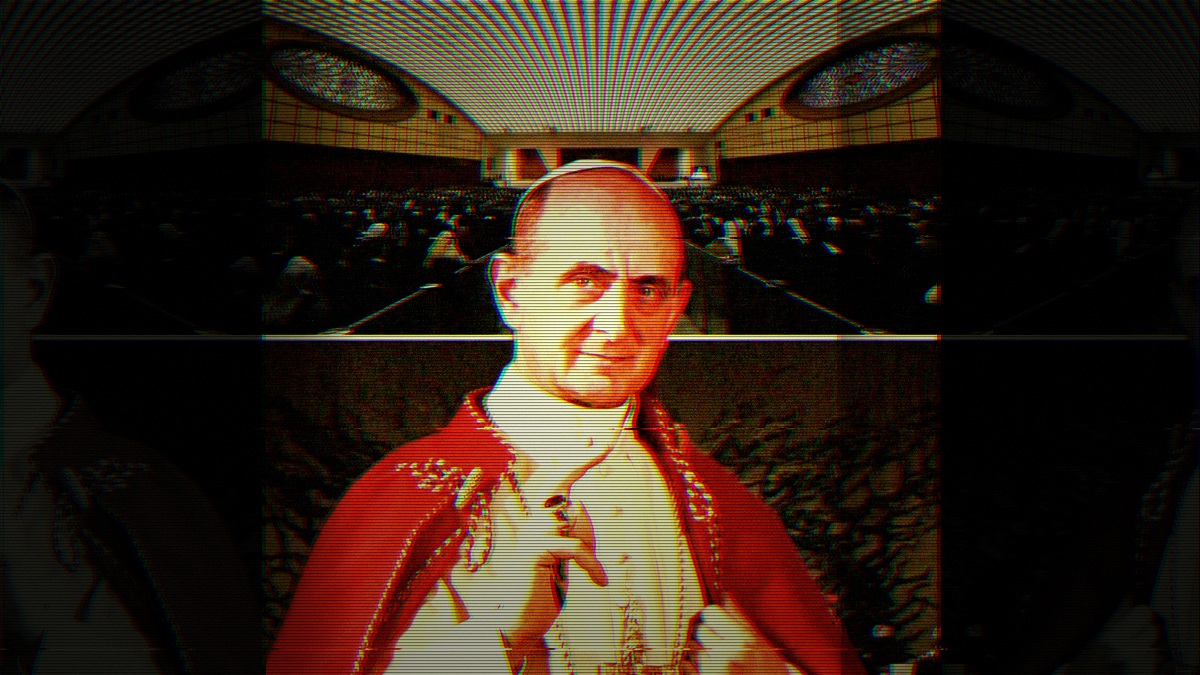
The Snake Pit
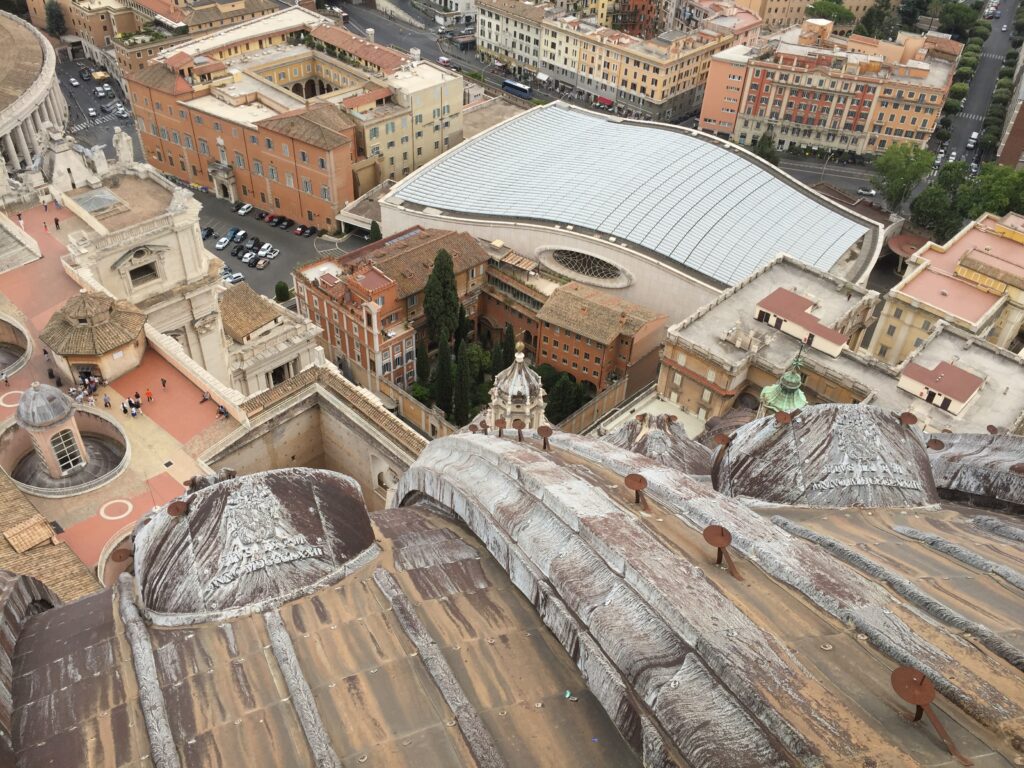
No doubt that any internet sleuth of Truth has, at some point, stumbled upon the Paul VI Audience Hall — or, as I like to call it, the Snake Pit. This sleek, modernist concrete structure slithers along the border of Vatican City and Rome on land donated by the Knights of Columbus — whose historical entanglement with Freemasonry is well documented. Two elliptical skylights serve as the eyes, the roofline coils, and the stage curves into a mouth flanked by two pillars that resemble fangs. And yes, the “infallible” pope himself sits on a throne exactly where the tongue would flick. The symbolism is too obvious to be accidental.
When I first shed my adolescent humanist atheism — partly triggered by a scandal in my own neighborhood Catholic parish during my youth — I briefly considered returning to the Catholic Church. The same church where I received my false paper-wafer communion housed a priest who was exposed as a pederast, a story all too common in Roman Catholicism. I also have a vivid memory buried deep in my mind: two women in short skirts and knee-high boots leaving the clergy residence late at night, just after my Confirmation, during a late-night stroll across the church grounds. Thanks to Grand Theft Auto III, my young mind already understood what that signified. My rejection of belief began then, almost as if evil intended it that way, since I still equated Christianity with Roman Catholicism.
Years later, when Grace illuminated me and I tried to make sense of the unexplainable, that was when I first saw, by apparent happenstance, the image of the Snake Chamber. How could the supposed center of Christendom put its pontiff at the tip of a serpent’s tongue? At first, I dismissed it as pareidolia, until I saw the aerial photos. Its outer walls and roof unmistakably form the shape of a snake’s skull. Divine Byzantine geometry, this is not. What are the origins of this monolith of modernist dross that strips the soul of any semblance of transcendental thought? Well, lo and behold, its story features the usual cast of villains and scoundrels.
The Conciliar Revolution
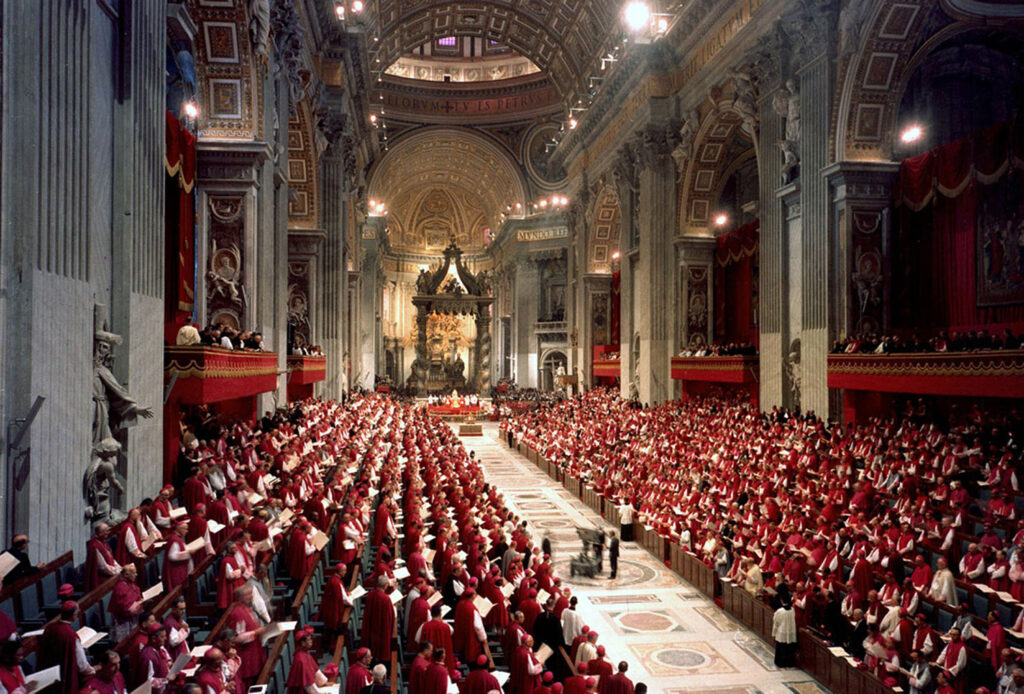
The Roman Catholic institution and Freemasonry have been in doctrinal conflict since at least the mid-18th century, when the secret society began chipping away at the first Protestant church in history — whose doctrinal pope fractured the unity of the One, Holy, Catholic, and Apostolic Church during the Great Schism. Freemasonry, a movement hell-bent on eroding Trinitarian Faith through the poison of Enlightenment ideals and Deist beliefs, is seen by many as having raised its victory banner over the cult of Catholicism with the reforms of Vatican II from 1962 to 1965, spearheaded in part by Pope John XXIII and his trusted advisor, Cardinal Augustin Bea — both men rumored to have Masonic ties.
The council stripped the Roman Catholic Mass of its ancient form, replacing it with the vernacular Novus Ordo Missae — the “New Order of Mass” — a phrase uncomfortably close to Novus Ordo Seclorum, inscribed on the back of the Masonic one-dollar bill.
According to Malachi Martin — a former Jesuit priest whose insider accounts of Vatican corruption blended documented fact with fiction in ways he never fully distinguished, so take this with a grain of salt — both Angelo Roncalli (Pope John XXIII) and his successor, Giovanni Montini (Pope Paul VI), were members of the Freemasonic fraternal order. I tend to believe this claim, guided by the principle that “you will know them by their fruits,” and by the reverence shown to John XXIII by Baron Yves Marsaudon — a 33° Mason and head of the French Supreme Council of the Ancient and Accepted Scottish Rite, whose admissions carry weight precisely because they come from inside the Masonic world itself. Marsaudon wrote that John XXIII became a 33° Mason while serving as papal ambassador in France — documented at length on VaticanCatholic.com, a traditionalist Catholic watchdog site whose editorial position is firmly sedevacantist, which readers should factor into their assessment.
Cardinal John Heenan — the Archbishop of Westminster from 1963 to 1975, not a fringe figure, which makes his claim all the more significant — stated in his memoir Crown of Thorns that John XXIII was elected primarily to pave the way for Montini’s succession as Pope Paul VI. Masonic publications such as Résurgence du Temple praised John XXIII’s “Templar Universalism” in 1975, while the Mexican Grand Lodge publicly mourned him as “a grand liberal” after his passing. Besides Vatican II, one of John XXIII’s lasting legacies is his 1959 decision to remove the phrase “perfidious Jews” from the Good Friday liturgy. He also composed a prayer asking forgiveness for Christian mistreatment of Jews, referring to them as “the chosen people.” Sounds to me like something a subversive Masonic snake would do, if you ask me.
The Montini Era
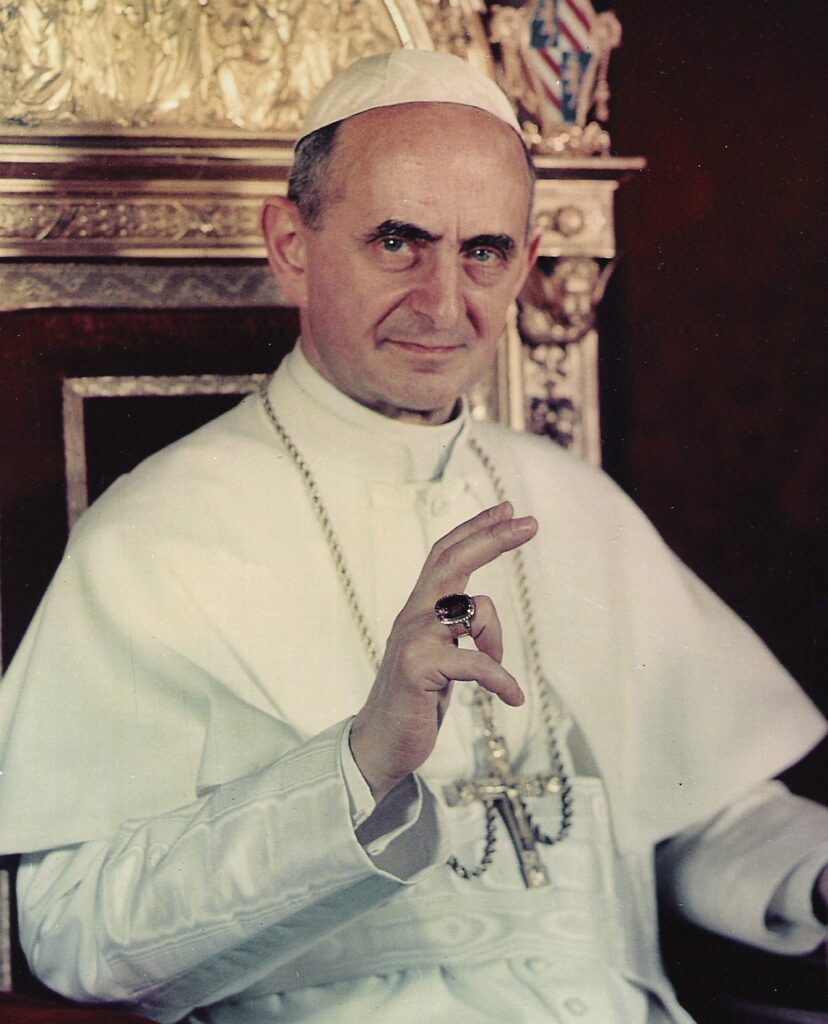
In 1963 — the same year the first Catholic president was assassinated by the very intelligence operatives who had already infiltrated the Vatican through the Mafia and the notorious P2 Masonic Lodge (cough CIA cough) — Giovanni Battista Montini became Pope Paul VI. Freemasonry in Italy had been banned by Mussolini in 1924 as a politically subversive force. The original Propaganda Massonica was dissolved, its doors closed, and its records sealed. Its later revival as Propaganda Due — or P2, a clandestine Masonic lodge later exposed as having infiltrated the Vatican, the CIA, the Mafia, and Italian government simultaneously — received the full approval of Allen Dulles, then CIA director and also a 33rd-degree Mason.
Paul L. Williams — a former FBI consultant whose book Operation Gladio: The Unholy Alliance Between the Vatican, the CIA, and the Mafia is the most thoroughly sourced account of this nexus available in English — read it cover to cover.
It was within this climate of hidden alliances and shadow influence that Paul VI commissioned architect Pier Luigi Nervi — internationally celebrated for his innovative use of reinforced concrete — to design a new, serpentine papal audience hall on the outskirts of Vatican City. Construction began in 1966 and was completed on June 30, 1971, at the height of Operation Gladio and the ascendancy of the P2 Lodge in Italy.
Nervi himself was no stranger to “sacred modernism.” By then, he had already designed the UNESCO headquarters in Paris — whose first Director-General was Julian Huxley, a committed eugenicist and self-described humanist who once said “The idea of God interfered with our sexual mores.” Strange, isn’t it, that the Vatican would share an architect with one of the cultural branches of the so-called New World Order?
Before his rise to the papacy, Montini played a key role in connecting the OSS — the direct precursor to the CIA — with the Sicilian Mafia. This relationship later continued through banker Michele Sindona — who served simultaneously as banker to the Vatican, the Sicilian Mafia, and the P2 Lodge, and who died in prison from cyanide poisoning in what was officially ruled a suicide — the central figure linking the CIA, the Mob, and the Vatican through P2. Sindona acted as a CIA operative funneling illegal funds, much of it from heroin trafficking, through clergy like Montini. This relationship persisted into Montini’s papacy: in 1969, concerned about losing the Vatican’s tax exemption under the Lateran Treaty, Pope Paul VI moved Vatican wealth offshore through Sindona’s financial networks.
By 1965, a list of Catholic clergy linked to Freemasonry was circulating, including bishops and cardinals who continued to rise within the Church despite their open Masonic affiliations. Throughout the Montini era, the pope maintained close relationships with Freemasonic and para-Masonic groups. One of his first acts as pontiff was to bestow the Papal Knighthood of St. Sylvester on Licio Gelli — a self-described atheist and head of the P2 Lodge who was later found to possess a membership list of nearly a thousand of Italy’s most powerful men, triggering a constitutional crisis when it was discovered in 1981. This was documented by Chiesa Viva, an Italian traditionalist Catholic publication founded by Fr. Luigi Villa, who spent decades investigating Masonic infiltration of the Vatican with the reported private encouragement of Padre Pio.
That same year, Paul VI entered the United Nations’ Meditation Room — a small sanctuary inside UN headquarters in New York, centered on an altar to a god deliberately left without a name or face, and widely described by critics as a space of Masonic and occult design. Against this backdrop, his frequent meetings with UN Secretary-General U Thant, his ecumenical talks with Orthodox Patriarch Athenagoras I — a 33° Mason — and audiences with members of the B’nai B’rith Lodge, whom he reportedly addressed as “my dear friends,” make his agenda as clear as can be.
As Masonic Baron Yves Marsaudon would later boast: “The Revolution which advanced from our lodges now extends beautifully over the Basilica of St. Peter.”
Many writers and reports have also claimed that Paul VI was homosexual — something not uncommon within either Freemasonry or the higher ranks of Catholicism, where such tendencies have troubled the institution for generations. As history shows, such secrets create fertile ground for blackmail by clandestine forces.
The Sculpture and the Smoke
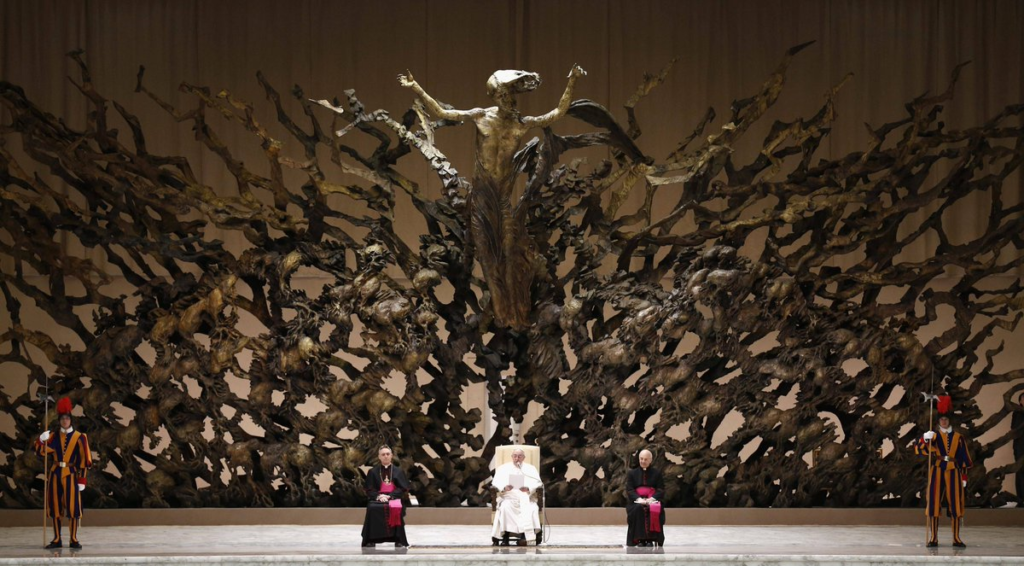
One year before he died, Paul VI unveiled the proverbial cherry on top of his instigated snake chamber. The Resurrection is a 66-foot-tall bronze sculpture by Pericle Fazzini — commissioned in 1970 to dominate the audience hall’s stage — that looms behind the papal throne. The piece depicts Christ rising from a nuclear bomb crater in a modern-day Gethsemane — a disturbing choice of imagery, considering that the atomic bomb was first used by Freemasonic 33rd-degree President Harry Truman to annihilate the most Christian city in Japan, Nagasaki. If you squint and focus with all your skitzo might, the middle section even resembles a goat’s head. Whether Baphomet or just abstract brutalism, you be the judge.
Fazzini reportedly suffered lung poisoning and developed a blood clot after inhaling toxic fumes during the sculpture’s creation. A fitting omen for a work so far removed from divine inspiration. Such afflictions do not befall Orthodox iconographers, whose grace-filled art serves as a window into heaven rather than a monument to despair.
In 1972, Paul VI himself confessed that “the smoke of Satan” had entered the temple of God through “some mysterious crack.” He knew exactly what crack he was talking about. He made it.
The Aftermath
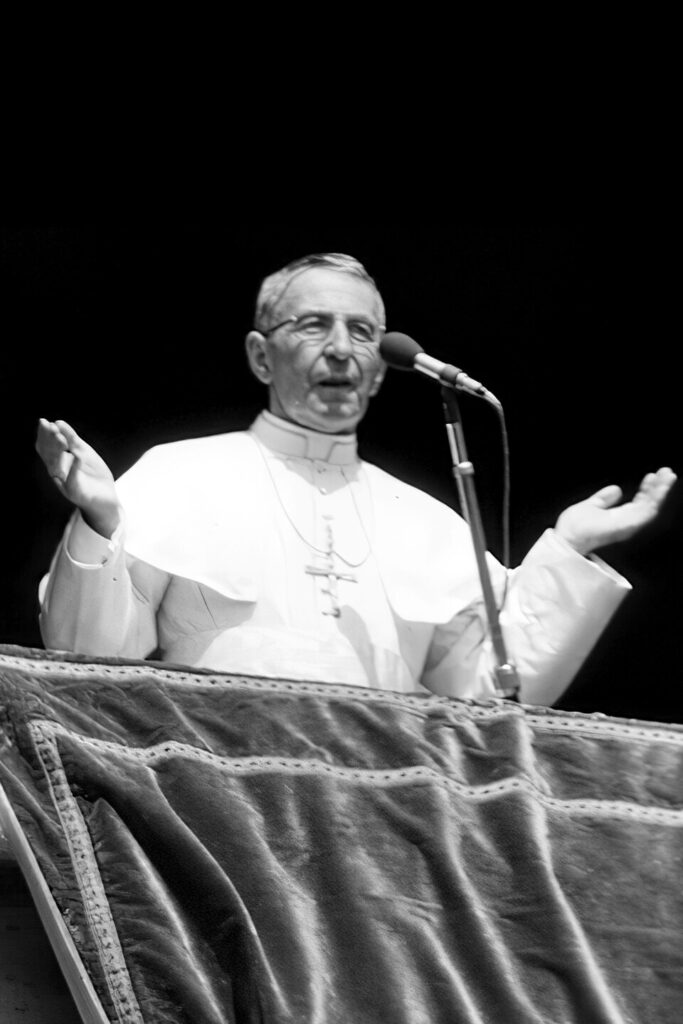
When Paul VI died, the vipers’ den was named after him, and the following year became known as the Year of Three Popes. Simultaneously, revelations about the Vatican’s connections with Freemasonry, the CIA, and the Mafia began to emerge into the public consciousness through the grace granted to a few courageous reporters.
Upon his death, the former Grand Master of the Grand Orient of Italy, Giordano Gamberini, gloated:
“It is the first time in the history of modern Freemasonry that the Head of the greatest religion in the West dies without hostility toward Freemasons. And for the first time in history, Freemasons can render homage at the tomb of a Pope, without ambiguity or contradictions.”
Pope John Paul I’s papacy lasted only thirty-three days — huh, 33, you don’t say — before he was found dead under mysterious circumstances, eyes bulging and lips pulled back in a Joker-like grimace. He had planned to purge the Vatican of Masonic and financial corruption, but was discovered dead the next morning. He was succeeded by John Paul II — an actor before his ordination — who kept nearly all of Paul VI’s inner circle and never excommunicated the P2 members, which his short-lived predecessor had vowed to do.
A curious footnote: in his youth, John Paul II worked for a chemical company later alleged to have supplied Zyklon B to the Nazis for use in their concentration camps. Born in Poland — a country that would later give us such lovely world leaders as Bibi Netanyahu — John Paul II ascended to the papal throne through what seemed to be clandestine manipulations behind the curtain, and business as usual churned within the walls of Vatican Inc.
Fast forward to 2014. Pope Francis — Jesuit, globalist, and notorious NWO supporter who has called openly for a New World Order after the pandemic — beatified Pope Paul VI. The serpent, it seems, wears a halo now — a false halo carved from Masonic marble.
The Stage That Remains
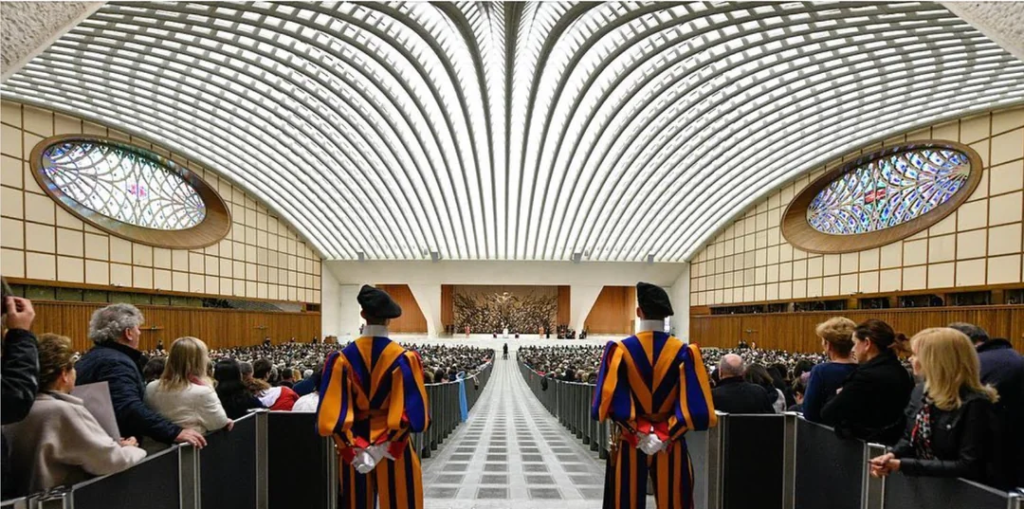
Today, the Snake Pit continues to draw its crowds. Week after week, the spectacles unfold: papal addresses, secular concerts, interfaith ceremonies of the one-world creed, and political pageants of the New World Order, staged beneath a roof that writhes and before a backdrop seemingly torn from a demoniac’s nightmare. The deceived Roman Catholic faithful gather in what they believe is a house of worship, yet it feels closer to a Roman circus — fitting, for one was held here: acrobats, elephants, and dancers performing before the pontiff himself, as reported in January 2025.
Whether by design or deception, the architecture preaches its own sermon: the black smoke that once seeped through a crack has long since filled the chamber. And as cameras flash beneath the bronze Christ rising from a crater of flame, one wonders what resurrection is truly being proclaimed: that of the Truth, or something far older, far darker, masquerading in a mask of light.
The serpent has not left the garden. It has merely built itself a stage, mocking those with eyes to see.