Before the Curtain Drops
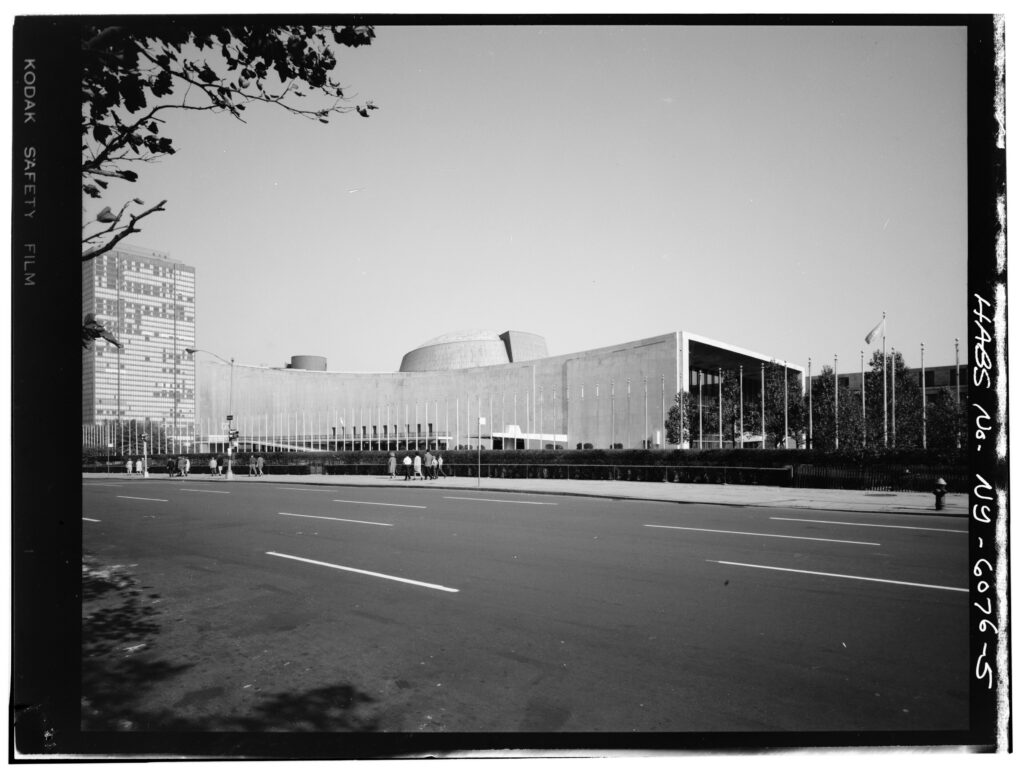
The United Nations feeds children. The United Nations stops wars. The United Nations is the conscience of the world. That is what we are told, and for a long time I did not look any further. It is so large, so embedded in the background noise of acceptable reality, that questioning it feels almost embarrassing. Reasonable people do not question the UN. Reasonable people trust the process.
Then I began looking at the process.
What I found was not a neutral arbiter of international disputes. What I found was an institution with occult foundations, Masonic architecture, a meditation room designed as a temple to a nameless god, consultative relationships with an organization formerly known as Lucifer Publishing, a peacekeeper corps with a systemic sexual abuse problem, a corruption record that would embarrass a mid-tier kleptocracy, and a 2030 agenda that, once you slow down and go through it goal by goal, reads like a blueprint for everything the Orthodox Church has always warned against.
The stated goals are peace, security, and human dignity. The record is something else entirely. And the spiritual architecture underlying it all is something most Christians, including most Orthodox Christians, have not been clearly told about.
Let us have a look.
The First Attempt
Every institution has a prehistory. The UN’s prehistory is worth knowing.
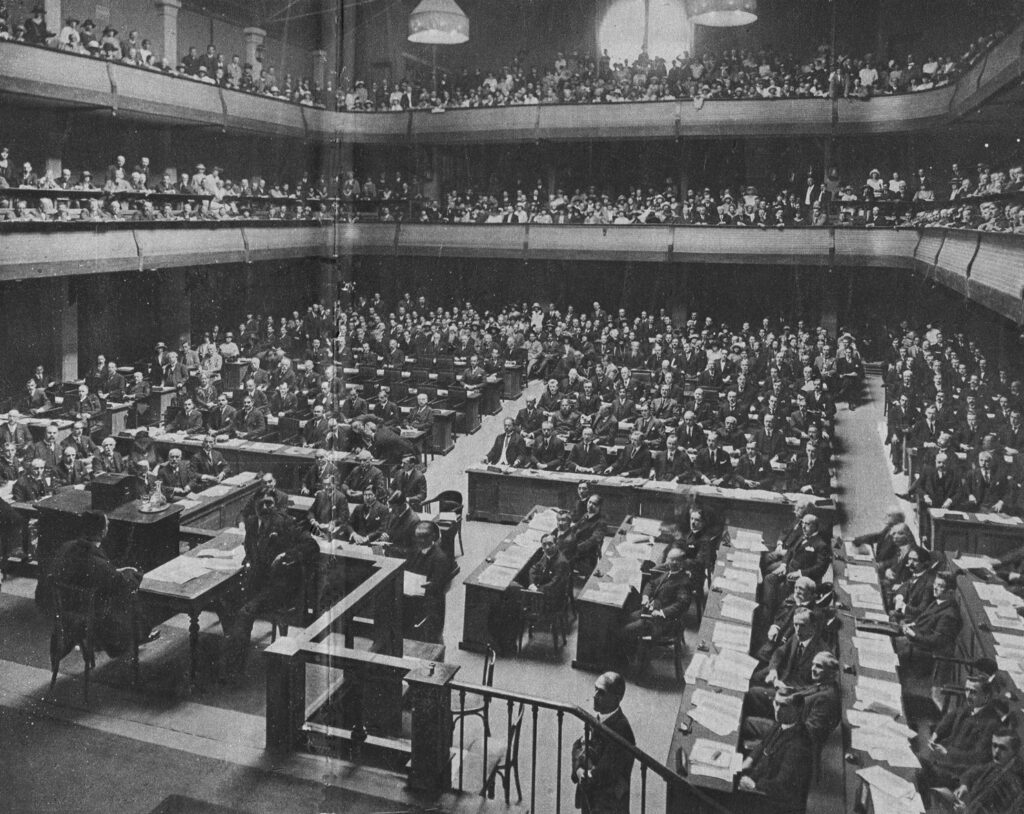
The League of Nations, the UN’s direct predecessor, was founded in 1920 after World War I. Woodrow Wilson, a Freemason, was its primary American architect. Franklin D. Roosevelt, also a Freemason, initiated on October 10, 1911, at Holland Lodge No. 8 in New York City, presided over the founding of the United Nations in 1945. Both were Masonic presidents. Both world wars. Both led to new global governance structures. The pattern is not subtle once you notice it.
David Livingstone, a Canadian researcher whose book Transhumanism: The History of a Dangerous Idea I recommend to everyone, has extensively traced the prehistory of these institutions in his Ordo Ab Chao series. In his account, the League of Nations did not emerge as a neutral peace project. It emerged as the political outgrowth of a long-running Masonic and occult vision for world government, traceable to figures such as Immanuel Kant, Giuseppe Mazzini, and Garibaldi, whose revolutionary nationalism and Masonic activism fused Enlightenment ideals, national uprisings, and fraternal networks into a single vision: a United States of Europe and, eventually, a brotherhood of all nations.
By World War I, this had moved from philosophy to implementation. Italian and French Grand Lodges convened international Masonic congresses in 1917 to draft the constitution of a League of Nations. Anglo-American elites, the Round Table network, Wall Street banking houses including Warburg and Kuhn, Loeb and Co., and Wilson’s own Inquiry group steered the Paris Peace Conference toward that goal. The Balfour Declaration and the redrawing of the Middle East were integral to the same project. When the US Senate rejected American participation in the League, the strategy shifted. The Royal Institute of International Affairs in London and the Council on Foreign Relations in New York were founded to shape elite opinion and prepare the ground for what would eventually become the United Nations.
In 1945, the UN was founded. In 1948, it adopted the Universal Declaration of Human Rights, drawing directly on the language and ideals of the French Revolution. Traditional Catholic critics have long described it as an organization with an agnostic philosophy, Masonic inspiration, and a practical disregard for God. They are not wrong.
That is a strong claim. The evidence supporting it is not hard to find.
The Woman Behind the Curtain
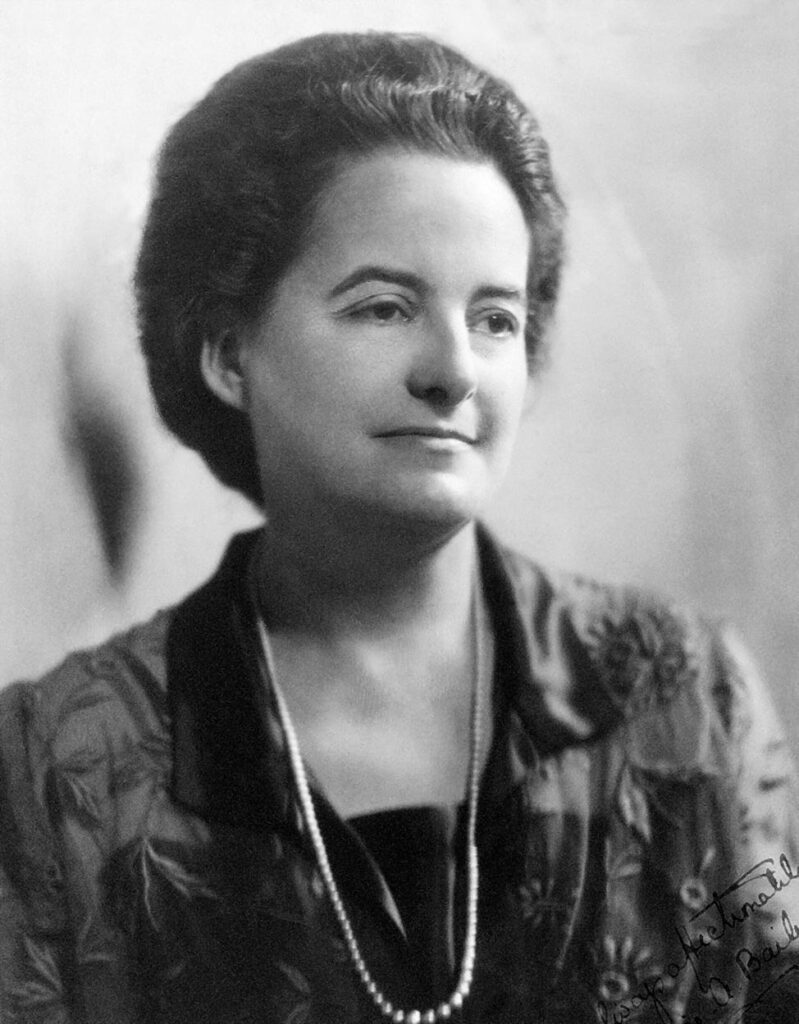
Alice Bailey is not a household name, but she should be.
Bailey was a Theosophist and occultist who founded the Lucis Trust in 1922. She chose that name deliberately. As the organization’s own history notes, the name derives from the Theosophical teaching that Lucifer, the archangel, brought intelligence to mankind. Before settling on Lucis Trust, the organization operated as Lucifer Publishing Company. The address is instructive as well: 866 United Nations Plaza, Suite 482, New York. It reportedly used to be 666. They changed the building number. They did not change the organization.
In 1948, Lucis Trust became one of the first spiritual or esoteric organizations to receive consultative status with the United Nations, a status it has maintained ever since. Its offshoot, World Goodwill, operates as an NGO within the UN system. Its literature explicitly promotes what it calls the Plan: a coming world order based on what Bailey described as Masonic principles and a universal religion. Today, Lucis Trust maintains its offices at the UN Plaza and describes its mission as supporting the United Nations’ goals through meditation, educational materials, and seminars.
Bailey’s major work, The Externalization of the Hierarchy, is worth reading in its own right. In it, she wrote about a great General Assembly of the Hierarchy to be held in 2025, at which the date for the first stage of the Hierarchy’s externalization would be set, meaning the open manifestation of what she called the Masters of Wisdom in human affairs. She described the period from her writing until 2025 as the Stage of the Forerunner, preparatory in nature and testing in its methods. That date has now passed. We are in 2026. Whether the assembly happened in some form invisible to the public or the timeline simply slipped is a question worth sitting with. What is harder to dismiss is that Agenda 2030 is being accelerated, the institutional architecture Bailey described is fully in place, and she wrote about all of it decades ago.
Her connections extend in multiple directions. She shared philosophical and organizational ties with Aleister Crowley through their mutual involvement in the Hermetic Order of the Golden Dawn. She studied Madame Blavatsky’s Theosophy. The so-called Tibetan Master, Djwhal Khul, who allegedly dictated her books, is described not as a human being but as a disembodied spirit, an entity she channeled in a practice indistinguishable from what the Church has always called divination.
Bailey also left behind what researchers have attributed to her as a ten-point agenda: remove God and prayer from schools; weaken parental authority; undermine the traditional family; normalize promiscuity, abortion, easy divorce, homosexuality, and gender confusion; debase art and saturate the media with hedonism; and finally, construct an interfaith movement that places all religions on the same level, then get the churches themselves to endorse and bless these changes. Reading that list in 2026 makes it difficult to argue that the program has not been largely implemented. What is harder to explain is how an occultist writing in the mid-twentieth century described so precisely what the following decades would produce.
The influence is not merely theoretical. Nicholas Roerich, another Theosophist with his own Tibetan Masters and Shambhala project, was a close influence on both Eleanor Roosevelt and Henry Wallace, FDR’s Vice President. Roerich’s occult imagery filtered into American state symbolism: it is widely argued that his influence contributed to the placement of the All-Seeing Eye on the dollar bill. Julian Huxley, the first Director-General of UNESCO, imported Teilhard de Chardin’s evolutionary mysticism, the noosphere, the Omega Point, and religious convergence into UN educational policy. The philosophical backbone of the UN system was laid by people who believed that humanity was evolving toward a single global consciousness, a single religion, and a single government, and who considered themselves the advance guard of that process.
The Meditation Room
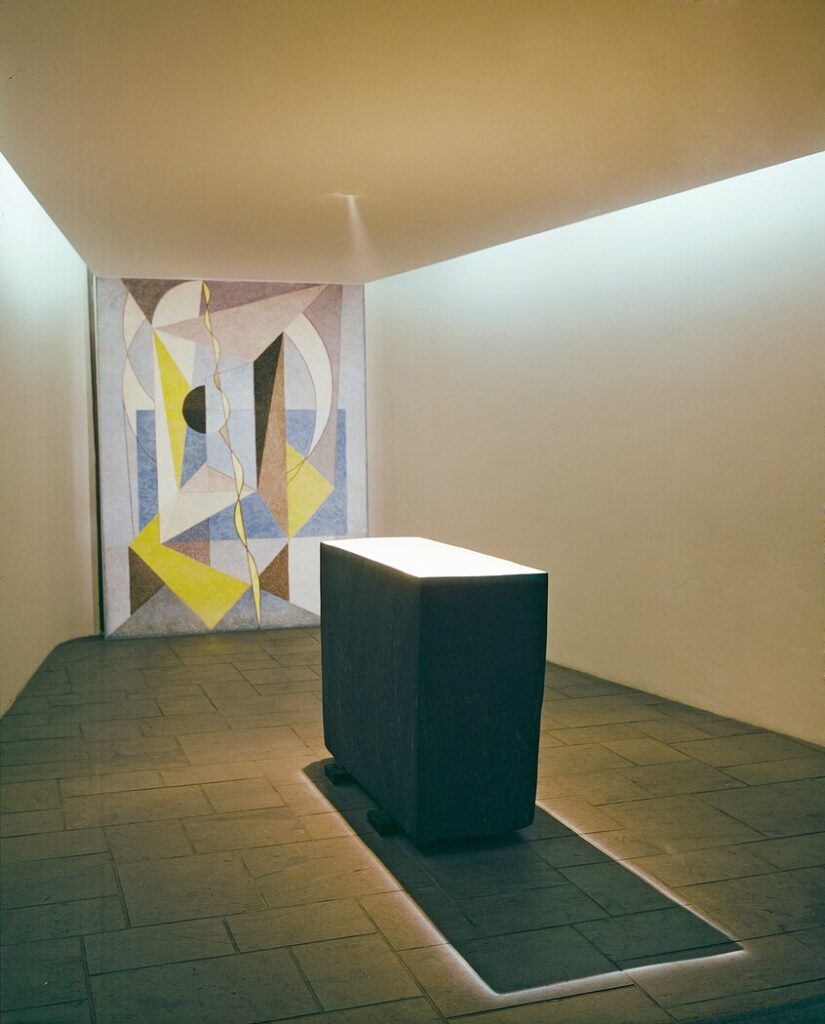
Every institution reveals itself through its symbols. The UN Meditation Room merits close examination.
It was established in 1952 at the request of Dag Hammarskjöld, the UN’s second Secretary-General, whose posthumous memoir Markings confirms his deep immersion in mystical spirituality. The room’s centerpiece is a large rectangular altar stone, described in the official brochure as the altar of no particular faith, a massive block of iron ore weighing six and a half tons, lit from above by a single shaft of light. The room contains no cross, no icon, no recognizable symbol of any confessional religion. It is explicitly designed as a space for a religion without a name, a faith accessible to all.
The mural on the wall was designed by the Swedish artist Bo Beskow and features abstract geometric forms. Independent researchers have noted that the room’s design incorporates the number 33 in its proportions, a number with obvious Masonic significance. The room sits adjacent to the UN Security Council Chamber, where decisions affecting the fate of nations are made. In December 2024, the UN General Assembly unanimously adopted a resolution designating December 21, the winter solstice, as World Meditation Day. The International Day of Yoga falls on June 21, the summer solstice. Both solstices are now UN observances. The calendar of a solar pagan religion, adopted by the body that claims to represent all of humanity.
Outside the UN headquarters in New York, a statue was installed in 2021 and then quietly removed after public outcry. It depicted a large creature with the body of a jaguar, the legs of a bear, and the wings and talons of an eagle. The UN named it The Guardian for International Peace and Security. Christian commentators immediately noted its resemblance to the beast described in Revelation 13:2: like a leopard, with bear’s feet and a lion’s mouth, given power by the dragon. The UN’s response was to remove the statue without comment. It did not explain why this particular image had been chosen to represent international peace and security in the first place.
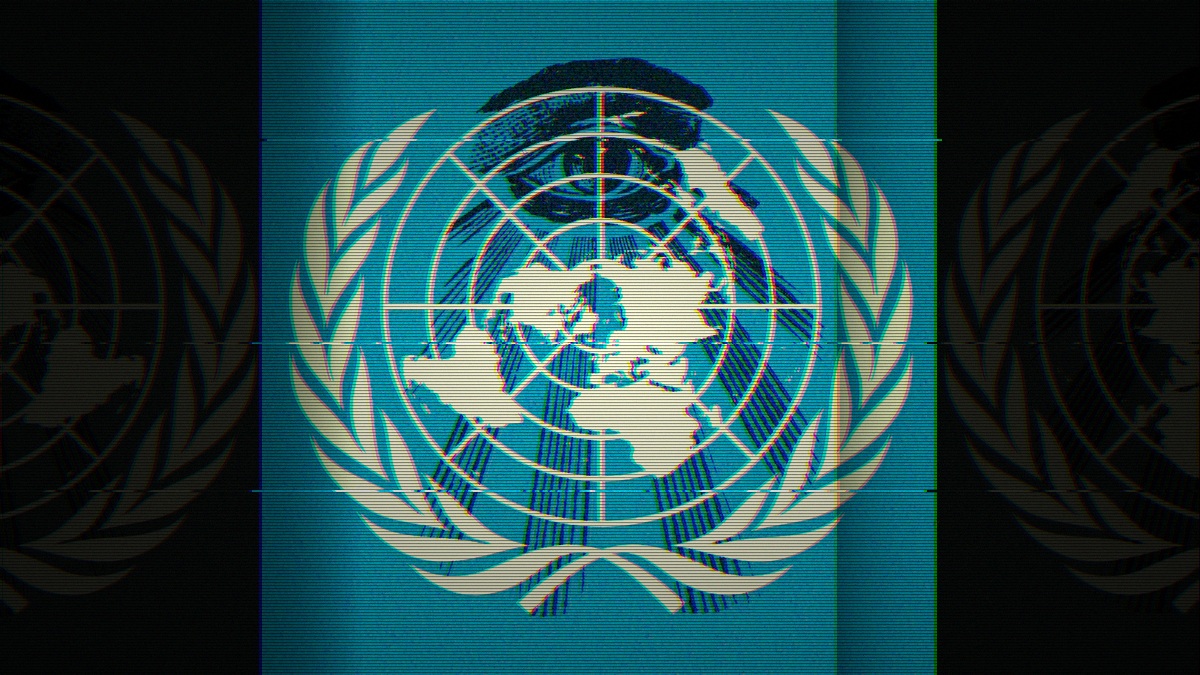
The United Nations flag features a world map surrounded by olive branches. The map uses an azimuthal equidistant projection centered on the North Pole, the same projection that maps rather cleanly onto a biblical cosmology, with Antarctica entirely absent from the image. The map is divided into 33 sections. Whether these choices are deliberate or accidental is, by now, a question that answers itself. At this level of symbolic sophistication, institutions do not make accidental design choices.
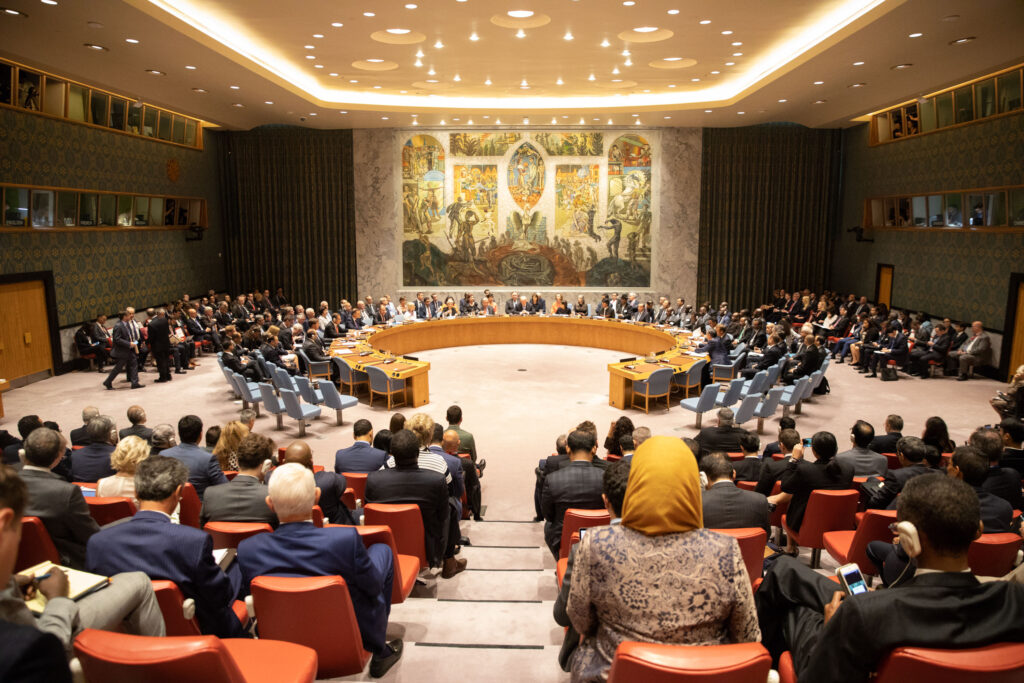
The Security Council Chamber itself sits behind a mural by the Norwegian artist Per Krogh, depicting a phoenix rising from its ashes. Death and rebirth. Destruction preceding a new order. The phoenix is not a Christian symbol. It is the symbol of a tradition that predates Christianity and has always seen itself as its replacement.
The High Commissioner and the Lodge
On December 1, 2020, Michelle Bachelet Jeria, the United Nations High Commissioner for Human Rights, met with top Masonic leaders in Chile to commemorate the 72nd anniversary of the Universal Declaration of Human Rights. The event was reported by the Masonic Grand Lodge of Chile. In her speech, Bachelet said that the world needs Masonic principles such as solidarity and fraternity to come together as one humanity.
This is not a footnote. This is the head of the UN’s human rights apparatus telling a Masonic audience that her organization’s foundational document is grounded in their principles. The Universal Declaration of Human Rights, the document the UN presents to the world as the secular scripture of universal dignity, described by the person responsible for enforcing it as a Masonic document.
And yet the UN Human Rights Council includes among its members some of the most repressive governments on earth. Saudi Arabia, where women require male guardianship for basic activities and flogging is a documented judicial practice. Somalia, where Al-Shabaab operates with near-total impunity, executing Christians and burning churches while the state cannot or will not stop it. Sudan, where a civil war has displaced over eleven million people, Christians are targeted for both their faith and their ethnicity, and more than a hundred churches have been destroyed or occupied. Countries with documented records of torture, forced disappearance, and the imprisonment of journalists sit on the council that claims to defend human rights and violate them as a matter of policy.
Rwanda happened while the UN watched. Bosnia happened while the UN debated. The Christians of Nigeria, Sudan, and Eritrea are being slaughtered now while the UN issues statements. The gap between the stated mission and the demonstrated record is not a failure of implementation but the institution’s reality.
The Blue Helmets
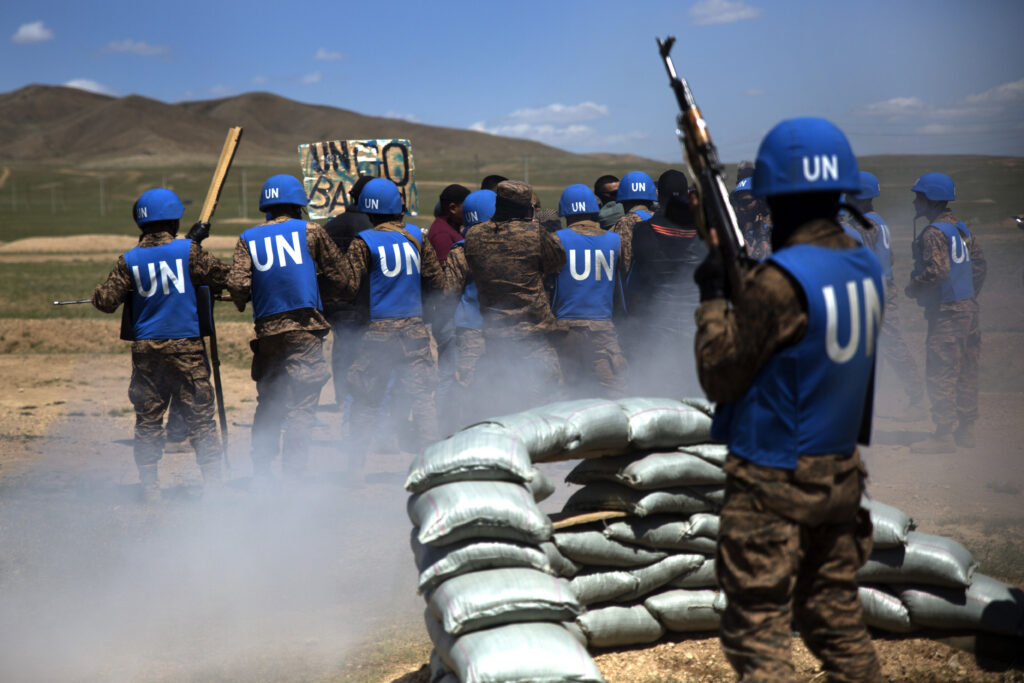
The United Nations Peacekeeping force has been deployed to some of the most vulnerable places on earth: Haiti, the Democratic Republic of Congo, the Central African Republic, and South Sudan. What has happened there is documented, though not widely discussed.
In Haiti between 2004 and 2007, at least 134 Sri Lankan peacekeepers were implicated in a child sex ring involving minors. In the Democratic Republic of Congo, more than 70 allegations have been filed against peacekeepers for the sexual abuse of women and girls, many under 18. In the Central African Republic in 2014 and 2015, at least 98 girls reported sexual abuse by UN peacekeepers from Burundi and Gabon. In 2023 alone, the UN received 758 allegations of sexual exploitation and abuse, 100 of which were related to peacekeeping missions. Sexual misconduct allegations again topped 100 in 2024.
These are not isolated incidents. They are a systemic pattern spanning decades and continents. The UN’s internal reporting confirms it. Human Rights Watch has documented it. Harvard’s student policy journal has called it the worst-kept open secret in international affairs.
For the children of Haiti, the Congo, and the Central African Republic, the arrival of UN peacekeepers has, in documented cases, meant predation by the very force sent to protect them. This is the organization that holds itself out as the conscience of humanity.
Corruption as Standard Practice
The Oil-for-Food Program, designed to allow Iraq to sell oil in exchange for humanitarian supplies under sanctions, was looted. A UN tribunal has ordered a former official to repay $58.8 million lost in fraudulent deals. A Greek UN employee embezzled more than a million dollars. A senior UN official secretly accepted $3 million in gifts from a businessman to whom he directed organizational funds, zero-interest loans, a Mercedes, and a tennis sponsorship. A UN agency has faced corruption allegations related to climate projects. UNRWA, the agency responsible for Palestinian refugees, has faced allegations that some of its staff participated in the October 7 attacks, allegations that a subsequent UN internal review found sufficient grounds to investigate.
There are approximately 5,500 NGOs affiliated with the UN that conduct what is described as charitable work. An investigation into their financial records has raised serious questions about large-scale money laundering. The UN Secretary-General has called for tighter global control of social media to stop what he calls a tsunami of conspiracy theories that threaten Agenda 2030. An institution that cannot account for its own finances is asking for the power to regulate what the public may read and say about it.
Agenda 2030: The Official Version and the Real One
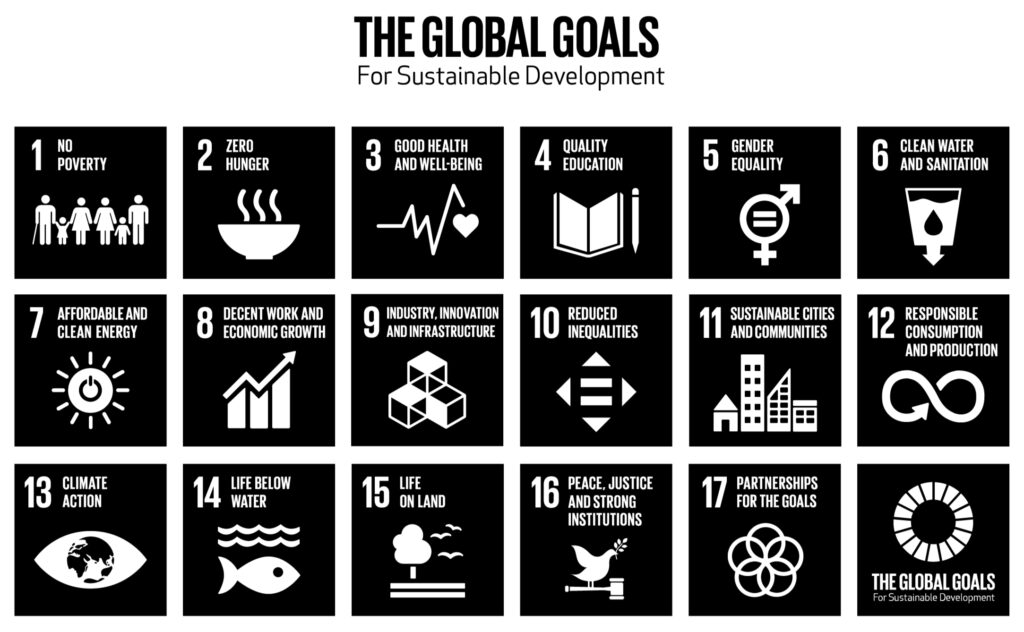
The UN presents its 17 Sustainable Development Goals as the most ambitious humanitarian framework in history: end poverty, protect the planet, ensure dignity for all by 2030. That is the sales pitch. What follows is what is in it.
Goal 1 — No Poverty. On paper: lift the world’s poorest out of destitution. In practice, the trajectory points toward a global basic income framework that ties recipients to digital ID systems and state-controlled disbursement. Welfare dependence repackaged as liberation. The question is never whether people get fed. The question is who controls the mechanism that feeds them.
Goal 2 — Zero Hunger. On paper: end hunger and achieve food security. The trajectory points toward the corporate takeover of global food systems through dependence on GMOs, Codex Alimentarius standards, and the privatization of the seed supply. Monsanto, now Bayer. The consolidation of agricultural genetics into a handful of corporate hands. The Dutch and French farmers are being destroyed by environmental legislation as this is being written. The end of private farms and vegetable gardens is not a conspiracy theory. It is a documented policy trajectory in multiple European jurisdictions. Hunger is easier to manage when you control the food.
Goal 3 — Good Health and Well-Being. On paper: universal health coverage, disease prevention, and access to medicine. The trajectory points toward mandatory vaccination frameworks and the pharmaceutical capture of global health governance through the WHO. The placebo-controlled perinatal HIV transmission trials conducted in Africa in the 1990s under CDC, WHO, and NIH funding, documented and criticized in the New England Journal of Medicine by Lurie and Wolfe in 1997, involved withholding a proven treatment from control groups, resulting in preventable infant HIV transmission. The ethical controversy surrounding those trials is well established. In Kenya in 2013, the Kenya Catholic Bishops’ Conference alleged that tetanus vaccines administered specifically to women of childbearing age were contaminated with HCG, a compound associated with sterilization. The WHO denied it. Testing commissioned by the Catholic Doctors Association disputed the WHO’s denial. The evidentiary record in the Kenya case remains contested, but the allegation was made by senior Catholic bishops in their own names, which is itself a form of testimony.
Goal 4 — Quality Education. On paper: inclusive, equitable education for all. Read against Alice Bailey’s attributed ten-point agenda, the trajectory aligns with uncomfortable precision: the removal of God from schools, the reframing of the family, and the promotion of gender ideology as educational content for children. Whether this is coordinated or ambient convergence is a genuine question. The outcome is the same either way.
Goal 5 — Gender Equality. On paper: equal rights and opportunities for women and girls. The trajectory points toward the ideological dismantling of the family as society’s foundational unit, the normalization of abortion as healthcare, and the legal erasure of biological sex as a meaningful category. Goals and outcomes are not the same thing.
Goal 6 — Clean Water and Sanitation. On paper: universal access to safe drinking water. The trajectory points toward water rationing through corporate privatization and the transfer of water rights from communities to multinational infrastructure funds. Clean water and controlled water are not the same thing.
Goals 7 and 8 — Energy and Economic Growth. Goal 7 targets the elimination of fossil fuels and the managed transition to state-controlled energy systems. Energy rationing is already being implemented across Europe. Goal 8 introduces universal digital IDs linked to financial systems. This is not speculative. The UN Development Program has published explicit methodology documents for implementing Central Bank Digital Currencies as tools for financial inclusion. The IMF created Special Drawing Rights as a global reserve asset in 1969. The World Economic Forum has called for a digital currency to replace the dollar. The UN is training governments on cryptocurrency and blockchain implementation with a 2026 target date. The architecture for a single, traceable global currency, controllable at the individual transaction level and revocable at will, is being built now under the language of inclusion and development.
Goal 9 — Industry, Innovation, and Infrastructure. Smart infrastructure, followed to its logical end, converges with technologies that were once science fiction. The UN’s own Scientific Advisory Board has published documents on neurotechnology. Brain-computer interface development falls within the scope of what UN-aligned bodies are already discussing as part of sustainable technological futures. The direction of travel is not ambiguous.
Goals 10 and 11 — Reduced Inequalities and Sustainable Cities. Goal 11 is the 15-minute city: smart cities built around AI-powered surveillance of movement, transactions, and behavior. Every purchase is tracked. Every journey logged. Humans concentrated into managed zones. The language is sustainability. The architecture is containment.
Goals 12 and 13 — Responsible Consumption and Climate Action. Goal 12 moves toward the erosion of private ownership under the rubric of responsible use. Goal 13 provides the moral cover for energy rationing, the end of non-essential air travel, and the elimination of modern conveniences through managed austerity dressed as environmental necessity.
Goals 14 and 15 — Life Below Water and Life on Land. Wildlife corridors and rewilding programs are already displacing rural populations in multiple countries. Control of wildlife means control of land. Control of land means control of movement, agriculture, and food. These are not projections. They are policies already active in parts of Europe.
Goal 16 — Peace, Justice, and Strong Institutions. The framework for centralized global governance, in which unelected bodies set binding policy for member nations and bypass democratic accountability entirely. This goal is the constitutional backbone of the others’ construction.
Goal 17 — Partnerships. The public-private architecture through which the World Economic Forum, Bilderberg-adjacent institutions, and global financial bodies already shape policy. The last goal is the mechanism that makes all the others enforceable. It is, in other words, the lodge.
Seventeen goals. One world. No exits.
The Secretary-General has warned of conspiracy theories threatening the agenda. An institution that seeks the power to suppress speech about itself while pursuing an agenda critics describe in these terms is, at a minimum, one that should be examined rather than trusted.
The Spiritual Agenda
Fr. Spyridon Bailey, an Orthodox priest and author, to whom I am indebted for opening my eyes to the theological dimensions of what this organization actually is, rather than the generic conservative talking point of globalism bad, makes an argument worth stating plainly. The United Nations offers a rival soteriology. While the Church proclaims salvation in Christ through repentance and grace, the UN proposes salvation from war and disorder through international law, global governance, and a universal human rights regime. Humanity is treated as a single moral entity that can be perfected by legislation. This rests on Enlightenment optimism about human rationality and, at its foundation, denies original sin and rejects the need for Christ.
To make this system workable across mutually incompatible religions and ideologies, the UN pursues a lowest-common-denominator humanism, brotherhood, tolerance, and equality elevated as the highest values, while confessional claims are treated as divisive and potentially extremist. The ecumenical movement, the World Council of Churches, and the pattern of papal visits to the UN podium, beginning with Paul VI in 1965 and followed by John Paul II twice, Benedict XVI, and Francis, represent, in this reading, the gradual absorption of institutional Christianity into the UN’s spiritual framework. John Paul II praised the UN’s objective of promoting respect for human rights without distinction of race, sex, language, or religion. The absence of God from that list is the point.
The UN observes World Interfaith Harmony Week, the International Day of Human Fraternity, the International Day of Yoga on the summer solstice, and World Meditation Day on the winter solstice. It also observes International Mother Earth Day, celebrating what allied environmental NGOs describe as Gaia, the living Earth as a divine being. It has a day to combat Islamophobia but no equivalent day to combat anti-Christian persecution, which, by any measure, is the most widespread form of religious violence on Earth. It has a Nelson Mandela Day, honoring a man who pleaded guilty in court to acts of public violence and whose organization sanctioned the 1983 Church Street car bomb in Pretoria, which killed 19 people. It does not have a day for the Christians being killed in Nigeria, Somalia, Sudan, Pakistan, Eritrea, Iran, Afghanistan, and India, or for the Christians classified as enemies of the state and worked to death in North Korean labor camps.
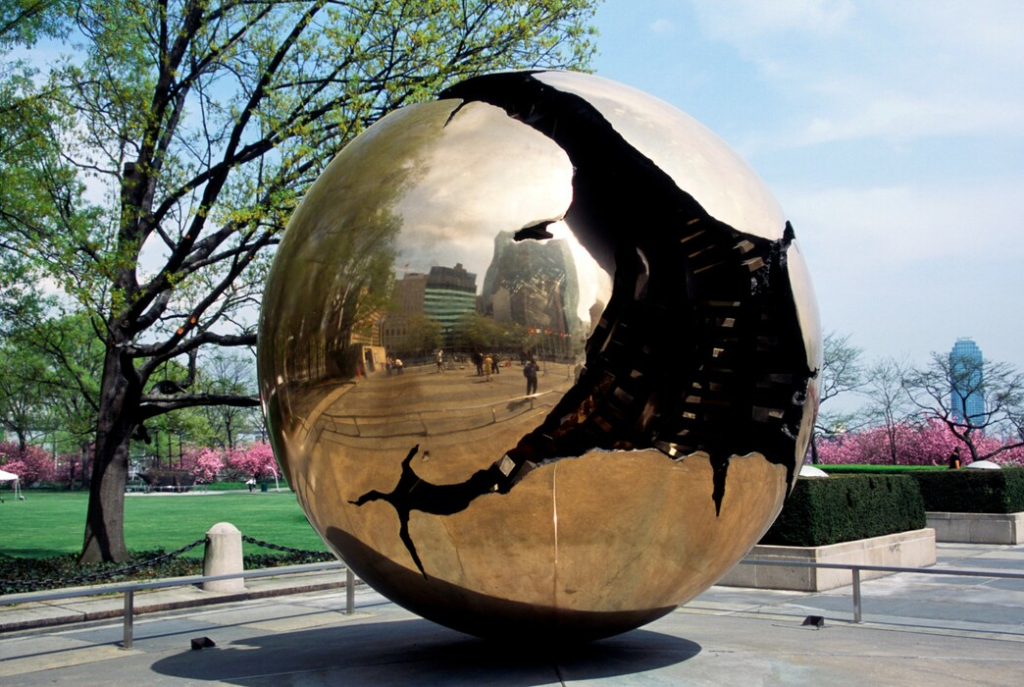
The Sphere Within Sphere sculptures at both the Vatican and the UN headquarters are identical in form, the work of the same sculptor, Arnaldo Pomodoro. Why the same sculpture occupies the symbolic center of both institutions is a question worth asking.
The UN Meditation Room, the Lucis Trust consultative status, formerly Lucifer Publishing, the Masonic language of the High Commissioner for Human Rights, the Bailey timeline ending in 2025, the beast statue named the Guardian of Peace, the phoenix mural in the Security Council Chamber, and the calendar of solstice observances all point in the same direction. Not toward peace and security, but toward a new world religion designed to replace the one that has always stood in its way.
So What Are We Looking At?
The United Nations was not founded by neutral humanitarians. It was founded by Freemasons, shaped by Theosophists, staffed by occultists and world federalists, and built around a spiritual framework that was always hostile to confessional Christianity and explicitly designed to supersede it. The stated goals, peace, security, and human dignity, are real enough as rhetoric. The demonstrated record includes peacekeepers preying on children, officials embezzling hundreds of millions, genocides proceeding uninterrupted while the Security Council debates procedure, and a 2030 agenda that, read carefully and followed to its logical ends, is a blueprint for total surveillance, financial control, speech regulation, and the erosion of national sovereignty, family structure, and religious identity.
Alice Bailey described a window from her time until 2025, a stage of the forerunner, preparatory and testing. Here we are. The acceleration of Agenda 2030 to 2025 was announced. The UN Secretary-General is calling for global regulation of speech. The digital currency infrastructure is being built. The smart city surveillance architecture is being deployed. The interfaith movement is absorbing denominational Christianity at an accelerating pace.
The Orthodox Church has always known what is at stake. We have the sacraments. We have the saints. We have the unbroken witness of two thousand years, which shows that the world, the flesh, and the devil operate through exactly these kinds of structures: impressive, beneficent in their stated purposes, and hostile in their actual effects on the souls of those who trust them.
The battle for the soul of humanity is not a metaphor. It is being waged through institutions like this one, in conference rooms, meditation rooms, UN plazas, smart city control centers, and social media regulation frameworks, by people who know exactly what they are building and who proceed with or without our awareness.
We should be aware.