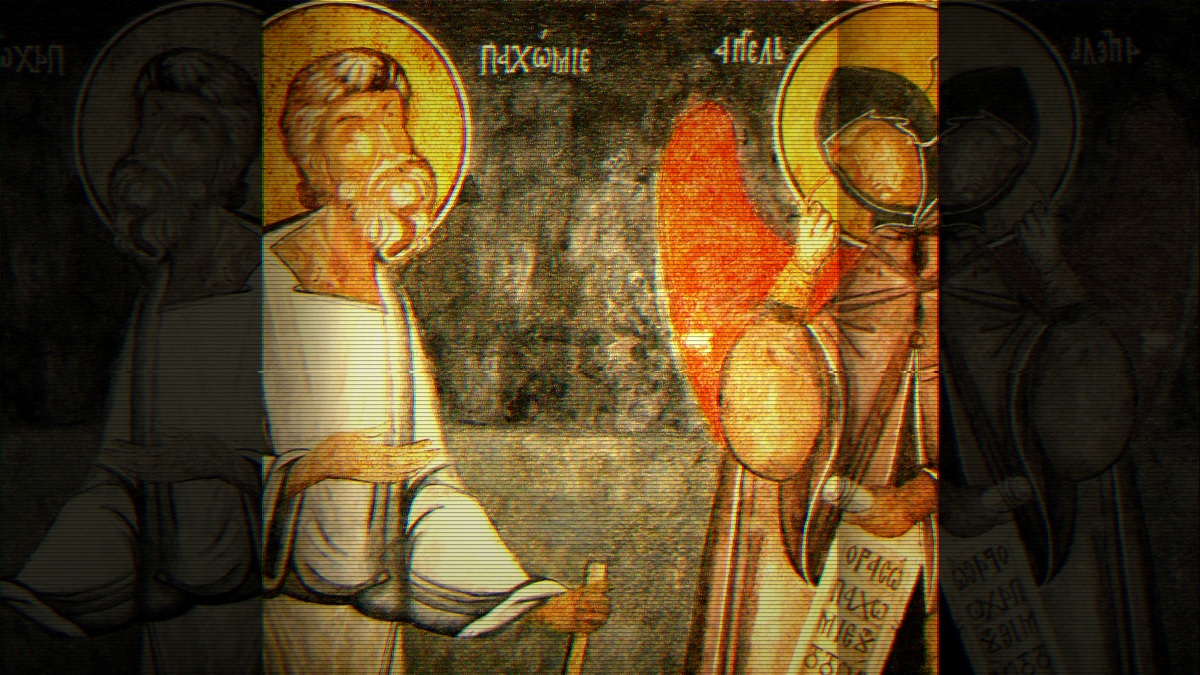
I. Biography of St. Pachomius
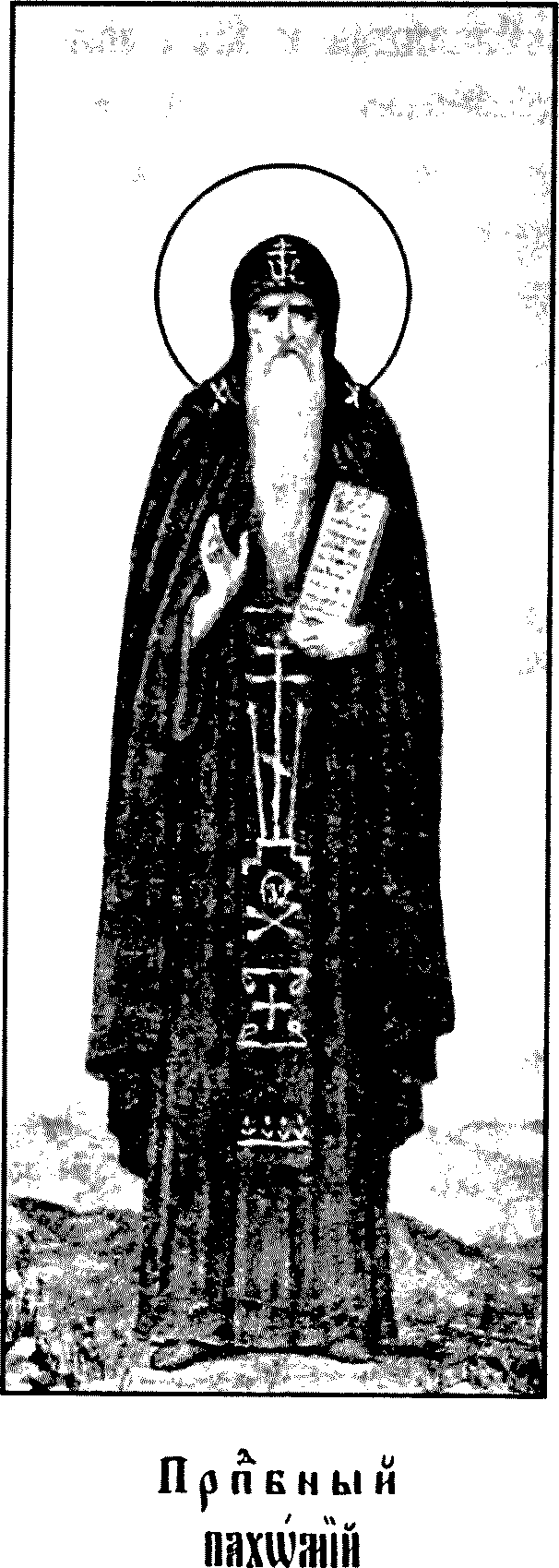
Saint Pachomius, one of the Desert Fathers and the founder of Christian cenobitic monasticism, was blessed with many visitations from angels who delivered divine mandates for the ascetic life. Born in 292 AD in the Lower Thebaid of Egypt to pagan parents, he lived during the reign of Emperor Constantine the Great. He first encountered Christianity not in a church, but through the unexpected kindness of Christian soldiers he met while serving in the Roman army. Their gentleness pierced him deeply. Inspired by their compassion, he decided — after being released from military service — to seek the God whom they served.
After his discharge, Pachomius traveled south into Upper Thebaid, where he was baptized and embraced the monastic life. Yet he found no rest. Not satisfied with the noise and closeness of early monastic settlements, he fled into the Egyptian desert to seek silence and undistracted remembrance of God. It was there that he encountered his spiritual father, the renowned hesychast Palamon, whose example Pachomius strove to imitate all his life.
Around the year 320, Palamon reposed in the Lord, and Pachomius withdrew to a deserted islet on the Nile — the island of Tabenna. With the help of his brother John, he established a small monastic dwelling for all who cried, in the spirit of the desert, “Death to the world.” Word of his holiness spread like fire across the sands. Men seeking God gathered around him — first a handful, then dozens, then hundreds. Soon, his monasteries numbered more than 14,000 monks: a city of ascetics in the emptiness of the desert.
The Pachomian koinonia was unlike anything the Christian world had seen. It was a network of monasteries — nine for men and two for women — united by a single rule, rhythm, and spirit of obedience. The monks lived in groups of three in houses. They worked together, prayed together, ate together, and kept only what was given to them. Their food was simple — vegetables, bread, and cheese. They often communicated solely through gestures, guarding their speech so that their hearts would remain still. During meals, they covered their faces so each monk saw only his own bowl. They slept sitting upright and received Holy Communion every Saturday and Sunday. The brotherhood was divided into twenty-four ranks, each corresponding to a letter of the alphabet, organized by spiritual maturity and behavior.
The Holy Spirit governed everything. Discipline, charity, humility, and love flowed through the community like a single bloodstream. Under Pachomius’s guidance, the monks were encouraged to strive for theosis. And because of his great humility, God granted him the grace of miracles.
In 348, while tending the sick during a plague, Pachomius himself became ill and fell asleep in the Lord. Saint Theodosius the Sanctified succeeded him as abbot, carrying forward the legacy of cenobitic monasticism.
Before examining the angelic revelation of the prayer rule itself, it is essential to recognize that this was not the first time heaven had intervened in the saint’s life. According to the earliest traditions faithfully preserved in both the Greek and Russian Orthodox Churches, Pachomius experienced an earlier angelic visit while still a hermit. An angel appeared and instructed him to gather brothers and start the communal life that would become the koinonia. This foundational vision marks the beginning of cenobitic monasticism. Only much later — when the large brotherhood had formed and the strong and the weak had developed notably different prayer practices — did Pachomius again seek God’s guidance. It was then, in response to that prayer, that the angel returned with the small tablet containing the rule that would unify the entire community.
II. The Angelic Revelation of the Prayer Rule
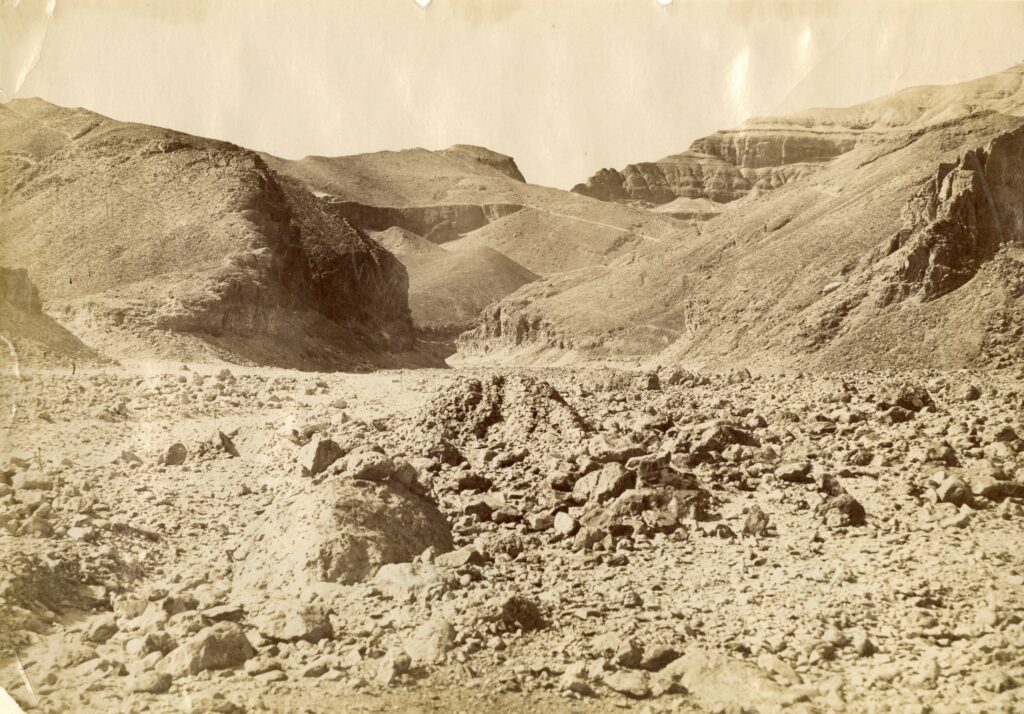
In the early days of the Pachomian monasteries, the brotherhood had grown with astonishing speed. Men flocked to the desert seeking the living God: experienced hermits hardened by years of solitude, fragile beginners newly delivered from the world, and others somewhere in between. Some prayed with incredible strength — standing through the night, bowing repeatedly to the earth, reciting long psalms from memory. Others struggled to remain upright during the psalm readings, fighting drowsiness, distraction, or the burden of inexperience.
Saint Pachomius feared a fracture in the community he had been entrusted to shepherd. The strong might become prideful; the weak could fall into despair. If each brother prayed in his own way, how could they remain of one heart and soul before God?
Night after night, he pleaded with the Lord for guidance:
“O Master, teach me how Thy servants may pray with one heart, that the strong may not boast and the weak may not be crushed.”
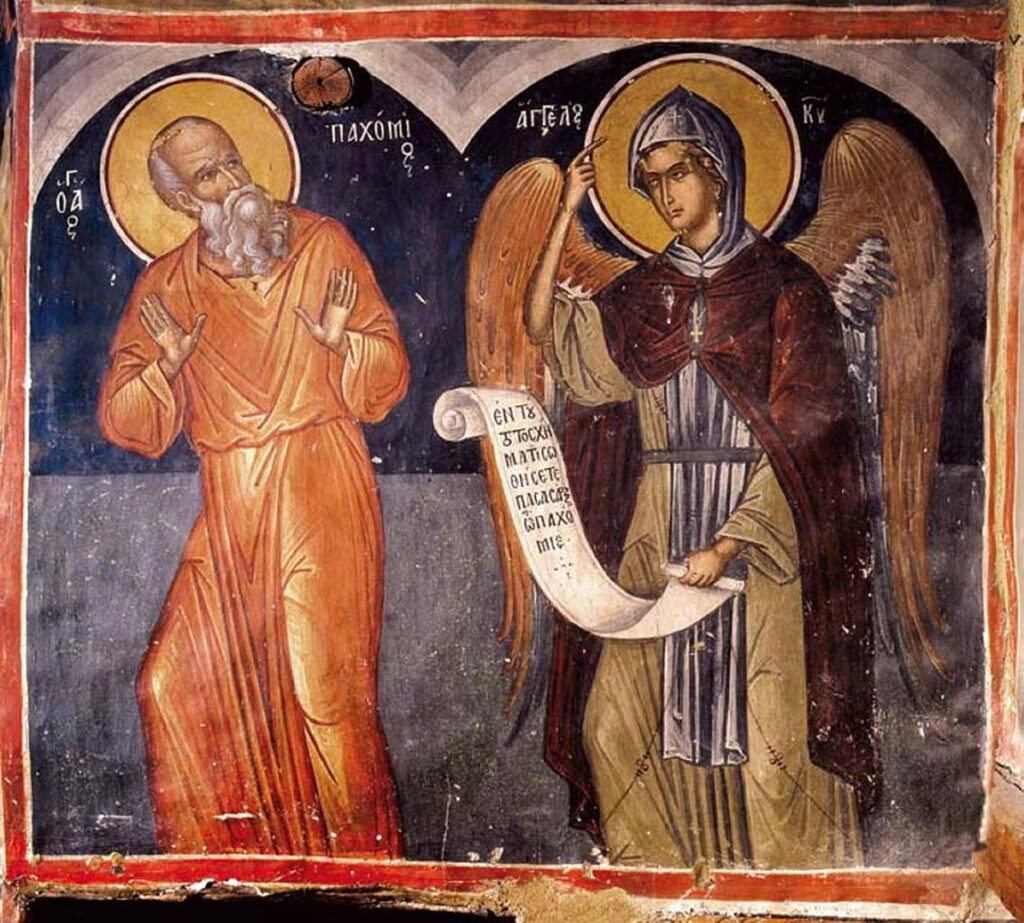
One night, as Pachomius knelt alone in his cell, a radiant light — gentle as dawn yet brighter than any earthly flame — filled the room without a source or shadow. The saint lifted his eyes and saw a young man dressed in white, a whiteness not of this world. His face was gentle, and his eyes were clear. In his hands he held a small tablet that shimmered with a quiet, unearthly brightness.
Overcome, Pachomius collapsed to the ground and covered his face.
“Fear not,” said the Angel — and the sound of his voice calmed every fear in the saint’s heart. “Pachomius, faithful servant of Christ, the Lord has heard your prayer.”
The angel lifted the tablet, and the writing upon it shone like gold — yet brighter still, as if illuminated from within by the peace of the Holy Trinity. These were short prayers, simple enough to memorize yet profound enough to unite souls of every measure: the strong, the weak, and all who would come afterward.
“This rule shall be observed at every hour of the day and night,” the Angel said. “Let each brother stand before God with humility and sincerity. Let the remembrance of God never cease among you. Whoever keeps this rule with faith, I will strengthen him. Whoever neglects it out of indifference will grow weak in spirit.”
Then, holding the tablet before the kneeling saint, the angel read aloud the rule.
The Angelic Rule Given to St. Pachomius
Through the prayers of our holy Fathers, O Lord Jesus Christ our God, have mercy on us. Amen. Glory to Thee, our God, glory to Thee.
O Heavenly King, Comforter, Spirit of Truth, Who art everywhere present and fillest all things, Treasury of good things and Giver of life: Come and dwell in us, and cleanse us of all impurity, and save our souls, O Good One.
Holy God, Holy Mighty, Holy Immortal, have mercy on us. (Thrice) Glory to the Father, and to the Son, and to the Holy Spirit, both now and ever, and unto the ages of ages. Amen.
O Most Holy Trinity, have mercy on us. O Lord, blot out our sins. O Master, pardon our iniquities. O Holy One, visit and heal our infirmities for Thy name’s sake.
Lord, have mercy. (Thrice) Glory to the Father, and to the Son, and to the Holy Spirit, both now and ever, and unto the ages of ages. Amen.
Our Father, Who art in the Heavens, Hallowed be Thy Name. Thy Kingdom come, Thy will be done, on earth as it is in Heaven. Give us this day our daily bread, and forgive us our debts, as we forgive our debtors; and lead us not into temptation, but deliver us from the evil one. O Lord, Jesus Christ, Son of God, have mercy on us. Amen.
Lord, have mercy. (Twelve times) Glory to the Father, and to the Son, and to the Holy Spirit, both now and ever, and unto the ages of ages. Amen.
O come, let us worship God our King. O come, let us worship and fall down before Christ our King and God. O come, let us worship and fall down before Christ Himself, our King and God.
Psalm 50 (51)
Have mercy on me, O God, according to Thy great mercy; and according to the multitude of Thy compassions blot out my transgression. Wash me thoroughly from mine iniquity, and cleanse me from my sin. For I know mine iniquity, and my sin is ever before me. Against Thee only have I sinned and done this evil before Thee, that Thou mightest be justified in Thy words, and prevail when Thou art judged. For behold, I was conceived in iniquities, and in sins did my mother bear me. For behold, Thou hast loved truth; the hidden and secret things of Thy wisdom hast Thou made manifest unto me. Thou shalt sprinkle me with hyssop, and I shall be made clean; Thou shalt wash me, and I shall be made whiter than snow. Thou shalt make me to hear joy and gladness; the bones that be humbled, they shall rejoice. Turn Thy face away from my sins, and blot out all mine iniquities. Create in me a clean heart, O God, and renew a right spirit within me. Cast me not away from Thy presence, and take not Thy Holy Spirit from me. Restore unto me the joy of Thy salvation, and with Thy governing Spirit establish me. I shall teach transgressors Thy ways, and the ungodly shall turn back unto Thee. Deliver me from blood-guiltiness, O God, Thou God of my salvation; my tongue shall rejoice in Thy righteousness. O Lord, Thou shalt open my lips, and my mouth shall declare Thy praise. For if Thou hadst desired sacrifice, I had given it; with whole-burnt offerings Thou shalt not be pleased. A sacrifice unto God is a broken spirit; a heart that is broken and humbled God will not despise. Do good, O Lord, in Thy good pleasure unto Zion, and let the walls of Jerusalem be builded. Then shalt Thou be pleased with a sacrifice of righteousness, with oblation and whole-burnt offerings. Then shall they offer bullocks upon Thine altar.
The Creed
I believe in one God, the Father Almighty, Maker of heaven and earth and of all things visible and invisible. And in one Lord Jesus Christ, the Son of God, the Only-begotten, begotten of the Father before all ages; Light of Light, true God of true God; begotten, not made; of one essence with the Father, by Whom all things were made; Who for us men and for our salvation came down from the heavens, and was incarnate of the Holy Spirit and the Virgin Mary, and became man; And was crucified for us under Pontius Pilate, and suffered and was buried; And arose again on the third day according to the Scriptures; And ascended into the heavens, and sitteth at the right hand of the Father; And shall come again, with glory, to judge both the living and the dead; Whose kingdom shall have no end. And in the Holy Spirit, the Lord, the Giver of life; Who proceedeth from the Father; Who with the Father and the Son together is worshipped and glorified; Who spake by the prophets. In One, Holy, Catholic, and Apostolic Church. I confess one baptism for the remission of sins. I look for the resurrection of the dead, and the life of the age to come.
Amen.
The Jesus Prayer
O Lord Jesus Christ, Son of God, have mercy on me, a sinner. (100 times)
Dismissal
It is truly meet to bless thee, the Theotokos, ever blessed and most blameless, and Mother of our God. More honorable than the Cherubim, and beyond compare more glorious than the Seraphim, who without corruption gavest birth to God the Word, the very Theotokos, thee do we magnify.
Glory to the Father, and to the Son, and to the Holy Spirit, both now and ever, and unto the ages of ages. Amen. Lord, have mercy. (Thrice) O Lord, bless.
O Lord Jesus Christ, Son of God, for the sake of the prayers of Thy most pure Mother, of our holy and God-bearing fathers, and all the saints, have mercy on us and save us, for Thou art good and the Lover of mankind.
Amen.
The Tablet Is Lifted
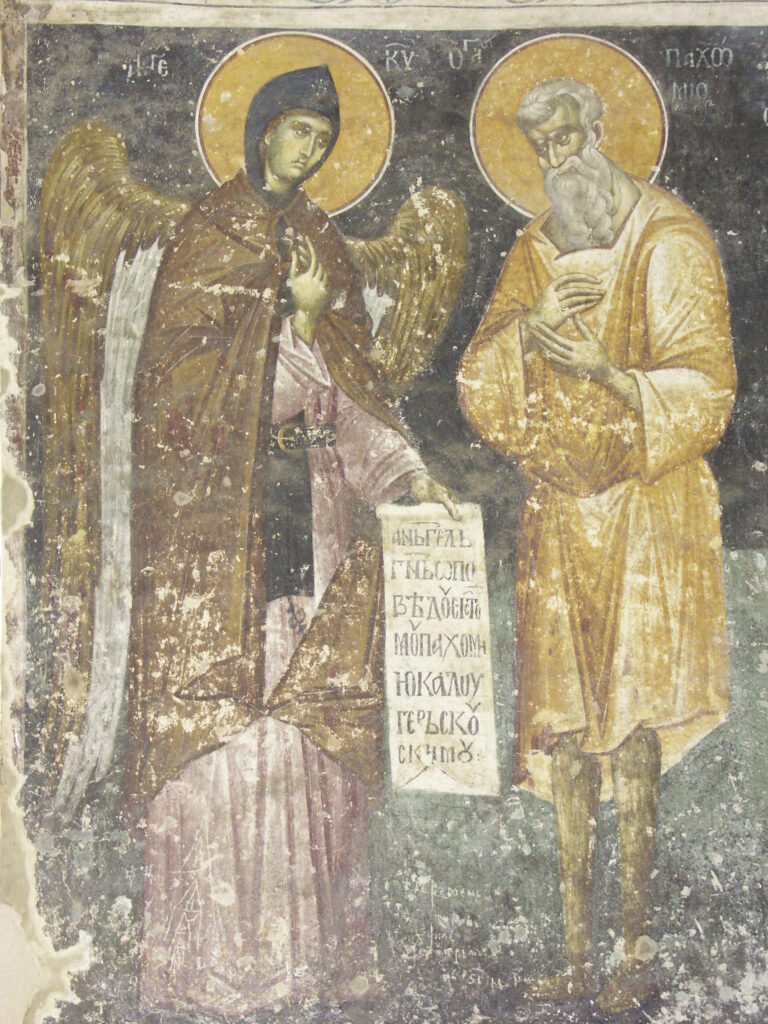
When the angel finished reading, he lifted the tablet once more. The writing shimmered with a final burst of divine light. Then the Angel traced the sign of the Cross in the air, and a scent sweeter than any earthly incense filled the cell. In an instant, the light faded, and he was gone.
Pachomius rose trembling — yet filled with a joy that no earthly language can capture — and hurried to his scribes to recite the rule verbatim. At dawn, the entire brotherhood assembled in the courtyard. Their lamps flickered against the monastery walls as Pachomius read aloud the divine instruction. Every heart was pierced with compunction. Without hesitation, they recognized the rule as a gift sealed by Paradise itself.
From that morning onward, the angelic rule became the guiding thread uniting the brothers: a rhythm of prayer that neither exalted the strong nor oppressed the weak, but bound the entire community into a shared remembrance of God.
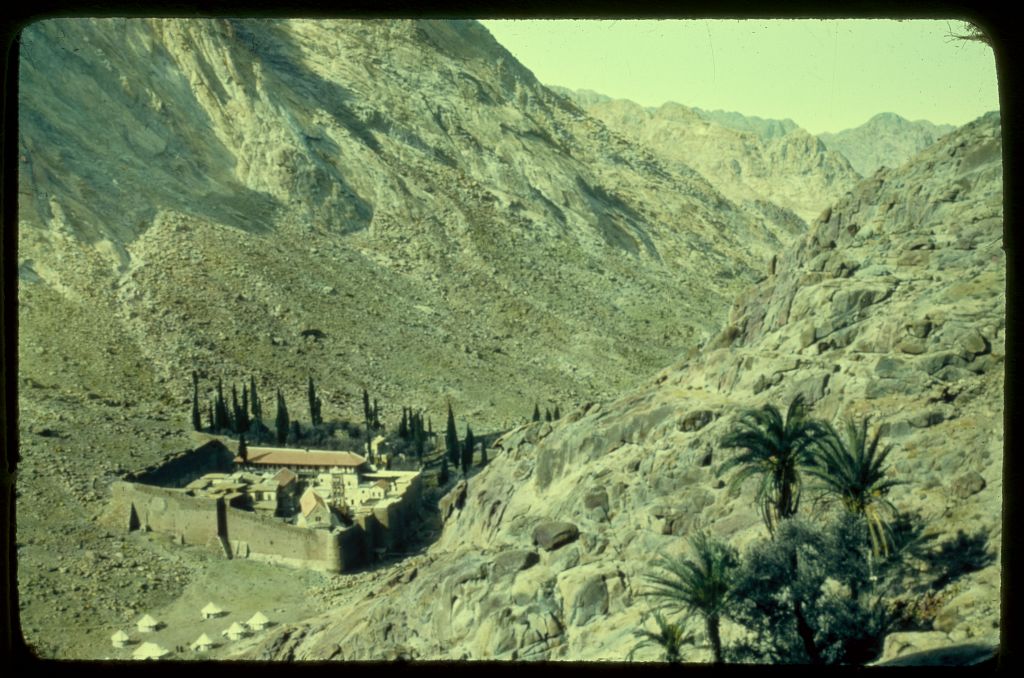
Over time, the rule spread far beyond Tabenna — reaching Nitria, Sinai, Constantinople, the Russian forests, and the hermitages of Sarov. Wherever men and women desired to pray with a pure heart, the angelic rule found a home.
When St. Pachomius sought a prayer for all, God sent an angel — and the angel taught him how people can pray without ceasing, giving him a rule that the saint himself followed at every hour of the day and night.
III. Significance, Transmission, and Living Tradition of the Angelic Rule
The prayer rule given by the angel to Saint Pachomius the Great holds a unique place in Christian history: it serves both as a foundational rule of prayer for a desert monastery and as a spiritual inheritance that continues to guide Orthodox prayer life today.
When the angel delivered the rule — short, straightforward, and easy to memorize — he offered more than a liturgical outline. He provided a spiritual foundation suitable for every Christian, whether a desert ascetic or a believer living in the modern world. As St. Ignatius Brianchaninov later taught, this rule was meant for the entire brotherhood, “for the vast community of monks dependent on him,” and its regular use was expected until a few advanced to the grace of unceasing prayer. In his words, the angelic rule “consisted of the Trisagion, the Lord’s Prayer, Psalm 50, the Symbol of Faith, and 100 Jesus Prayers” — treating the Jesus Prayer as a universal Christian prayer, familiar, simple, and accessible to all.
Yet the angelic prayer rule was never meant for monks alone. Its strength lies in its simplicity and its ability to stay in the heart. Over time, it became a spiritual anchor not only for hermits and cenobitic monks but also for lay believers seeking to guard the memory of God. St. Seraphim of Sarov advised many of his spiritual children — especially those living in the world — to follow a version of this rule. For them, it provided a daily rhythm of communion with Christ: hour by hour, breath by breath.
In our modern age, marked by constant movement and distraction, the rule remains as powerful as ever. Contemporary spiritual fathers still recommend it as an ideal prayer routine for travelers, workers, and commuters — anyone whose commitments make it difficult to follow the full cycle of the canonical hours. The angelic rule can be memorized and recited even while on the go; it can replace morning or evening prayers when a book is not available; yet it continues to anchor the soul in the timeless rhythm of repentance, confession of faith, and remembrance of God.
Its ongoing relevance is also evident in contemporary Orthodox prayerbooks. I am especially thankful for Daily Prayers for Orthodox Christians by John (Ellsworth) Hutchison-Hall, through which I first encountered the complete text of this ancient rule and recognized its lasting importance for our present time. Its publication continues the unbroken connection from desert sands to crowded cities, from the earliest Pachomian dwellings to the homes of Orthodox Christians worldwide.
In the end, the angelic prayer rule stands as a testament to the fact that God does not abandon His children to their own devices but provides a way to pray — simple, humble, eternal. For the monks of the desert, it united them with one heart; for Christians living in the world, it opens a path to pray without ceasing. And for all who honor Saint Pachomius on his feast day, May 15, this rule remains one of the brightest gifts God has bestowed through him — a legacy of divine guidance given through angelic hands, offered to every soul who desires the remembrance of God.