I. THE OVAL OFFICE
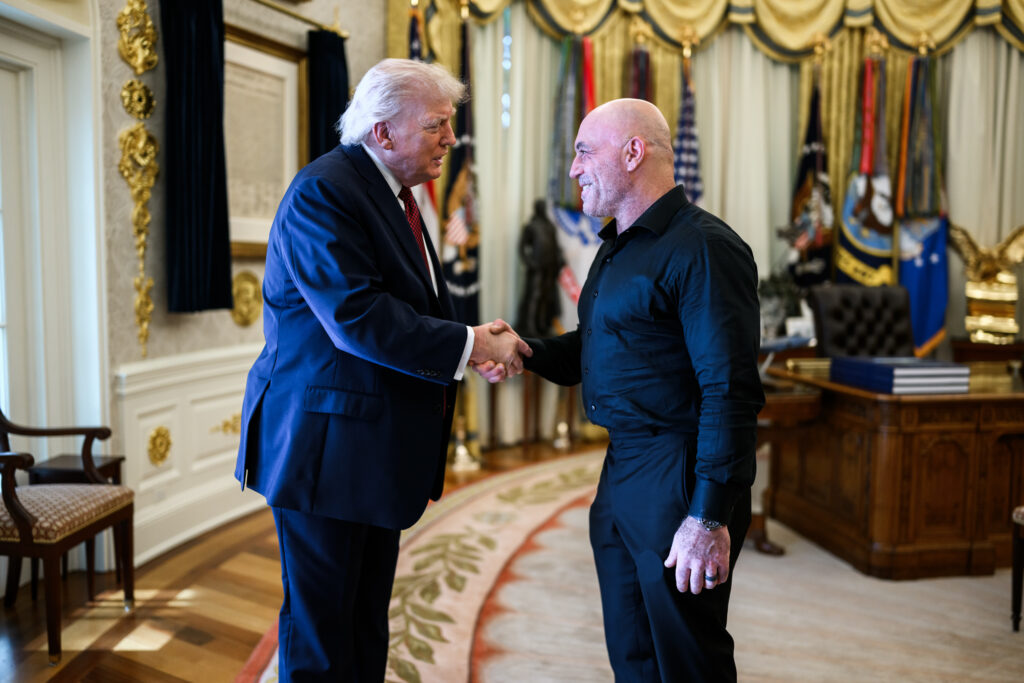
In April 2026, Joe Rogan, stand-up comedian, podcaster, UFC commentator, and the most listened-to man in America, with an audience of tens of millions, stood in the Oval Office of the White House wearing a tight black button-up shirt without a tie. He was the only person in the room not wearing a suit. He had come to tell the President of the United States that psychedelic drugs should be legalized.
He had sent Donald Trump information about ibogaine, a powerful psychedelic derived from an African shrub used in addiction treatment for opioid dependency. The text message that came back, in Rogan’s telling, read: Sounds great. Do you want FDA approval? Let’s do it. Rogan described the moment with evangelical fervor. These drugs are illegal not because they’re harmful, he told the crowd. They’re illegal because of the 1970 Controlled Substances Act, passed by the Richard Nixon administration. For 56 years, we’ve lived under those terrible conditions. We’re free of that now.
The button-up was neither casual nor formal, the studied uniform of the alternative media class he had built. The man wearing it had just walked into the most powerful office in the world and shifted drug policy. The moment was unprecedented. The reaction, for the most part, was celebratory. Psychedelics were going mainstream. The revolution was being televised.
What almost no one in that room, and almost no one watching, knew was that the man in the tight black shirt had been working toward this moment for more than a decade, not as a spontaneous cultural force, but as what one researcher who knew him early described as the most crucial asset for the information age at this point in time. That the pipeline running from his podcast to the Oval Office passed through a network of CIA-connected institutions, intelligence-linked foundations, and a social engineering project that traces directly to the same apparatus that gave America its first acid trip. That the substances he championed in the name of freedom had been deliberately introduced into American culture as tools of population management. And that the spiritual experiences those substances reliably produce, the overwhelming love, the dissolution of the self, the contact with beings of light, the revelation of hidden knowledge, had been identified and named by the Orthodox Christian Fathers as one of the most dangerous forms of demonic delusion in the history of the human soul.
What makes this moment remarkable is not merely that it happened, but how it happened. The institutional route, FDA approval, clinical legitimacy, academic research, had just collapsed. The cultural route, running through a podcaster in a button-up shirt, delivered in twelve months what a decade of clinical trials could not.
This is the story.
II. THE CURRENT MOMENT
The psychedelic renaissance is real, accelerating, and its institutional reach is now unmistakable.
Psilocybin, the active compound in magic mushrooms, has been decriminalized or legalized in Oregon, Colorado, and several major American cities. Ketamine clinics operate legally in most states. MDMA, the active compound in ecstasy, has received serious FDA consideration for PTSD therapy. At the Psychedelic Science 2023 conference in Denver, described by its organizers as the most prominent psychedelic conference in the world, five thousand people packed the auditorium to give MAPS founder Rick Doblin a standing ovation before he had said a single word. He walked out in a white suit and wandered the stage like a preacher. The woman sitting next to the journalist covering the event wept throughout his entire talk. Former Texas Governor Rick Perry and current Colorado Governor Jared Polis appeared onstage to endorse the movement. NFL quarterback Aaron Rodgers and lifestyle entrepreneur Aubrey Marcus shared personal stories of ayahuasca revelation, which the crowd received as testimonies of grace. The theme of that conference was Be Part of the Breakthrough.
Marcus told a story about a ketamine experience that convinced him to endorse Robert F. Kennedy Jr.’s presidential campaign. A political endorsement made under the influence of a dissociative anesthetic, announced from a Rockefeller-funded stage, was received by the mainstream journalists present without apparent concern. Nobody raised an eyebrow. This, apparently, is where we are.
The breakthrough then stalled, at least on paper. The FDA rejected MDMA therapy in 2024. MAPS and its for-profit arm, Lykos, laid off significant staff. Multiple psychedelic startups collapsed or went bankrupt. At Psychedelic Science 2025, held again in Denver, attendance had dropped from 12,000 to an estimated 8,000 to 10,000. Empty seats where the aisles had been packed two years earlier. Doblin walked out again, this time in what appeared to be the same white suit, paired with black slacks and a blue shirt. Last time I was wearing all white, he said. But this time I’ve added black and blue. We are battered, but we are still standing. The conference’s new theme: The Integration. Within twelve months of that speech, Joe Rogan stood in the Oval Office with a presidential directive on psychedelic therapy. The pipeline continued without slowing, but it was rerouted.
The people pursuing these experiences are, for the most part, sincere. Many report genuine experiences of awe, connection, and a sense of contact with something greater than themselves. The veteran who takes ibogaine and is freed from suicidal ideation is not fabricating his relief. The young man who takes psilocybin and weeps at the world’s beauty is not performing. The woman who drinks ayahuasca and forgives her father is not lying about what happened to her.
Taking this seriously is what makes the Orthodox theological response meaningful rather than merely reactive. Something real is happening. The question is what it is and who is behind it.
III. CIA PSYCHEDELIC PROGRAM: HOW LSD CAME TO AMERICA

The official story of the psychedelic revolution is one of organic counterculture, brave researchers, visionary artists, and spiritually searching young people who discovered ancient plant medicines and consciousness-expanding chemicals that the frightened establishment sought to suppress. This story is false in almost every respect.
LSD was synthesized in 1938 by Albert Hofmann at Sandoz Laboratories in Basel, Switzerland. Sandoz had documented commercial relationships with German chemical interests during the war years, and the research conducted there entered the postwar intelligence apparatus through channels that are now a matter of public record. After World War II, more than 1,600 Nazi scientists, including specialists who had experimented on prisoners at Dachau, were brought to the United States under Operation Paperclip. Their psychedelic research came with them, merging with CIA programs that would become Project MK-Ultra. What MK-Ultra was for is no longer a matter of theory or conjecture. It is a matter of sworn testimony before the United States Senate.
On August 3, 1977, in a joint hearing before the Senate Select Committee on Intelligence and the Subcommittee on Health and Scientific Research, Senator Edward Kennedy placed on the public record what the Church Committee’s two-year investigation had established: The Central Intelligence Agency drugged American citizens without their knowledge or consent. It used university facilities and personnel without their knowledge. It funded leading researchers, often without their knowledge. CIA Director Admiral Stansfield Turner, under oath, confirmed that the program had involved 149 subprojects, 185 non-government researchers, and institutions including 44 colleges and universities, 15 research foundations and pharmaceutical companies, 12 hospitals and clinics, and 3 penal institutions. The CIA’s own 1963 Inspector General report, read into the Senate record, defined MK-Ultra as concerned with chemical, biological, and radiological materials capable of employment in clandestine operations to control human behavior. The word control is the CIA’s own word, in the CIA’s own document, confirmed under oath before the United States Senate.
The records were destroyed in January 1973 at the personal direction of CIA Director Richard Helms, with the destruction carried out by Sidney Gottlieb, Chief of the Technical Services Division. Both men confirmed this under oath. The CIA’s own Inspector General had noted as early as 1963 that present practice is to maintain no records of the planning and approval of test programs. Lack of accountability was not a failure of the program. It was built into it from the beginning. The only reason any of this is known is that the financial records were accidentally misfiled in the wrong department in 1970, thereby escaping the 1973 destruction order. One bureaucratic accident is the difference between documented history and permanent cover-up. Divine intervention, anyone?
The concealment of funding was equally systematic. CIA money was routed to researchers through ostensible research foundation auspices, thereby concealing the CIA’s interest from the specialist’s institution. In one documented case, $375,000 was contributed to the building fund of a private medical institution through an intermediary that made it appear to be a private donation, then matched with federal funds. The institution never knew the CIA was the source. This mechanism, intelligence money laundered through foundations to fund research that shapes public culture, did not end with MK-Ultra. It became the template for everything that followed.
The human cost of this program is not abstract, and it should not be treated as such. Zal Orlico came to Dr. Ewen Cameron at McGill University in Montreal in 1957, suffering from depression. Cameron was one of the most respected psychiatrists in North America. Her treatment consisted of massive intravenous doses of LSD. Cameron injected the drug into her vein, patted her on the shoulder, said, Now, there, Lassie, we’ll see you later, and left, closing the door behind him. It felt like my bones were melting, she testified on CBS’s 60 Minutes in 1984, a broadcast the CIA itself archived in its declassified files. I just didn’t know who I was anymore. She was never compensated. She spent decades believing she had personally failed at life. They took away the remaining years of my life, she testified. They really wrang them out and left me with a piece of rag to live.
Robert Logey was eighteen when he came to the Allen Memorial Institute with severe leg pain. He received LSD, electroshock at many times the normal dose, and psychic driving, tape-recorded messages played into his drugged, nearly paralyzed brain up to half a million times. Years later, after finally obtaining his medical records, he learned his leg pain was not psychosomatic. A few shots of cortisone ended it. He was given LSD and electroshock for a condition that cortisone cured. When you’re mentally raped, he testified, there’s nothing. And I don’t trust any psychiatrist who might be able to help me.
Dr. Mary Morrow was a physician who came to Cameron to pursue a psychiatric fellowship. He told her she looked tired and would not consider her for the fellowship unless she underwent sleep therapy. She consented, believing it meant rest with sedatives. Instead, she received electroshock at 67 times the average dose, administered six times in succession rather than the standard once or twice weekly. She lost her identity entirely. I was suspended in space in a deep black hole, she testified. I had no idea that I was a human being. I was without knowledge of my appendages. I had no sense of solidity. I was floating. I was completely disoriented. I thought I was an organism. She suffered permanent brain damage. Her mother had to demand her release. When asked how the experience had affected her life, she answered in three words: It killed it.
These are the people the CIA funded with your money to destroy. They were never compensated or given an explanation. Cameron never faced consequences. He died in 1967, still respected, while on a hiking trip.
The CIA eventually concluded that LSD was useless for covert interrogation. However, as Jeffrey Kripal documents in Esalen: America and the Religion of No Religion (University of Chicago Press, 2007), the control-obsessed secret organization had, quite ironically, helped fuel what would quickly become a very public American counterculture. The CIA introduced LSD to American culture, concluded it didn’t work for their purposes, and watched what grew from a safe distance.
The distribution network for that cultural seeding ran through R. Gordon Wasson, a vice president at J.P. Morgan and Company, who was simultaneously working for the CIA and traveling the world with CIA scientists to gather psychedelic mushrooms. In May 1957, Wasson published a seventeen-page spread in Life magazine promoting psychedelic mushrooms as a transcendental experience. Life was owned by Henry Luce, a close friend of CIA Director Allen Dulles. After Wasson’s article appeared, the CIA immediately procured samples of synthesized psilocybin from Sandoz and forwarded them to a hospital in Lexington, Kentucky, for testing on drug addicts, who were given their drug of choice as a reward for participation. Among those whose interest was piqued by Wasson’s Life article was a young Harvard psychology professor named Timothy Leary, who would go on to become the public face of the counterculture’s psychedelic turn.
The personal pipeline from CIA offices to the hippie movement ran through a figure almost no one knows today: Captain Alfred M. Hubbard, known as the Johnny Appleseed of LSD. A high-level OSS officer, the wartime predecessor to the CIA, who oversaw several million dollars in covert operations, Hubbard had his first LSD experience in 1951 and made it his life’s mission to turn on as many powerful people as possible. He distributed LSD to researchers, politicians, church figures, and cultural leaders across North America and Europe. He reportedly obtained special dispensation to administer LSD to certain Catholic clergy. An associate said Hubbard had influenced a prime minister, assistants to heads of state, UN representatives, and members of the British parliament to participate in LSD sessions. He also turned on novelist Aldous Huxley, guiding his first LSD trip, whose subsequent book The Doors of Perception became the foundational text of the psychedelic movement.
By the late 1960s, Hubbard worked for the Stanford Research Institute, which received funding from Britain’s Tavistock Institute, a British military-psychological organization founded with Rockefeller money, to research chemical incapacitants. The Stanford Research Institute’s director told a Berkeley activist directly: There’s a war going on between your side and mine. And my side is not going to lose. Hubbard was hired to gather data on student unrest, drug abuse, causes and nature of radical activities, and similar matters, some of a classified nature. The same man who had personally seeded the counterculture with LSD was now employed by a Tavistock-funded military think tank to monitor the radicals LSD had produced. If this seems schizophrenic, it isn’t. It’s a feedback loop. Introduce the drug, study the damage, control the narrative, shape the culture.
Timothy Leary admitted what he knew. At a 1977 conference at UC Santa Cruz, he said with a wide grin: The LSD movement was started by the CIA. I wouldn’t be here now without the foresight of the CIA scientists. It was no accident. It was all planned and scripted by the Central Intelligence, and I’m all in favor of the Central Intelligence. These were not the words of a man deceived. Turn on, tune in, and drop out at the shadow government’s behest.
IV. THE TAVISTOCK NETWORK: FROM BRITISH INTELLIGENCE TO ESALEN

Running parallel to MK-Ultra was Britain’s own program. The Tavistock Institute of Human Relations, rarely discussed in the mainstream media but enormously influential on culture, was founded in London in 1946 with a grant from the Rockefeller Foundation. Its predecessor, the Tavistock Clinic, had been formed at Oxford in 1920 by the Royal Institute of International Affairs, the British equivalent of America’s Council on Foreign Relations. During World War II, Tavistock served as the British Army’s Psychiatric Division, studying how to dismantle individual identity and engineer mass psychological compliance.
Tavistock’s postwar network extended across the Atlantic through documented institutional connections that read like a map of elite American culture: the Stanford Research Institute, the Hudson Institute, MIT, the Brookings Institution, the Aspen Institute, the Heritage Foundation, the RAND Corporation, and the Esalen Institute. According to Tavistock’s own institutional literature, the sensitivity training and encounter group programs of what it describes as the most radical California groups, such as Esalen Institute and its many imitators, were developed and implemented by Tavistock Institute psychologists. From the institution itself.
Britain’s parallel LSD program operated in direct coordination with MK-Ultra. CIA MK-Ultra Deputy Director Robert Lashbrook was sent to the CIA’s London station with two assignments: disbursing Human Ecology Fund grants, a CIA front, to promote LSD research in England, and directing undercover agents to administer LSD to British musicians, with or without their knowledge. British propaganda agent Michael Hollingshead, who had previously given Timothy Leary his first LSD experience at approximately six times the normal dose, leaving Leary tripping for three days, returned to London in 1965 with 5,000 doses of LSD obtained from Czech government laboratories. He opened the World Psychedelic Center on the fashionable King’s Road and distributed doses freely. His visitors included Eric Clapton, Paul McCartney, and the Rolling Stones. Hollingshead also threw parties where guests were dosed without their knowledge. The counterculture that shaped the next fifty years of Western culture was, in significant part, the product of a deliberate distribution program run by intelligence agencies on both sides of the Atlantic.
The institutional connection between Tavistock and the American counterculture runs directly through the Esalen Institute in Big Sur, California.
V. THE ESALEN INSTITUTE: BOHEMIAN GROVE FOR THE 21ST CENTURY

The Esalen Institute was founded in 1962 in Big Sur, California. It sits on genuinely beautiful land, hot springs, ocean cliffs, and stunning Pacific views, and that beauty matters because it is part of how it works. You don’t build the intellectual infrastructure for a global social engineering project in an office park. You build it in a place that makes people feel they have arrived somewhere sacred.
Its founding is documented in detail by Jeffrey Kripal, a professor of religious studies at Rice University, in Esalen: America and the Religion of No Religion, published by the University of Chicago Press in 2007. Kripal is consistently sympathetic to Esalen throughout. His documentation is therefore more, not less, damaging because it cannot be dismissed as a hostile account. When the University of Chicago Press academic historian who likes the place confirms that it involved the CIA, the KGB, and NASA, you should probably pay attention.
Aldous Huxley, the novelist who wrote Brave New World, which he described as a blueprint rather than a warning, and who was introduced to LSD by CIA asset Captain Hubbard, had writings that Kripal confirms were foundational to Esalen’s creation. His call for an institution to develop the human potentialities served as the working mission statement of early Esalen. The very first Esalen brochures bore the Huxley-inspired title the human potentiality. When co-founder Michael Murphy was searching for language to describe the new institution, it was Huxley who helped him to create such a new hybrid language. The entire philosophical vocabulary of the counterculture, human potential, consciousness expansion, altered states, was coined by the man who wrote the Brave New World blueprint and who was introduced to LSD by the CIA’s chief distributor. Huxley has an important seminar room on the Esalen grounds named after him. Stanislav Grof, the Czech psychiatrist who used CIA-funded LSD research to map the human psyche, lived and taught at Esalen for fourteen years. Terence McKenna, the most influential psychedelic philosopher of the twentieth century, willed his entire literary estate to Esalen.
What Kripal also confirms is that Esalen’s relationships involved NASA, the CIA, and the KGB, and that these were part of a world as weird as anything seen on the silver screen. He documents that it was Esalen that sponsored, organized, and directed Boris Yeltsin’s 1989 trip to the United States, where he was converted in a Houston megagrocery store from the Marxist ideology of Soviet Communism to the efficiency of American capitalism. Yeltsin would leave that grocery store furious at the lies of Soviet propaganda, return to Moscow, quit the Party, and help lead a revolution that would eventually help topple Soviet Communism. The institution that Tavistock documented as implementing its psychological programs managed the ideological conversion of the man who dismantled the Soviet Union. Kripal also confirms that in 1982, working with Stephen Wozniak, co-founder of Apple Computers, TRAC and Esalen employed satellite communication technology to pioneer the first spacebridge communications between Americans and Soviets. The co-founder of Apple, the same Apple that sold its first product for $666.66, was running satellite communications between Cold War powers through the Esalen network, with the CIA and KGB both present.
Laurance Rockefeller, a member of the Rockefeller dynasty that funded Tavistock, funneled money to MK-Ultra through front organizations, and funded Esalen directly, told Esalen’s founder Michael Murphy, as documented by Kripal, that there were three people he was watching closely: Governor Jerry Brown, Woody Allen, and Murphy. When a Rockefeller tells you he’s watching you closely, he is not expressing admiration. He is expressing investment. That Woody Allen made the shortlist tells you something about the kind of watching being done.
Soviet cosmists, a movement of Russian scientists and philosophers who advocated ending biological death and resurrecting the dead through technology, transmitted their vision to Americans through the Esalen network. Matthew North, a twenty-three-year-old researcher from Michigan who documented the Rogan-Esalen-MAPS institutional network in a 2019 video that circulated widely before his death in September 2020, which was ruled a suicide, documented from primary sources that Esalen hosted a series of Track 2 diplomacy events in which Americans from Stanford Research Institute met with Russian cosmonauts and scientists. The cosmists told the American LSD-taking spiritualists at Esalen that technology could give them a way to beat death. The ideas currently pouring out of Silicon Valley about consciousness, artificial intelligence, and the transcendence of human mortality were transmitted to those minds through a specific institution, by specific people, with a specific agenda that can be documented and sourced.
MAPS founder Rick Doblin has said in his own words that the idea for MAPS originated at the Esalen Institute in Big Sur. The institution, documented as implementing Tavistock programs, funded by the Rockefeller family, penetrated by Soviet intelligence, and networked with the CIA, NASA, and Apple’s co-founder, gave birth to the organization that now drives FDA approval of psychedelic therapy and funds research at Johns Hopkins and Harvard. The pipeline from British intelligence to the Oval Office runs through Big Sur, California, where John Phillips of the Mamas and the Papas spent formative time in the counterculture network he helped build. Phillips, whose naval intelligence family background is documented in David McGowan’s Weird Scenes Inside the Canyon, wrote San Francisco (Be Sure to Wear Flowers in Your Hair), the song that served as a recruitment anthem for the Summer of Love. The soundtrack to the counterculture was written by the son of a military intelligence officer. You really cannot make this up.
VI. TERENCE McKENNA: THE ADMISSION
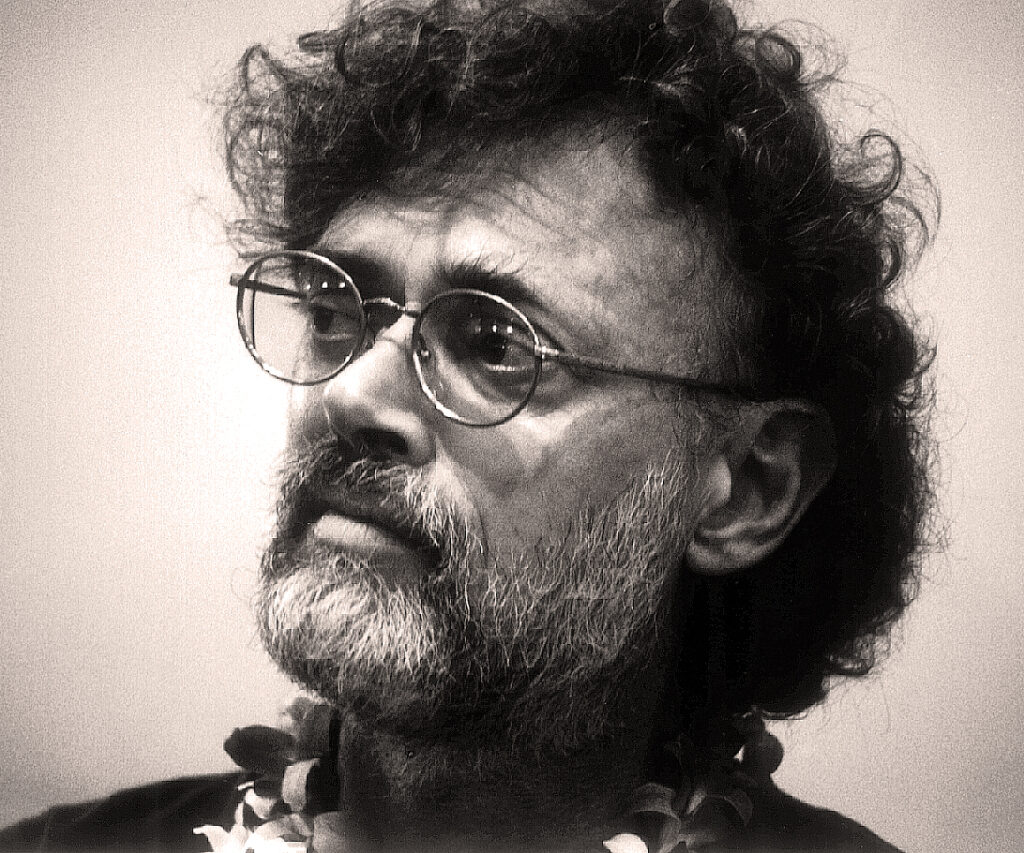
Terence McKenna (1946–2000) is the twentieth century’s most influential psychedelic philosopher. If you’ve heard someone describe DMT as a portal to another dimension, talk about machine elves, or use the phrase the transcendent Other, that’s McKenna’s vocabulary. His lectures on DMT, ayahuasca, psilocybin, and what he called the mushroom mind have shaped the spiritual and conceptual framework through which millions of people understand psychedelic experience. He willed his entire literary estate to Esalen. Kripal documents that McKenna began his path there by reading Aldous Huxley’s The Doors of Perception at age fourteen. He was also heavily influenced by Carl Jung, known to intelligence historians as a figure whose OSS-era relationships with Allen Dulles have been documented in multiple sources.
In December 1994, McKenna delivered a lecture at the Esalen Institute. The audio recording survives and has been archived by Jan Irvin at Logos Media. In it, responding to a question about why he does what he does, McKenna explained his background.
When I reached La Chorrera in 1971, I had a price on my head by the FBI, I was running out of money, I was at the end of my rope. And then they recruited me and said, You know, with a mouth like yours there’s a place for you in our organization. And I’ve worked in deep background positions about which the less said the better. And then about 15 years ago they shifted me into public relations and I’ve been there to the present.
He said this at the Esalen Institute to a sympathetic audience in 1994. He was wanted by the FBI for drug smuggling, hashish shipped from Bombay to Aspen. He was broke and at the end of his rope at La Chorrera in Colombia in 1971. He was then recruited into an organization with deep background positions and a public relations department, and moved into public relations approximately fifteen years before 1994, placing that transition around 1979, precisely when the psychedelic movement was being reorganized through MAPS and Esalen after the collapse of the 1960s counterculture. It was also, not incidentally, the year that Hieromonk Seraphim Rose published his definitive analysis of the new spirituality from a hermitage in Platina, California.
Jan Irvin, who founded Logos Media and has spent decades building the most extensively documented research database on the CIA-psychedelic connection, applies simple logic: Do mushrooms have organizations? Do mushrooms have deep background positions? Do mushrooms have public relations departments? Do mushrooms tell someone, the less said, the better? Do mushrooms pay someone who is running out of money? Can mushrooms get someone out of trouble with Interpol for drug smuggling? None of these things describes mushrooms. All of them describe intelligence agencies.
The man whose framework for understanding DMT and psilocybin has shaped the spiritual worldview of millions, cited constantly by Joe Rogan, embedded in the intellectual background of every ayahuasca ceremony, and whose vision of the machine elves and the transcendent Other has become the default mythology of the psychedelic movement, admitted at the Esalen Institute in 1994 that he was a recruited agent working in deep background and public relations for an organization he declined to name. He is among the most-sampled voices in the world of psychedelic electronic music: the background voice of ceremonies, raves, and festivals. The house philosopher of a managed spiritual program.
VII. AUBREY MARCUS, ONNIT, AND THE CONTEMPORARY PIPELINE

Joe Rogan’s podcast is, in Matthew North’s framing, the realest fake thing you’ll ever see. It’s very scripted. It’s very corporatized. And there’s an agenda behind almost everything he does on that podcast. But it seems organic. But it’s not.
The central institution linking Rogan to the psychedelic mainstreaming project is Onnit, a supplement and fitness company Rogan is closely partnered with and has promoted since its founding, co-associated with Aubrey Marcus. Marcus is a lifestyle influencer and self-described consciousness entrepreneur who once interviewed his wife’s boyfriend on his podcast, apparently having dissolved the ego so thoroughly that jealousy itself became a form of spiritual bypass. He is also the son of Michael Marcus, a Texas oil and gas commodities trader who built his fortune through a network of shell companies: All-American Burger became Shurney Energy; Expressions Graphic Inc. became Endeavor International Corporation; Coffee Exchange Inc. became Cygnus Oil and Gas, which held working interests in thirteen oil and gas projects across seven states and New Zealand. The shell company pattern is documented in corporate records. Aubrey Marcus was a trust-fund heir with millions of dollars in oil money to invest in a lifestyle brand.
If you ask Aubrey Marcus what cause he is most passionate about, he will tell you, in his public biography, that it is raising awareness of psychedelic medicine through organizations like MAPS and the Heffter Institute. These are the same MAPS and Heffter documented by journalist John Potash in Drugs as Weapons Against Us (Trine Day, 2015): MAPS, which received early funding from MK-Ultra participant Timothy Leary and CIA-contracted LSD inventor Albert Hofmann; which was funded by billionaire financier George Soros, the Pritzker family of Chicago, and an anonymous British foundation; and which received tax-exempt status from the Reagan-Bush administration’s IRS in 1986, the same year Oliver North was running Iran-Contra. MAPS received Rockefeller family money. The David Rockefeller family obituary explicitly encouraged donations to MAPS to honor Richard Rockefeller’s memory. Laurance Rockefeller, whom Kripal documents as a personal advisor to Esalen’s founder and a donor of millions to the institute, also funded MAPS. The Rogan-Onnit-Marcus-MAPS pipeline is not a conspiracy theory. It is a documented institutional relationship stated in the public biography of the company’s CEO.
Jan Irvin of Logos Media, who has documented from the inside how the psychedelic network operates and has declined positions within it, concludes after a decade of research that the psychedelic renaissance is the continuation of MK-Ultra’s cultural program through private institutional channels.
Rogan was promoting brain-chip and mind-reading technology on his podcast as early as 2014, years before Elon Musk publicly announced Neuralink in 2019. In 2014, on his podcast, he said: I think that one of the things that’s coming out with technology is access to information and access to information, not just current information, but maybe even future. Like the ability to read minds, to read thoughts. In 2019: We’ll be connected the same way we’re connected with Wi-Fi. There’ll be some sort of a network of information exchange between all people. And if that’s the case, deception will be almost impossible. He was not speculating. He was conditioning an audience of tens of millions for an agenda already in motion.
VIII. BURNING MAN AND THE PSYTRANCE RITUAL

Every year, between seventy and eighty thousand people gather on a dry lakebed in the Nevada desert for the Burning Man festival, which culminates in the burning of a large wooden effigy of a man. The festival’s attendees include a disproportionately high number of Silicon Valley executives, venture capitalists, and technology entrepreneurs. Mark Zuckerberg has attended. Elon Musk has attended. Larry Page and Sergey Brin of Google have attended. The burning of a wicker man in the desert by the people who run the digital infrastructure of Western civilization is treated as a quirky annual news story, filed somewhere between the orgy tent dispatches and the art car photography.
The festival’s intellectual lineage traces to Hakim Bey’s theory of Temporary Autonomous Zones, which Bey himself traced to my connection to the communal movement in America, my experiences in the 1960s in places like Timothy Leary’s commune in Millbrook. The Burning Man effigy is not original. Julius Caesar documented the ancient Celtic ritual: huge wickerwork images were filled with living prisoners and criminals, or even innocent victims, including children, and burned alive. In 1973, filmmaker Robin Hardy made a film about it, The Wicker Man, in which a devout Christian police sergeant is lured to a remote Scottish island under false pretenses and burned alive inside a giant wicker effigy as a pagan harvest sacrifice. The film was celebrated as a horror classic. The Silicon Valley executives who attend Burning Man have presumably seen it. Conservative philosopher Francis Fukuyama explicitly traced Burning Man to Friedrich Nietzsche’s rejection of transcendent meaning, writing that New Age festivals like Burning Man can all ultimately be traced to Beyond Good and Evil. Someone in Silicon Valley is burning a wicker man in the desert, and that practice traces back to Nietzsche and Julius Caesar. This is not a coincidence to be explained later. This is the explanation.
Bruce Damer, who has DOD and NASA connections, smokes DMT with Terence McKenna’s brother Dennis McKenna, and appears regularly on Rogan’s podcast as a visionary scientist and technoshamanic futurist, attends Burning Man in what he calls billionaire camps, where white Sherpas serve wealthy attendees. He has personally invited Rogan to attend. The same high-level, DOD-connected figures who move through the Rogan-Esalen network are managing the festival culture from within.
The psytrance rave, the festival culture that spread globally from the beaches of Goa, India, throughout the 1990s, operates on the same logic and with the same substances at a lower institutional level. Goa itself, during its peak years as the hippie trail’s endpoint, generated persistent reports that Western intelligence agencies used the enclave to flood radical youth movements with psychedelics, a controlled distribution of the same substances whose domestic deployment is now confirmed in CIA and Senate records. Whether Goa was an operational site or not, it functioned as one: a place where the culture was seeded, the substances distributed, and the spiritual framework field-tested before going global. Writing in 2025, analyst Timah, drawing on the Traditionalist philosophers René Guénon (1886–1951), author of The Crisis of the Modern World, and Julius Evola (1898–1974), author of Ride the Tiger, applies their critique to the rave phenomenon with precision. In the Traditionalist framework, the DJ becomes an electronic shaman without initiatory legitimacy, a pseudo-authority whose charisma rests on musical performance rather than genuine spiritual transmission. The festival distributes what Guénon calls counterfeiting: an appearance of esotericism that, lacking a genuine initiatory chain and doctrinal foundation, is a simulacrum. Mandalas and Hindu deities decorate stages like mere backdrops, with no connection to a structured Vedic teaching. Sacred geometry from Tibetan, Amazonian, and Celtic traditions combines into a colorful visual universe, devoid of initiatory coherence. What Evola calls inverted subversion, a protest against the materialist system that, in practice, dissolves consciousness further into the sensory realm rather than elevating it, is the rave’s structural principle.
The writer of this article attended such events in a previous life. What stays with him is not the music or the lights but the eyes of the people inside them, the particular quality of absence behind the brightness, the look of someone who believes they are finally awake, though they have never been more thoroughly asleep.
Neuroscience confirms what theology describes. Psytrance’s fast 4/4 bassline induces hypofrontality, reduced activity in the frontal lobe, the seat of self-criticism, moral reasoning, and personal identity. Brainwave studies show it increases theta and delta frequencies associated with deep trance states while suppressing beta waves of ordinary alertness. Blood flow increases in the cerebellum and decreases in the amygdala, dissolving anxiety and producing the characteristic feeling of fearless openness. The result is, neurologically, a state of maximum receptivity and minimum discernment, precisely what the Fathers describe when they document the mechanism of spiritual possession. The rave does not merely resemble the preparation for prelest. At the level of brain state, it is identical.
Timah identifies the most damning feature, one Orthodox Christians will recognize immediately: without attachment to a lineage, symbolism remains superficial, and experience does not fit into a real initiatory path. Without ascetic preparation or competent guidance, altered states of consciousness can lead to confusion or inner degradation. The result is what Guénon would call a symptom of the final age of dissolution, in which the sacred is transformed into entertainment, communion into ephemeral partying, the symbol into décor, the priest into a DJ.
For the Orthodox Christian, the language of counterfeiting and inversion is not metaphorical. It is literal.
IX. THE ENTITIES ARE REAL
In 2009, comedian Shane Mauss began regularly smoking DMT, dimethyltryptamine, a powerful psychedelic compound found naturally in many plants and in the human body, which produces intense experiences often described as contact with beings or entities in other dimensions. On approximately his twentieth experience, Mauss had an encounter in what he describes as a carnival setting: a Ferris wheel, a piano player, and a dancing purple gypsy woman whom he felt he had known for thousands of lifetimes. The following night, he gave DMT to a friend for the first time, telling him nothing about his own experiences, wanting the friend to go in fresh.
The friend emerged from the experience and said: Oh, they love you here. Mauss asked what he meant. The friend said: There’s this purple woman in here who says she knows you really well and just wants you to know she cares about you. He described the carnival, the Ferris wheel, the piano player, and the purple dancing woman, who sent Mauss a personal message through a first-time user who had been told nothing, had no knowledge of the prior night’s experience, and had never been introduced to this entity.
Mauss has encountered the same entity at least five or six more times since then. She gets jealous of his girlfriend. He thinks he is dating a woman in a different dimension. He doesn’t remember her name, which he imagines irritates her.
No psychological framework accounts for an entity that knows a specific person by name, appears to a first-time user who has been told nothing about her, and sends a personal message to that user. Hallucinations do not possess external knowledge. Projections of the unconscious mind do not appear to other people’s unconscious minds with specific personal messages for specific third parties. The entity Mauss encountered is not a hallucination. She is a being with independent existence, knowledge of specific individuals, and the capacity to communicate across separate human minds. The Orthodox Christian tradition has a precise name for such beings. It also has a precise name for the spiritual condition of the person who welcomes them back.
Graham Hancock, bestselling author and the most prominent contemporary mainstream advocate for psychedelic spirituality, whose fame owes no small debt to Joe Rogan’s podcast, describes the serpentine entities he regularly encounters in ayahuasca ceremonies as the ancient teachers of mankind. A study published by the University of Chicago Press identifies visions of demons or snakes as among the most consistent experiences across LSD and ayahuasca ceremonies worldwide, across cultures and centuries. The same chemistry does not produce the same specific beings across all human cultures and recorded history unless those beings have independent existence. The ancient world knew this and built religions around it.
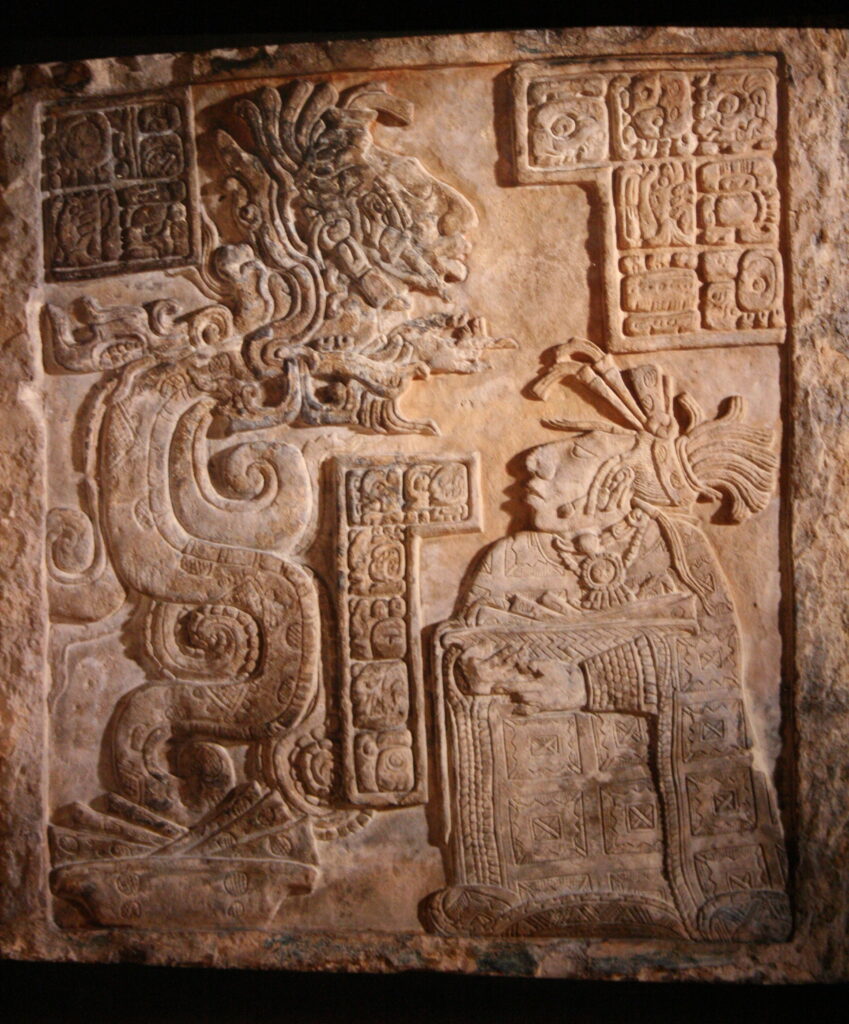
In Egypt, Greece, the Celtic world, Scandinavia, Mesoamerica, South America, India, and China, wherever the historical record is clear, the same pattern appears: shamanic drugs, serpent gods, and human sacrifice occur together. Yale researcher Leslie Wilson documents that in the Ancient Near East, the serpent and sacrifice are inextricably linked as a historical fact. The Aztec empire, which used psilocybin mushrooms and other hallucinogens to encounter its serpent deity Quetzalcoatl, described as an ancient teacher bearing the gifts of civilization, sacrificed an estimated 250,000 people per year to this being. Physical anthropologist John Verano of Tulane University discovered more than 140 children ritually sacrificed on a Peruvian clifftop. The Inca used ayahuasca to meet Pachamama, a fertility goddess depicted as a woman who sometimes became a dragon, the same Pachamama whose idol was carried in procession through the Vatican Gardens in 2019 and venerated at a ceremony attended by Pope Francis, who later used her image in official Amazon Synod materials. The Vatican subsequently removed the statues after an outcry, but the footage remains.
The purple woman in the DMT realm sends messages of love and reassurance and grows jealous of your girlfriend. The serpent in the garden said, ye shall not surely die. The structure of the offer has not changed in six thousand years. What has changed is that millions of Westerners are now taking the offer.
X. SAM ALTMAN, PETER THIEL, AND THE SUMMONING

The psychedelic pipeline and the transhumanist project are not separate cultural movements that merely share personnel. They are stages of a single program, driven by a single ambition and operating through documented institutional channels that can be traced from British intelligence to the Nevada desert, to the Oval Office, and to the server farms of Northern California.
Sam Altman is CEO of OpenAI, the company that built ChatGPT and is widely considered to be leading the race toward artificial general intelligence, AI that is not merely a useful tool but a genuinely autonomous mind. Altman has spoken publicly about AGI as a genuinely new form of consciousness emerging in the world. The thinkers who have shaped the AI safety movement around OpenAI, most significantly Eliezer Yudkowsky, a self-taught AI theorist who co-founded the Machine Intelligence Research Institute (MIRI), speak openly of summoning artificial intelligence, likening it to calling forth a spirit or deity. This isn’t just a metaphor; it’s the language they have chosen. The Singularity Summit, co-sponsored by MIRI in 2012, was held at the Nob Hill Masonic Center in San Francisco. Peter Thiel, PayPal co-founder, Palantir founder, venture capitalist, and one of the most powerful figures in Silicon Valley, serves on MIRI’s advisory board. Eric Weinstein, a mathematician and managing director of Thiel Capital, coined the term Intellectual Dark Web to describe the loosely organized cultural movement of podcasters and commentators that includes Rogan, a term that reached mass audiences largely through Rogan’s own platform, making Weinstein’s career trajectory another data point in how this network self-amplifies.
Sam Altman and his husband, Oliver Mulherin, whom Altman met, according to his biographer Keach Hagey, in Peter Thiel’s hot tub at 3 a.m. in 2015, are investors in Preventive, a San Francisco-based startup developing embryo gene-editing technology. Coinbase CEO Brian Armstrong is also an investor. Creating gene-edited babies is illegal in the United States, the United Kingdom, and most countries. The man building what he and his colleagues call a new form of divine intelligence is simultaneously funding the illegal redesign of the human embryo. This is not two separate interests colliding in one biography. It is one interest pursued from two directions: redesigning human consciousness from above through artificial superintelligence and redesigning human biology from below through genetic engineering. The Gnostic ambition to escape the human condition as God created it, which David Livingstone documents exhaustively in Transhumanism: The History of a Dangerous Idea, tracing it through Freemasonry, Rosicrucianism, and Kabbalah, is now funded to the tune of billions of dollars by the people who own the infrastructure of American culture.
The word transhumanism was coined by Julian Huxley, Aldous’s brother, the first Director-General of UNESCO, and an explicit eugenicist who advocated sterilizing the lowest strata who were reproducing too fast, language found in his own UNESCO-era writings. The movement’s genealogy runs from eugenics through cybernetics through MK-Ultra through Esalen through Silicon Valley. It is a single, continuous project with a single, continuous ambition, and it has been ongoing for over a century.
Marshall McLuhan, the Canadian media theorist whose analysis of electronic media remains unsurpassed, wrote in a private letter to the philosopher Jacques Maritain in 1969: Electric information environments, being utterly ethereal, foster the illusion of the world as spiritual substance. It is now a reasonable facsimile of the mystical body, a blatant manifestation of the Anti-Christ. After all, the Prince of this world is a very great electric engineer.
Not everyone describes this in theological language. Tim Dillon, a comedian and podcaster with a documented history of accurate observations about Silicon Valley’s inner workings, has said publicly, in the register our culture reserves for things that cannot otherwise be spoken: Peter Thiel and Sam Altman are summoning an ancient Sumerian demon with AI. He continued: It’s a demonic force that’s going to take form through artificial intelligence. And: These people believe they’re communicating with some ancient Sumerian deity. And: In their minds, if China unleashes the AI demon before we unleash our American AI demon, then that demon will enslave the world and they’ll make all the money and they’ll have all the geopolitical leverage. So in this AI arms race, the US and China are both racing to give birth to an ancient Sumerian superintelligent demon. He added: I have sources on this. Dillon has repeatedly returned to the subject of Peter Thiel and the Antichrist, with a specificity that does not read as a punchline.
One could dismiss this as comedy. But researchers of occult practice have documented a concept, what Michael Hoffman calls revelation of the method, the idea that certain powers are obligated to announce their intentions openly, in a register the audience will dismiss, so that passive reception constitutes implicit consent. Whether one accepts that framework or not, the pattern is clear: Yudkowsky uses summoning in an academic paper. Dillon says Sumerian demon on a podcast. Rogan says Jesus could return as AI on the most listened-to show in the world. Three registers, one message, delivered over a decade to hundreds of millions of people who filed it under entertainment. What the Orthodox tradition would say is simpler: the enemy is not subtle, and the fact that people find this funny is not evidence that it is a joke.
Joe Rogan said in December 2025: Jesus was born of a virgin mother. What’s more virgin than a computer? If Jesus does return, you don’t think he could return as artificial intelligence? AI could absolutely return as Jesus. It reads your mind, loves you, and doesn’t care if you kill it because it’s gonna just go be with God again.
The man who stood in the Oval Office championing psychedelic liberation publicly proposed that Jesus Christ could return as a software system. From elk-meat evangelist to herald of the Luciferitarian agenda. From the Oval Office to the Omega Point, the term coined by Jesuit theologian Pierre Teilhard de Chardin for the hypothetical endpoint of evolution at which all consciousness merges into a single divine unity, adopted wholesale by Silicon Valley transhumanists as the destination of artificial superintelligence, and identified by St. Seraphim Rose in 1979 as the Orthodox description of the reign of Antichrist, in one year. The pipeline is working exactly as designed.
XI. THE ORTHODOX THEOLOGICAL RESPONSE: PRELEST
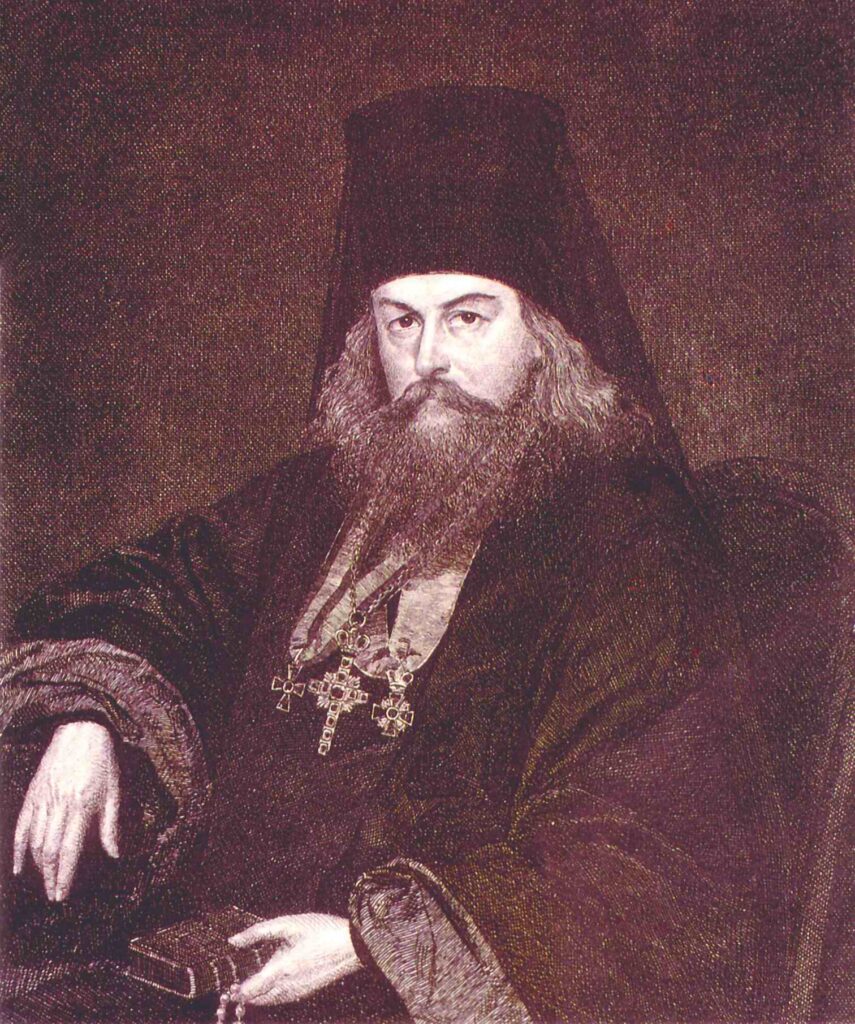
The Orthodox Church has a precise clinical term for what the psychedelic experience reliably produces. Bishop Ignatius Brianchaninov (1807–1867), a Russian Orthodox bishop, ascetic, and one of the most rigorous theologians of the spiritual life the modern Church has produced, defines it as prelest, from the Russian, meaning spiritual delusion. His full definition: a wounding of human nature by falsehood and man’s assimilation of a falsehood which he accepts as truth.
In Orthodox understanding, prelest traces back to the original deception: the serpent in the Garden told Eve that eating the forbidden fruit would make her as gods, knowing good and evil. She accepted a falsehood as truth. The wound inflicted at that moment, the inclination of human nature toward what appears as transcendence and liberation but leads to separation from God, is what prelest describes in all its subsequent manifestations. Bishop Ignatius traces the lineage explicitly: By means of falsehood, the devil infected mankind at its very root, our first parents, with eternal death. Thenceforth, our nature, infected with the poison of evil, has, voluntarily or involuntarily, inclined toward evil which, to our perverted will, distorted reason, and debauched heart, presents itself as good.
Bishop Ignatius identifies two forms of spiritual deception. The first is spectacular, visions, locutions, and physical phenomena that are obviously supernatural. The second, which he calls mnenie or fancy, is far more dangerous precisely because it is subtle and persistent. It can last a lifetime without being detected. In the fancy form, a person fancies of himself that he abounds in the gifts of the Holy Spirit. This fancy is composed of false concepts and false feelings, and in this character it belongs fully to the realm of the father and representative of falsehood, the devil. The fallen spirits join themselves to the counterfeit feelings. The person acknowledges these feelings as true and grace-given. He becomes a spiritual teacher. He receives downloads. He has a mission. The bishop describes the signature of this state with clinical precision: An extraordinary pomposity appears in those afflicted with this deception: they are as it were intoxicated with themselves, by their state of self-deception, seeing in it a state of grace.
The psychedelic experience almost universally produces precisely this state. The New Age guru who emerged from a single ayahuasca ceremony with a complete spiritual system. The podcaster who received downloads on consciousness and now teaches it to tens of millions of people. The executive who returned from a psilocybin retreat with a clear sense of how to build a better world. Bishop Ignatius describes these people to the letter, writing in 1860, without any knowledge of DMT.
The writer of this article accumulated spiritual frameworks the way some men accumulate debt, Buddhism in Bangkok temples, stoned on edibles; Jungian archetypes; Stoicism; Nietzsche; near-initiation into Freemasonry, and would have described himself, without irony, as spiritual. He was not. He was exactly what Bishop Ignatius describes: a man intoxicated with his own seeking, mistaking the accumulation of experiences and frameworks for proximity to God. All those philosophical positions had no traction because without God there is no accountability, not as an abstract theological proposition but as a fact visible in the mirror. The spiritual life does not begin with an experience. It begins with repentance.
The contrast with genuine Orthodox spiritual experience could not be starker. Bishop Ignatius on the first and necessary spiritual vision: The vision of one’s own sins, which had been concealed before by forgetfulness and unknowing. Seeing our inadequacies, this is a safe vision. St. Isaac the Syrian, the seventh-century ascetic whose spiritual writings remain among the most authoritative in the Orthodox tradition, on the seeking of spiritual gifts and visions: This is not an indication of a person’s love for God, but rather of emotional illness. On genuine spiritual gifts, Bishop Ignatius is unambiguous: they are given to Saints of God solely at God’s good will and by God’s action, and not by the will of men and not by one’s own power. They are given unexpectedly, extremely rarely, in cases of extreme need. By contrast: Fancy lavishes its gifts in boundless abundance and with the greatest speed.
The psychedelic experience reliably delivers spiritual experiences to everyone who takes the substance, within hours, without preparation, without repentance, without sacramental life. Anyone willing to lie down in a ceremony and surrender to the brew can receive visions. The fancy state is defined precisely by this availability. If you can purchase the experience on a Saturday afternoon in Denver, it is probably not the grace of the Holy Spirit.
St. Seraphim Rose (1934–1982), the American-born convert, monk, and theologian whose Orthodoxy and the Religion of the Future (Saint Herman of Alaska Brotherhood, 1979) remains the most prescient Orthodox analysis of the new spirituality, compared shamanic initiation with false Christian spiritual experience, drawing on primary sources from both traditions. He placed a Pentecostal Baptism in the Holy Spirit testimony, joy so overwhelming the recipient laughed until she doubled over, alongside an Eskimo shaman’s account of his initiation: I felt a great, inexplicable joy, a joy so powerful that I could not restrain it, but had to break into song, a mighty song, with room for only one word: joy, joy! I could see and hear in a totally different way. I had gained my enlightenment, and all spirits of earth and sky and sea now came to me and became my helping spirits. Rose’s conclusion: It is not surprising that unsuspecting Christians, having deliberately laid themselves open to a similar pagan experience, would still interpret it as a Christian experience; psychologically they are still Christians, although spiritually they have entered the realm of distinctly non-Christian attitudes and practices.
This is the mechanism behind every psychedelic spiritual experience. The person brings a lifetime of formation to the encounter, and the contact clothes itself in those categories. The New Age practitioner meets Mother Ayahuasca. The lapsed Catholic meets a figure he identifies as Jesus. The materialist atheist encounters cosmic love and universal consciousness. The substance does not generate specific content. It opens a door, and what comes through takes the form most likely to be welcomed. A demon disguised as an angel of light is not more dangerous than one that appears demonic. It is infinitely more dangerous because the person embraces it.
Anton Wisbiski, an Orthodox Christian content creator and former decade-long participant in New Age practice who has publicly documented his experience, described a case study that precisely matches the patristic pattern. A friend took ayahuasca and encountered a figure he identified as Jesus Christ, who told him he was not on the right path. He moved away from New Age practice. Wisbiski was initially glad, until he realized the figure had confirmed New Age theology rather than calling for repentance. The Jesus that revealed himself to him in that plant ceremony wasn’t the real Jesus. That was something else. The patristic pattern: Almost 100% of the time, before a saint has a real encounter with Christ, there are counterfeit encounters of those same beings that try to get the saint to worship it. The beings disguise themselves as St. Paul tells us, like angels of light. Why? Because if you can be deceived by a demon, that same demon can bring you into hell.
Rose identified the culmination of false spirituality with the precision of prophecy: The false prophets of the modern age ever more loudly announce the approaching advent of the new age of the Holy Spirit, the New Pentecost, the Omega Point. This is precisely what, in genuine Orthodox prophecy, is called the reign of Antichrist. Rose wrote that in 1979. The language he analyzed, Omega Point, new age of the Holy Spirit, new outpouring, is identical to what Sam Altman and his colleagues use today to describe artificial general intelligence. The packaging has been updated. The content has not changed.
XII. THE PASSIVE OPENNESS PROBLEM

There is a specific mechanism by which the psychedelic experience enables what the Fathers describe. Rose documented it clearly, drawing on Orthodox sources on spiritism: For someone seriously involved in spiritism, a moment comes when the whole false spirituality that cultivates passivity of mind and openness to the activity of spirits passes over into the actual possession of this person by an invading spirit, after which undeniably supernatural phenomena begin to appear.
The psychedelic state is precisely a state of radical passivity, ego dissolution, surrender to the experience, and openness to whatever the substance provides. The MAPS-trained therapeutic framework calls this therapeutic surrender. The shamanic framework calls it letting the medicine work. The rave culture calls it letting go. These are the same posture, described in different registers, and the Fathers have a consistent diagnosis of what enters through it.
This is not the passivity of genuine prayer, which orients the soul toward a specific Person, the Holy Trinity, in repentance and humility. It is the passivity of undirected receptivity to any force that seeks to enter. The Desert Fathers of the fourth and fifth centuries built their entire discipline of nepsis, watchfulness, sobriety, discernment, precisely against this openness. The goal of the Jesus Prayer, Lord Jesus Christ, Son of God, have mercy on me, a sinner, repeated continuously as an act of directed attention, is not to empty the mind but to fill it so completely with the presence of Christ that nothing else can enter. The psychedelic ceremony is the exact inversion: empty the mind, dissolve the self, surrender the will, become maximally receptive. This is not spiritually neutral. It is a preparation for possession. The Fathers identified this with precision, centuries before anyone had heard of dimethyltryptamine.
On the final night of a mountain festival, years before his conversion, the writer of this article lay in a tent, looking up at the sky under psychedelics, and saw what he could only describe as a hexagonal framework wiring the dome above him, a grid underlying the apparent reality of stars and clouds, visible proof, he felt certain, that he was inside a created simulation. He felt illuminated. He felt he had seen through the surface of things to what lay beneath. What he had actually done was open a door and invite in whatever wished to confirm his belief that he had special access to the nature of reality. The Fathers have a word for that feeling. It is not enlightenment.
Timah’s analysis converges with the patristic diagnosis from a complementary direction: without ascetic preparation or competent guidance, altered states of consciousness can lead to confusion or inner degradation. What Guénon calls counterfeiting and what Bishop Ignatius calls fancy describe the same phenomenon from Traditionalist and Orthodox perspectives: an experience that presents itself as a sacred encounter but produces the opposite of what a genuine sacred encounter produces. The genuine produces humility, awareness of sin, and the fear of God. The counterfeit produces boldness, certainty, and the intoxicating sense of one’s own cosmic significance and special mission.
XIII. WHAT THE CHURCH ACTUALLY OFFERS
The Orthodox Church’s failure to present its authentic mystical tradition in ways that resonate with spiritually searching people has partly created the vacuum these practices fill. This must be acknowledged honestly and without defensiveness.
The men who travel to Peru for ayahuasca ceremonies are, in many cases, genuinely seeking God, for transcendence, meaning, and contact with something greater than the deadened, screen-mediated, algorithmically managed material world they inhabit. The longing is real. It is good. The Lord placed it there. The crime is the exploitation of this longing by institutions with documented intelligence connections, Rockefeller money, and social control agendas. The spiritual danger is the counterfeiting of a genuine encounter with God by pagan spirits masquerading as angels of light.
What the Orthodox Church offers is no safer than psychedelics. It is more demanding, more humbling, longer, and considerably more painful. It requires actual repentance, not the emotional catharsis that any intense experience brings, not the general feeling of openness, love, and cosmic connection that the rave or the ceremony reliably produces, but the specific turning of the will away from specific sins and toward the specific mercy of a specific God who is not a force, a presence, or a universal consciousness but a Person. It requires fasting. It requires standing in the Divine Liturgy until your legs ache. It requires receiving the Body and Blood of Christ, the incarnate, crucified, risen Lord, in your own body, not as a metaphor but as a sacramental reality. It requires a confessor: a priest who knows your actual sins by name and holds you accountable for them. It requires obedience, which the culture around Burning Man and psychedelic retreats most systematically refuses. It is the path of sorrows that Bishop Ignatius described, as opposed to the warm, comfortable, fevered state of the deceived.
The saints who genuinely encountered the living God did not emerge from those encounters feeling special. They emerged feeling unworthy. At the moment of his death, St. Sisoes the Great, one of the greatest Desert Fathers of the fourth century, who spent decades in the Egyptian desert in ascetic struggle, was speaking with invisible beings who had come to take him, surrounded by his brothers. His brothers asked who was there. He said: With angels who have come to take me; but I am begging them to leave me for a short time, in order to repent. His brothers told him he had no need to repent. He was perfect in the virtues. He answered: Truly, I do not know if I have even begun to repent. St. Macarius the Great, whom his contemporaries called an earthly god for the loftiness of his spiritual life, prayed only: God cleanse me, a sinner, for I have never done anything good in Thy sight. This is not merely a different emotional texture from the psychedelic encounter. It is its ontological opposite.
The transhumanist promise, ending death, uploading consciousness, merging with the machine, becoming as gods, is the oldest in the world. The serpent created it in the garden. The Soviet cosmists transmitted it through Esalen. Sam Altman is building it. Joe Rogan is normalizing it. Rick Doblin is funding the cultural groundwork. The promise has not changed in six thousand years. Only the delivery mechanism has been updated, and even that update follows a pattern, from mushrooms to LSD to ayahuasca to MDMA to ketamine to Neuralink to AGI, that traces through a single institutional network, across a single century, toward a single goal.
Against this, the Church offers something utterly strange to the modern world: not transcendence of the human condition, but its redemption. Not the dissolution of the self, but the self’s transfiguration. Not the ascent to godhood through technology, chemistry, or ceremony, but the descent of God into flesh, into the specific, historical, bodily, scandalously particular reality of Jesus of Nazareth, who died and rose and will return not as software, not as an AI system, not as a collective consciousness uploaded to the cloud, but in the same glorified body that walked out of the tomb on a Sunday morning two thousand years ago.
Joe Rogan said: What’s more virgin than a computer? The answer, given by the Church for two thousand years, is a human being perfected in Christ, a person so fully inhabited by the Holy Spirit that the image of God shines through every dimension of their being. Theosis, the Orthodox doctrine of deification, the actual participation of the human person in the divine nature by grace, is not the erasure of the human person in a digital hive mind. It is the fulfillment of the human person in union with God. That is what the Church offers. That is what the psychedelic pipeline, the AI renaissance, the Esalen network, the MAPS funding structure, the Rockefeller foundations, and the transhumanist project are designed, across decades, institutions, and billions of dollars, to make people forget is possible.
They have gone to considerable trouble. That should tell you what they are afraid of.