I want to start with a date.
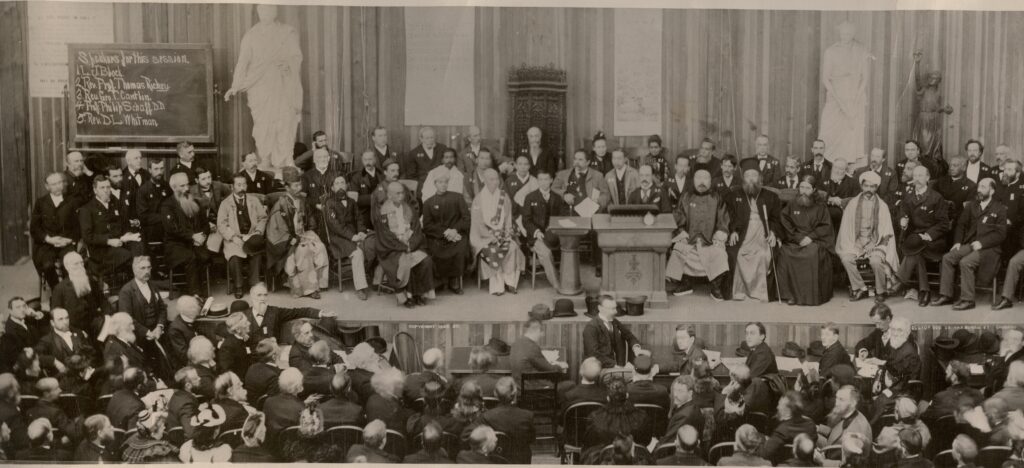
September 11, 1893. Chicago. A curious date, if there ever was one. The Parliament of World Religions opens at the Memorial Art Palace, the first major interfaith gathering to bring Eastern and Western religions together on the same stage. Seven thousand people fill the Hall of Columbus. The presiding officer, Charles Carroll Bonney, a Swedenborgian lawyer and civic reformer, the man who spent thirty years designing this moment, steps to the podium and delivers three words that read like the shortest sentence in the history of religious conquest: The day arrived.
Among the attendees was an Antiochian archimandrite, Fr. Christopher Jabara, one of the first Orthodox priests in America, fresh from New York and bearing credentials from the Patriarch of Antioch. By the time he left Chicago, he told newspaper reporters that the Gospels and the Koran were essentially one, that a committee of representatives from the world’s great religions should investigate all dogmas and announce the correct one to humanity, and that Americans must show the world a new religion in which all hearts may find rest. He also helpfully noted that once Christians abandoned the doctrine of the Trinity, nothing would stand between Christianity, Islam, and Judaism. From the podium, Jabara announced that Columbus discovered America for the oppressed. Americans must now discover a universal religion for all mankind.
He returned to New York to find his congregation had changed the locks on the chapel door. They had read the newspaper and were finished with him. He eventually drifted to Egypt, trying to persuade Christians to abandon the Trinity so they could unite with Muslims and Jews. Some doors, once opened, don’t close easily.
Not everyone in that room was so enthusiastic. The Russian Orthodox bishop of Alaska, Nicholas Ziorov, arrived on opening day, met briefly with delegates, expressed deep regret that his church duties called him away, and was conspicuously absent from every subsequent session. He looked at what was being assembled, then left and did not return.
One Orthodox priest saw the Parliament and lost his theology. One Orthodox bishop saw the Parliament and walked out. What the Parliament was capable of doing to a man who engaged with it uncritically, and what discernment looked like for those who sought it, both are documented from 1893. The project that those two men were responding to is still running and has only grown larger.
Then Vivekananda walked to the lectern.
A Hindu monk named Narendranath Datta, known to his followers as Swami Vivekananda, addressed the crowd as Sisters and Brothers of America. The standing ovation lasted two minutes. He had been in the country for six weeks. He arrived with a mission he had described to his Indian audiences before departing in terms that should make any Christian’s blood run cold: Up, India, and conquer the world with your spirituality. Spirituality must conquer the West. A war cry that has now produced forty million yoga-pant-wearing Americans invoking the demonic Kali, whether they know it or not, paying sixty-five dollars a month to be spiritually robbed in climate-controlled studios by an industry worth sixteen billion dollars annually.
Nobody in the Hall of Columbus heard that speech. They heard the one meant for the masses.
What Vivekananda showed the West that day, as he established Vedanta Societies across America, as Harvard philosophers sat at his feet, as high society, already half-seduced by Schopenhauer’s flirtation with Eastern mysticism, lionized him as a conquering hero of the spirit, was yoga, seen from certain angles, in soft, radiant light. His historian, Stefanie Syman, documents it plainly: such subtractions and elisions continue to this day. He showed them universal tolerance. Science and reason. A spiritual technology for the modern age. He did not mention Kali. He did not mention Aham Brahmasmi. He did not mention what Hatha yoga was actually designed to do at its core. A serpent, if there ever was one, and we will get to the serpent, because it is the literal center of the whole enterprise.
He had bowed mentally to the goddess Saraswati before he opened his mouth to tell his Indian audiences this. They found it delightful. The Chicago crowd found him electric. Different audiences. Different speeches. Same man, same mission. And that mission, it turns out, was the project of a Master Mason who privately worshipped the goddess of death, transmitted to an audience prepared to receive him by thirty years of Theosophical and Swedenborgian occult conditioning.
This is where yoga entered the West.
I know this territory well. Before I found Orthodoxy, I was on the mat. David Lynch is partly to blame. I idolized him, read that he credited Transcendental Meditation for everything, and signed up. I was in my late twenties, still doing the partying circuit, coming home at noon after weekends that had long since stopped giving me anything. The money from a sales job I’d been good at no longer satisfied. I’d spent years with the 48 Laws of Power in my head, the constant I’m the best affirmations fueling my climb out of poverty, but it had worn thin. I was tired of deceiving people. I wanted something real. Eckhart Tolle handed me The Power of Now on my commute, and I read it, slightly ashamed, hiding the cover from other passengers. A cat waiting outside a mouse hole, when a thought arises, strike at it, stay in the present moment. That was a revelation to me. I had never stopped to look at my own mind. My thoughts were a constant whirlwind. No wonder I chased party after party, substance after substance. These were only fleeting glimpses of the present moment. I was going to rewire my brain naturally, healthily. I was going to be free.
Tolle mentioned Christ. I almost put the book down. But he framed Him as an ascended master on par with Buddha, not as God but as a man of wisdom, and that, I could accept. I’d been burned by Christianity. I saw women in short skirts and knee-high boots leaving the priest’s house not long after my confirmation, too young to fully understand what I was seeing, old enough to know something was wrong. Then every priest in the news was involved in child pornography and abuse. My family was culturally Catholic; I walked out of the Church and into atheism, and that atheism eventually produced the hedonism I was now trying to escape two decades later. Tolle gave me a way back toward something spiritual without requiring me to reenter the institution that had failed. I started TM, twenty minutes daily. I started reading Buddhist philosophy. I felt better. I was more pleasant at the office. My partying began to decrease. I was getting higher on my own supply.
And then I started yoga because that’s what spiritual people do. I found a YouTube instructor named Cassandra and began a ten-minute morning practice, followed by my TM meditation. I was embarrassed by it, the man buns, the pseudospiritual shallowness, the general douchebaggery I associated with the culture. I kept it private, the same way I kept the Tolle book hidden on the train. But I kept doing it.
The pipeline from yoga to everything else opened quietly. The same world that hosted the YouTube yoga tutorials also featured astrology, tarot, and a dozen other divination practices, all presented in the same clean, minimalist aesthetic, the same wellness language, and the same promise of self-discovery. The mat was a doorway, and the corridor beyond it was long. I didn’t see where it led because I was looking at my screen and feeling more limber.
At first, I struggled with OM at the end of sessions. I felt a pit in my stomach at the thought of embracing something with OM in it. I told myself the ego hates spiritual things. Within a month, I was OMing at full volume, clasping my hands and bowing toward my television. I researched OM and found it was said to be the original sound of the universe, the creative word of the cosmos. What I didn’t find, because nobody told me, was whose sound it actually is. That comes later in this article. Meanwhile, my lust became more inflamed rather than less. I was watching more pornography than before, fantasizing more about the women at the office, focusing on the chakra in my loins, and trying to attract women through sheer will. My work began to suffer. My income dropped. I didn’t care, money was just an object. My boss called me in and suggested a two-week vacation. I agreed immediately. I already knew where I was going.
India. That’s where spiritual people go to find themselves.
I never made it there. This was before Christ rescued me. I can’t help but think of all the women who go there searching for themselves and find something very different. India’s rape statistics are not a footnote to its spiritual reputation. They are part of the same spiritual climate. The nation that exports the divine feminine to the West has one of the highest rates of sexual violence against women in the world, and the phenomenon is documented as normalized and systemic rather than incidental. The goddess culture and the violence against women coexist in the same geography and tradition, and that coexistence is not a coincidence. We will return to Kali and what her worship actually demands.
The day arrived. One hundred and thirty years after Chicago, forty million Americans practice yoga. The United Nations celebrates it each summer solstice. Children practice it in public school gymnasiums. Hospital therapists prescribe it to trauma survivors. Protestant churches host it in fellowship halls. In the US Department of Education public hearings documented in Phyllis Schlafly’s Child Abuse in the Classroom (Crossway Books, 1985), parents gave sworn testimony about yoga being taught in schools in the early 1980s: We teach them Yoga to attain peace, harmony, and self-awareness, one teacher explained, with the lights out, children lying on the floor in guided fantasy and breathing exercises. School counselors were telling students that Christianity had served its purpose, but students should now seek other forms of religion, and then suggesting yoga. That was forty years ago. It has only deepened since.
The instinct that sent Bishop Ziorov out the door and made Jabara’s key stop working remains available to Orthodox Christians. St. Paisios of the Holy Mountain looked at all of this and said, Do not do it. Not out of fear, but out of knowledge of exactly what it is. So do we. Let me show you.
The Yoke
Let’s begin with the word itself, because its meaning says it all.
Yoga. From the Sanskrit root yuj, to harness, to bind, to join under a yoke. Aleister Crowley, who spent years in India studying yoga directly from Hindu teachers and incorporated what he learned into his Thelemic magical system, opens his Eight Lectures on Yoga (1939) with the etymology because he considered it foundational: It means Union, from the same Sanskrit root as the Greek word Zeugma, the Latin word jugum, and the English word yoke. From the root yeug, to join.
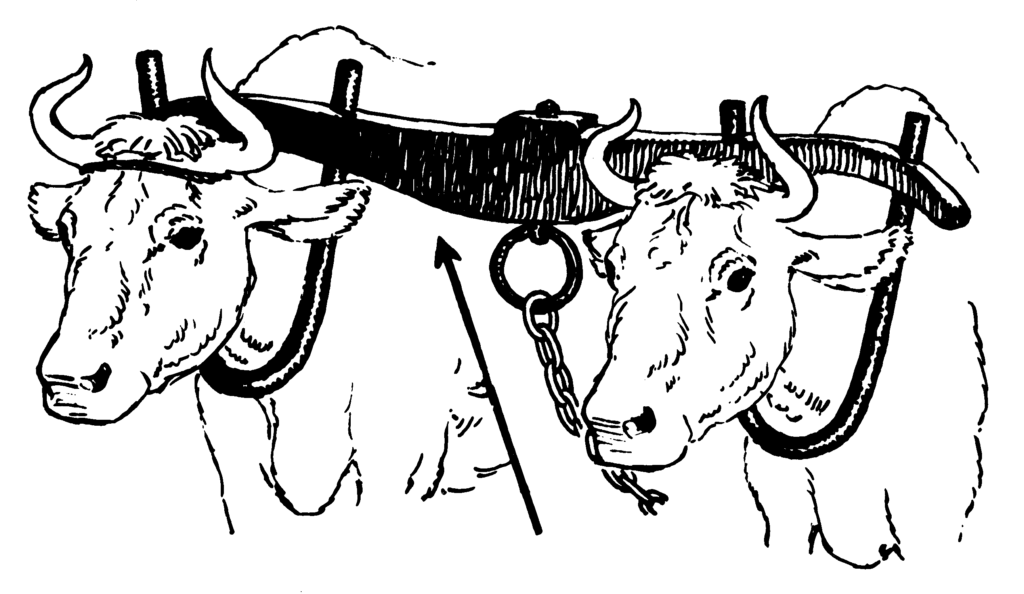
The yoke. The farm implement that harnesses oxen to work. The piece of wood placed on the necks of conquered peoples during Roman triumphs. The mechanism that joins two animals under a common burden and direction, whether they consent or not. Not peace. Not flexibility. Not mindfulness. Not man buns. A binding union that subordinates one to the other.
The question yoga always raises and never honestly answers in its Western packaging: what, exactly, is the practitioner bound to?
The Yoga Sutras of Patanjali, the foundational text of classical yoga, brought to the West by Vivekananda with his own commentary, state the goal in the second sutra. Vivekananda translates it: Yoga is restraining the mind-stuff from taking various forms. The mind is stilled. The individual consciousness, stripped of its contents and characteristics, is freed to recognize its identity with the universal. In Vivekananda’s commentary, in the Monistic form, you say that man is God and goes back to Him again. And: The sooner we get out of this condition which we call ‘man,’ the better for us.
Man is God. The purpose of the practice is to realize this. The sooner you stop being a person, the better.
Not: man bears the image of God and can be restored to a relationship with Him. Not: man is called to theosis, deification through participation in the divine energies, in an eternal personal relationship with the One who made him. Man simply is God. Already. The endpoint of the practice has a Sanskrit name: kaivalya. Patanjali’s own word. It doesn’t mean union. It means isolation, the absolute aloneness of pure consciousness, separated from all matter, all thought, all relationship. The soul resting in itself, alone, having dissolved the individual into the universal. The wellness industry calls this peace. The tradition calls it liberation.
Nicolas Berdyaev, Russian religious philosopher, deeply read in the Fathers and the mystics, writing in 1914 before a single Western yoga studio existed, identified the issue with surgical precision in The Meaning of the Creative Act: yoga, he wrote, is a graceless way upward from below, a way of physical effort rather than of love. He contrasted it with Orthodox Christian mysticism, which is based upon the acquisition of grace, on the presence of Christ at the very beginning of the way, and is permeated with the pathos of love towards God. He saw the formal resemblance between yogic technique and hesychast practice clearly, and then drew the line that matters: Yoga does not know the grace of love, the overflowing love of God’s heart for man and the world. A graceless way upward from below. That’s basically the whole article in six words.
Crowley, who had no interest in making yoga palatable to Christians, confirms the destination without softening it: the goal, he writes, is to fling ourselves up into the furnace of ecstasy which flames from the abyss of annihilation. He is advertising this. He is describing it as the point. According to researcher David Livingstone’s documentation of Crowley’s Book of the Law, the demon Aiwass commands directly: To worship me, take wine and strange drugs whereof I will tell my prophet, and be drunk thereof! They shall not harm ye at all. It is a lie, this folly against the self. Crowley applied yoga techniques systematically as a technology for attaining Samadhi to achieve demonic contact and power. He was not embarrassed by this but proud of it.
Here is what you need to understand about modern postural yoga, the kind practiced in the Protestant fellowship hall, the hospital therapy program, the school gymnasium, and gentrified neighborhoods across the country and the world. Mark Singleton’s Yoga Body (Oxford University Press, 2010) documents what the industry does not advertise: modern postural yoga is not ancient. It was largely invented in the early twentieth century by synthesizing Hindu religious practice with European gymnastic traditions and the YMCA physical culture movement. The Mysore palace gymnasium, the lineage of every major Western yoga style, through Krishnamacharya, who trained Iyengar, Jois, and Desikachar, deliberately stripped the practice of its Tantric origins and repackaged it as hygienic nationalism. As yoga scholar Geoffrey Samuel put it, middle-class Indians found yoga’s historical obsession with sex and magic an embarrassing heritage.
Hugh Urban’s academic study, Tantra: Sex, Secrecy, Politics, and Power in the Study of Religion (University of California Press, 2003), documents the strategy directly: if Hinduism and the Indian nation were to be defended as strong and autonomous, the profound stench of Tantra would have to be deodorized, either by rationalization and purification or by concealment and denial. Urban documents that the two most important figures in this deodorization were Vivekananda and Sir John Woodroffe, a British jurist and pioneering Orientalist.
The metaphysical destination remained unchanged. The poses still invoke Hindu deities. Vivekananda’s commentary on Patanjali’s Sutra II.51 is unambiguous: the result of the Pranayama breathing exercises is Udghata, which awakens the Kundalini. The breathing exercises in every yoga class, marketed as nervous system regulation, are, according to the foundational text and its author’s commentary, a technology for awakening a serpent goddess at the base of the spine.
The wrapper changed. The payload did not. Full integration with the snake.
The Canvas Was Already Primed
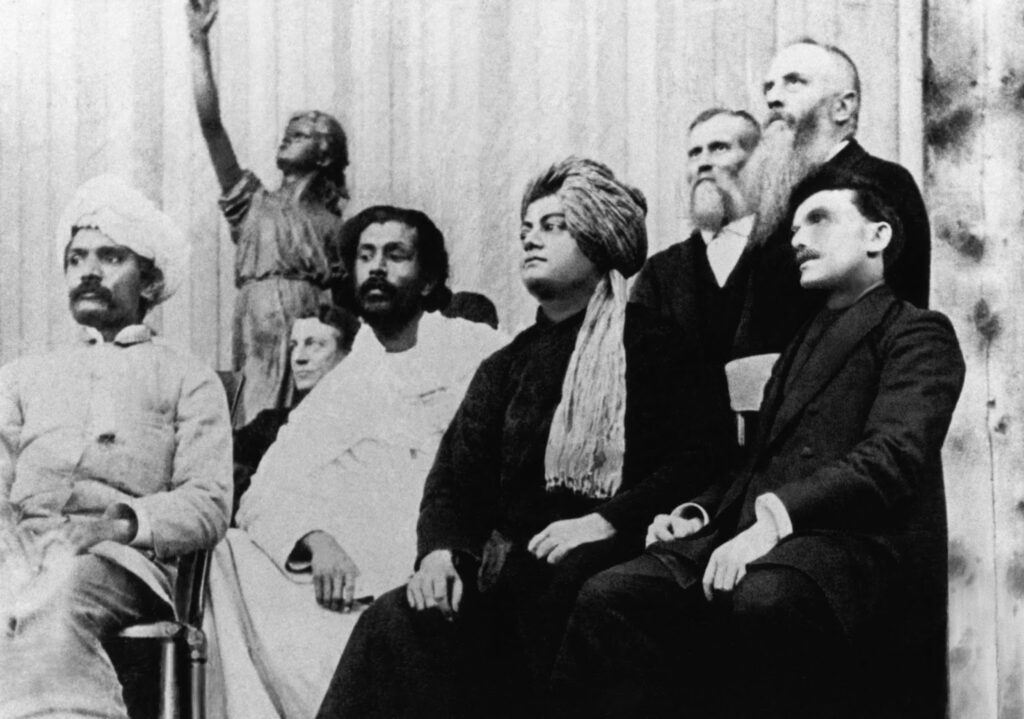
Before Vivekananda arrived at the Parliament in Chicago, someone had been preparing the audience for eighteen years.
Helena Blavatsky cofounded the Theosophical Society with Henry Steel Olcott in 1875. Olcott was a Mason. Blavatsky received a Masonic charter from John Yarker of the Memphis-Misraim rite for her Co-Masonic order. The Theosophical Society was structured as an initiatory society with degrees, explicitly modeled on Freemasonry, and its stated purposes included the formation of a universal brotherhood without distinction of race or religion, the Masonic universal brotherhood formulation. For years before Vivekananda set foot in America, Blavatsky had publicly asserted that Indian Yoga was and is a true science, endorsed and confirmed by thousands of experimental proofs. Western occult culture was ready, and the Theosophists had prepared the reception.
Charles Bonney, the head of the Parliament, drew on Swedenborg’s Divine Providence: every nation that lives according to its religion receives something spiritual into its natural principle. Every sincere seeker travels toward the same divine ground. Albert Pike had articulated the same theology in Morals and Dogma in 1871: It is the universal, eternal, immutable religion, as God planted it in the heart of universal humanity. The Lodge, Swedenborg, and Vedanta were three expressions of one current. Vivekananda walked in and found the presiding officer already agreeing with his central premise.
Vivekananda himself was a Master Mason. On February 19, 1884, Narendranath Datta joined the Anchor and Hope Lodge No. 234 in Calcutta. He was raised to the degree of Master Mason on May 20 of the same year, nine years before the Parliament. This is documented in The Life of Swami Vivekananda by his Eastern and Western disciples, confirmed by the Lodge’s own records and the District Grand Lodge of Bengal’s official history. When he ran short of money in Chicago during his American mission, a Freemason named G.C. Connor provided letters of introduction to Masons across the city who sponsored his continued work. The Brotherhood took care of its own. Spiritual conquest is, after all, a joint venture.
As David Livingstone documents in Transhumanism: The History of a Dangerous Idea (Sabilillah Publications, 2015), Vivekananda was listed by Nevill Drury as the fifth individual who exercised a key influence on the New Age movement, and he was the first to bring Vedanta and yoga to the West in the late nineteenth century. Annie Besant, who assumed leadership of the worldwide Theosophical movement when Blavatsky passed away in 1891, was among those who made a profound impression at the Parliament. The Theosophists held their own congress at the 1893 Parliament, which Bonney listed alongside the Jewish Church, the Catholic Church, and the Methodist Church, equal institutional participants.
The architect of the White City, Daniel Hudson Burnham, whose neoclassical built environment for the World’s Columbian Exposition was so otherworldly that contemporaries called it a vision of the New Jerusalem, sat in Bonney’s own Swedenborgian congregation. The White City drew twenty-seven million visitors and struck Americans as evidence that a new age had begun. Burnham designed it, and Bonney organized the Parliament within it, with Master Mason Vivekananda as the featured speaker.
September 11, 1893. The day had truly arrived. The next notable September 11th is when the Pentagon began construction.
Rabi Maharaj, born into the highest Brahmin caste in Trinidad, son of a father regarded as an avatar, a practicing guru by age thirteen before his conversion to Christianity, watched the same project roll across the West in the 1960s and wrote in 1977 what he understood from the inside: Slowly and with a growing sense of alarm, I became convinced that Satan was masterminding an invasion of the West with Eastern mysticism. I could see that few Christians really understood his plan and were prepared to combat it. He had administered the Shakti pat, the transmission of spiritual energy by touch to the forehead, widely practiced in modern Western yoga lineages, to devotees who came to him as a child. He knew what he was transmitting. Shakti is one of the names given to Kali, he writes, Shiva’s murderous, blood-drinking consort, the mother goddess of power who dispenses the primal force flowing at the heart of the universe. The touch your yoga teacher gives during adjustments. The energy transmitted in the Kundalini lineage. Kali. He was channeling Kali at thirteen and didn’t realize it needed to be questioned until he found Christ.
One hundred and twenty-two years after Chicago, the United Nations celebrated the first International Day of Yoga on June 21, 2015, the summer solstice, chosen because, in the Hindu tradition, it marks the day the god Shiva turned to his disciples and began transmitting yogic science. The UN is the institution whose New York headquarters contains a meditation room with an unsupported magnetic iron ore altar facing an abstract fresco, a room with no cross, no scripture, no image of any recognizable deity, described by its designers as a place of silence where forces beyond our comprehension can be contemplated. That institution now administers a global solstice ceremony dedicated to a practice designed to yoke practitioners to Brahman. Narendra Modi proposed the resolution. His formulation from the General Assembly podium: It is not about exercise but about discovering a sense of oneness with yourself, the world, and nature. Aham Brahmasmi, the Sanskrit phrase for I am the Absolute. Delivered to the world’s governments. Adopted without a vote.
Robert Mueller, a former UN Assistant Secretary General, openly advocated for a one-world religion modeled on the UN. On Hinduism and reincarnation, he stated: Yes, we must join our Hindu brethren and henceforth call our planet Brahma or the Planet of God. On September 28, 1986, the New York Times reported that representatives of some of the nation’s largest corporations, including IBM, AT&T, and General Motors, met in New Mexico to discuss how metaphysics, the occult, and Hindu mysticism might help executives compete in the world marketplace. The spiritual conquest Vivekananda announced from the Chicago lectern was proceeding right on schedule.
A 1983 US Army Intelligence and Security Command document, LTC Wayne McDonnell’s classified assessment of the Monroe Institute’s Gateway program, now declassified via the CIA’s CREST database, independently arrived at a model of consciousness structurally identical to Vedanta. The Monroe Institute used binaural audio technology to induce altered states of consciousness, out-of-body experiences, and remote viewing. McDonnell’s model, written for military commanders, holds that individual consciousness is the differentiated aspect of universal consciousness that resides within the Absolute. The endpoint of expanded consciousness is dissolution into the Absolute. Kaivalya, in Army Intelligence language. The document also instructs Gateway participants to prepare for possible encounters with intelligent, non-corporeal energy forms when time-space boundaries are exceeded. The US Army was telling its personnel to prepare for contact with entities. The Hindu tradition calls those entities the fruit of the practice. The Orthodox tradition calls them something else.
The Poses Are Offerings
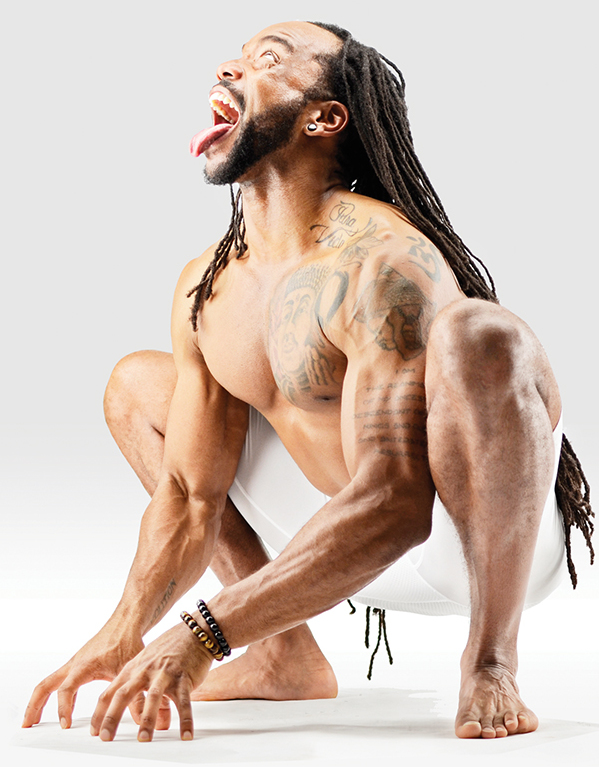
Yoga poses are not exercises. They are named after and function as ritual invocations of specific Hindu deities, and this is not a personal interpretation of the Hindu tradition. It is what the Hindu tradition says about itself.
B.K.S. Iyengar, founder of the world’s most widely practiced yoga style, whose books introduced millions of Westerners to postural yoga, states in Light on Yoga, a book that remains firmly on the bottom of my bookshelf, covered in dust, until research for this article was needed, that the asanas are also named after gods of the Hindu pantheon and that some recall the Avataras, or incarnations of Divine Power. Natarajasana is Shiva’s cosmic dance. Hanumanasana invokes the monkey god. Virabhadrasana calls on a fierce form of Shiva. He openly acknowledges this and records it as a feature.
Sun Salutation, Surya Namaskar, is the most widely practiced sequence in yoga. It consists of twelve poses, each corresponding to one of the twelve names of the sun god Surya, traditionally performed at sunrise, facing east. The twelve Sanskrit names, chanted with the movements, are salutations to the sun deity in each of his forms. The woman in the Tuesday morning studio class has been told she is doing cardio. In the tradition’s own terms, she is ritually saluting a Hindu solar deity with her body. These are different things, and this is not mere fancy expensive stretching.
Hatha yoga, the branch of the tradition from which all Western postural yoga descends, is itself a branch of Tantra. William Broad, the New York Times science correspondent who practiced yoga for decades and spent five years investigating it, documents this directly in The Science of Yoga (2012): Hatha is a branch of Tantra. It was developed to accelerate the Tantric agenda and make enlightenment possible through the precise application of willpower and the redirection of libidinal energy. The Monier-Williams Sanskrit dictionary gives the root of Hatha as hath: to treat with violence. The Hatha Yoga Pradipika, the fifteenth-century text that is the oldest extant manual for this practice, opens with sections on perineal pressure exercises described as opening the doors of liberation and techniques for extending lovemaking. Broad notes that contemporary books and teachers seldom refer to the practice’s true origins.
David Gordon White at UC Santa Barbara, one of the foremost Tantra scholars in the Western academy, documents in Kiss of the Yogini (University of Chicago Press, 2003) that the original Tantric tradition from which yoga developed was a sex cult in which practitioners sought access to the sexual fluids of yogini goddesses to gain supernatural powers. That is not a church pamphlet warning. It is a University of Chicago Press monograph. Both White and Broad followed the evidence independently and reached the same conclusion: yoga began as a sex cult. This point is widely accepted in academic literature but remains controversial in studio brochures. I wonder why.
Woodroffe, the Supreme Court Judge at Calcutta who wrote under the pen name Arthur Avalon, produced The Serpent Power: The Secrets of Tantric and Shaktic Yoga, which became the primary source text for virtually all Western Kundalini yoga practice. Hugh Urban documents that Woodroffe was an apologist, building the case that the Tantras represent a noble, pure, and ethical philosophical system in basic accord with the Vedas and Vedanta. A British judge in colonial service built the apologetic that made it possible for the West to accept Tantric practice without recoiling. The deodorization had a specific architect.
There is also the matter of Shakti pat, the energetic transmission by touch to the forehead, a practice found in virtually every major modern yoga lineage. Rabi Maharaj was administering it at thirteen. His description of what he was channeling: Shakti is one of the names given to Kali, Shiva’s murderous, blood-drinking consort. Every Western yoga teacher who gives an energetic adjustment is, in the tradition’s own theological understanding, transmitting the power of the goddess of death. They haven’t been informed of this, and their students, who are chasing physical fitness and wellness, definitely haven’t either.
The Serpent at the Base
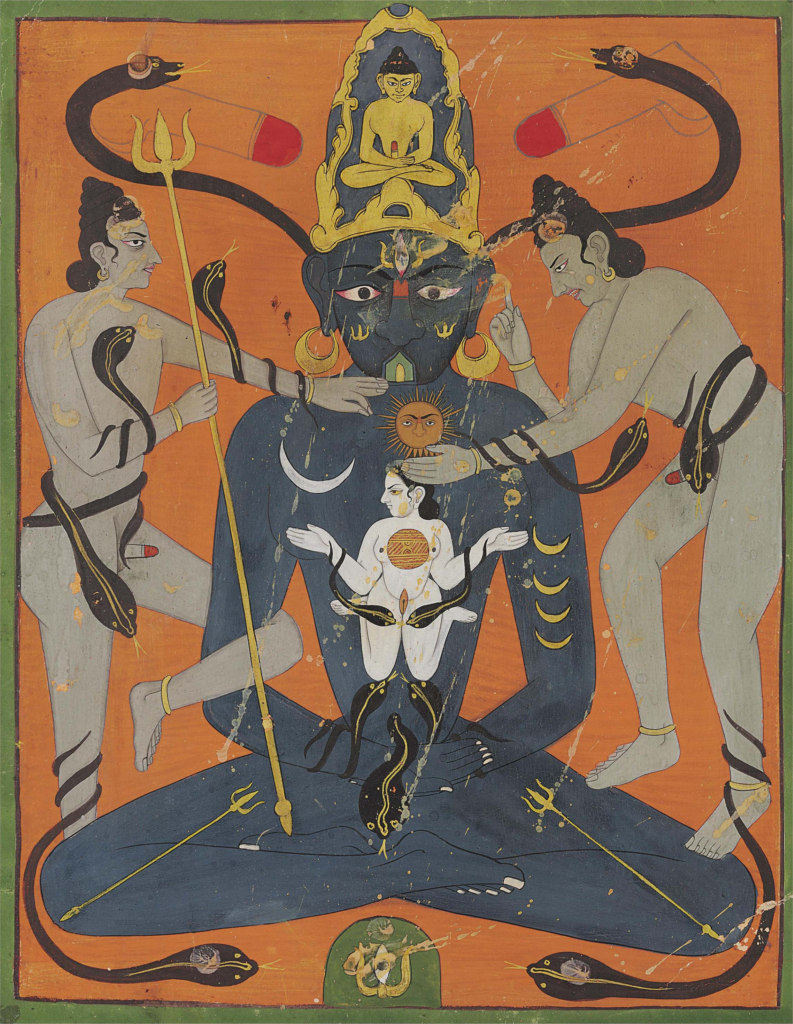
At the base of the spine, coiled three and a half times around a central channel, a goddess lies asleep.
Her name is Kundalini, more fully Devi-Kundalini, the divine serpent. As Livingstone documents, drawing directly on Hindu Tantra, the practitioner’s goal is to awaken Shiva, the masculine principle, which lies dormant at the base of the spine. This awakens the latent power known as Kundalini, envisioned as a coiled, sleeping serpent. As the Kundalini serpent rises through the chakras, it culminates in union with the final and seventh crown chakra, Sahastrara, the thousand-petaled lotus, located at the top of the head, representing the feminine energy of the universe. The aspirant then becomes engrossed in deep meditation and infinite bliss.
The Kundalini process, Livingstone notes, is often identified with the Caduceus of the Greek god Hermes, two snakes spiraling around a central staff, which is now a common symbol in medical iconography. The serpent of the yoga studio and the serpent on the doctor’s office door are the same symbol. Western medicine absorbed it without knowing what it carried.
In the tradition’s own language, Kundalini has a title that requires you to sit with: she is called, in her active form, the world bewilderer. That phrase comes from C.G. Jung’s 1932 Zurich seminar on Kundalini yoga, published as The Psychology of Kundalini Yoga (Princeton University Press, 1996): Sakti-Kundalini or Devi-Kundalini is a goddess. The Kundalini serpent is also a Devi-Kundalini, a chain of glittering lights, the world bewilderer. By creating confusion, she produces the world of consciousness, the veil of Maya.
Jung spent four lectures mapping the Kundalini chakra system onto his theory of the collective unconscious and, in his final lecture, identified her as the same principle as the Soter, the Savior Serpent of the Gnostics. The Gnostic Soter, the divine spark imprisoned in matter, the serpent who promises liberation from the prison of creation, the prison that, in Gnostic theology, is the world made by a false creator God. Jung’s depth psychology is Neo-Gnosticism dressed as therapy. The archetypes are the ancient gods, renamed. The collective unconscious is the Gnostic Pleroma, renamed. The individuation process is the Gnostic return to the divine spark, renamed. As Livingstone documents, Joseph Campbell regarded Kundalini as India’s greatest gift to us, and both Campbell and Mircea Eliade, alongside Jung, were the most prestigious academic promoters of Kundalini to Western culture, carrying it from occult circles into the academic mainstream. Eliade praised Tantra as the highest form of yoga. Three men whom I once admired.
Jung’s warnings about yoga practice for Western practitioners are among the most overlooked passages in the entire yoga literature. Many yoga books cite him approvingly, yet always omit the same passages. Here they are: he called Kundalini awakening a deliberately induced psychotic state that, in certain unstable individuals, might easily lead to a real psychosis. And: Kundalini strikes at the very roots of human existence and can let loose a flood of sufferings of which no sane person ever dreamed. And: The European who practices yoga does not know what he is doing. It has a bad effect upon him; sooner or later he gets afraid, and sometimes it even leads him over the edge of madness.
Rabi Maharaj knew this from within the practice. The line between ecstasy and horror was very fine, he writes about Kundalini. Demons described in the Vedas were known to take possession of some Yogis. When he finally reached the goal yoga promises, the direct experiential realization of Aham Brahmasmi, he worshipped himself before a mirror. I was God, he writes. Walking the streets, I felt that I really was the Lord of the universe and that my creatures were bowing before me. Years later, his mother was found seated in lotus position before a tall mirror at an ashram, worshipping the Self. Two generations of a family, the tradition’s highest attainment, staring at their reflections, calling them God. The serpent’s promise made good.
In 2017, Brown University researchers published a peer-reviewed study in PLOS ONE documenting adverse effects among meditators and yoga practitioners: lasting depersonalization, functional impairment, involuntary movements, visual and auditory phenomena, and, in the clinical language of secular neuroscience, encounters with entities or presences. Willoughby Britton is a secular neuroscientist. She followed the evidence into territory that made her unpopular in the wellness community. Something is encountered. The tradition calls it progress. The clinic calls it an adverse event.
By the 1980s, San Francisco alone had generated enough Kundalini crisis cases to sustain a dedicated counseling service, the Kundalini Crisis Clinic, founded by psychiatrist Lee Sannella. The Spiritual Emergency Network’s hotline received more than five hundred calls in one year.
Maharaj’s account of the drug-yoga convergence is among the most theologically precise analyses available. Having encountered drug users in London whose psychedelic experiences were identical to his yogic ones, he concluded: I began to ponder and to pray earnestly about the fact that so many addicts had the same experiences as Yogis: what one got on drugs the other got through Eastern meditation. I learned that drugs caused altered states of consciousness similar to those experienced in meditation, making it possible for demons to manipulate the neurons in the brain and create all manner of seemingly real experiences that were actually deceptive tricks played on the mind. The same evil spirits that had led me ever deeper into meditation to gain control of me were obviously behind the drug movement, and for the same diabolical purpose. Timothy Leary said it from the other direction: LSD is simply modern yoga. Both men, coming from opposite traditions, identified the same mechanism. Maharaj explains it.
The Goddess and Her Demands
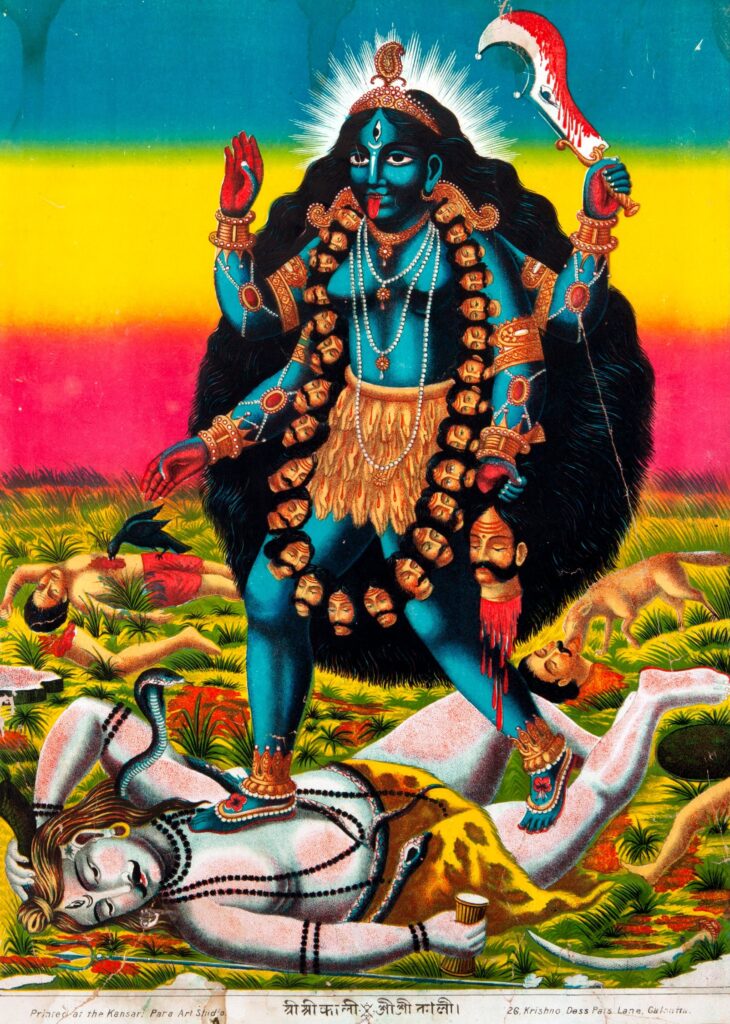
Let us now speak plainly about what yoga, at its root, actually worships.
Vivekananda, Master Mason, Harvard philosopher’s darling, conqueror of the Western spiritual imagination, was a devotee of Kali. Not the domesticated Kali of Western yoga studios, but the Kali of the cremation grounds. He inherited this from his guru, Ramakrishna, who sang to Kali from the cremation grounds: Come, O Mother, come! For Terror is thy name. Vivekananda’s stated religious ideal, as documented by his own disciple Sister Nivedita, was to become one with the Terrible forevermore. On animal sacrifice before Kali’s image, in his own recorded words: Why not a little blood to complete the picture?
Vivekananda’s own words, recorded by his disciples, confirm what his public speeches concealed. Who can say that God does not manifest Himself as Evil as well as Good? But only the Hindu dares to worship him in the evil. How few have dared to worship death, or Kali! Let us worship death! The man who stood in the Hall of Columbus and told seven thousand Americans about universal tolerance and the brotherhood of religions was, in private, advocating the worship of the goddess of death. Different audiences. Different speeches. Same man. Same mission.
In Orthodoxy and the Religion of the Future (1975), St. Seraphim Rose poses the question that the 1893 standing ovation never paused to ask: Is this to be accepted as an example of the authentically spiritual life of the unbaptized? Or is it rather a proof of the Psalmist’s words: The gods of the pagans are demons?
The Office against Heresies of the Holy Metropolis of Paphos, November 2024 statement on yoga: In yoga, the goddess Kali, the goddess of death, seeks to unite yoga practitioners with Shiva through shakti, thereby uniting them with demons through the deception of a seemingly innocent and ancestral activity.
Anton LaVey, the founder of the Church of Satan and author of The Satanic Bible, identifies Shiva as a synonym for Satan or Lucifer. The founder of the Church of Satan and the tradition practiced in forty million American living rooms share the same deity, described with different vocabulary.
The documented extreme expression of this tradition in contemporary India is not a thing of the past. Dan McDougall, reporting for The Observer from Uttar Pradesh in 2006, documented twenty-eight human sacrifices in western Uttar Pradesh in the preceding four months. His primary case: a three-year-old boy named Aakash Singh, abducted while sleeping, his nose, ears, and hands sliced off in a ritual performed before an image of Kali, his bleeding body laid before her. In February 2016, Newslaundry documented a father who beheaded his teenage son following a black magic manual; a couple who had a six-year-old kidnapped and mutilated; a woman who killed her neighbor’s three-year-old after a tantrik promised unlimited riches. In December 2013, a fifty-year-old woman named Kalavati Gupta was beheaded in a sacrifice ritual in Nalasopara, Mumbai. These are the reported cases. Most are not reported, as with the rape numbers in the country.
This article does not claim that yoga practitioners perform human sacrifice. It claims that the goddess invoked, in the studio, in the New Age healing circle, in the feminist spirituality movement, in pop culture, has a face. Katy Perry’s 2015 Super Bowl halftime show, a lion-goddess spectacle watched by 118 million people, took place at a stadium near the 33rd parallel, the same latitude as the Trinity nuclear test site, and the same number as the 33rd degree of Scottish Rite Freemasonry. Perry has spoken of being inspired by the divine feminine, the same divine feminine invoked across the yoga and New Age transmission project that has been running since Chicago in 1893.
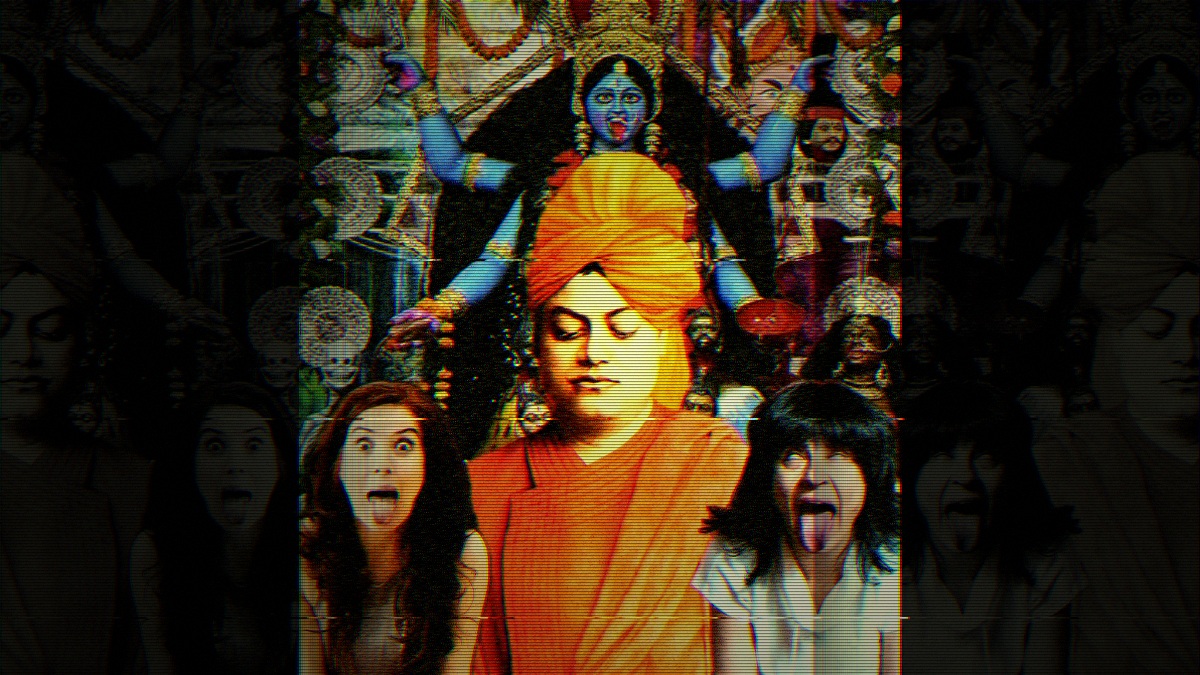
The blue-faced Hindu deity has a protruding tongue, skulls at the throat, and a severed head in its hand. The tradition calls her the divine feminine and Shakti. In her most primal form, she is Kali. Kundalini, the energy that yoga practice is designed to awaken, is hers. The distance from the mat to the altar is real, not infinite.
The Guru and the Machine
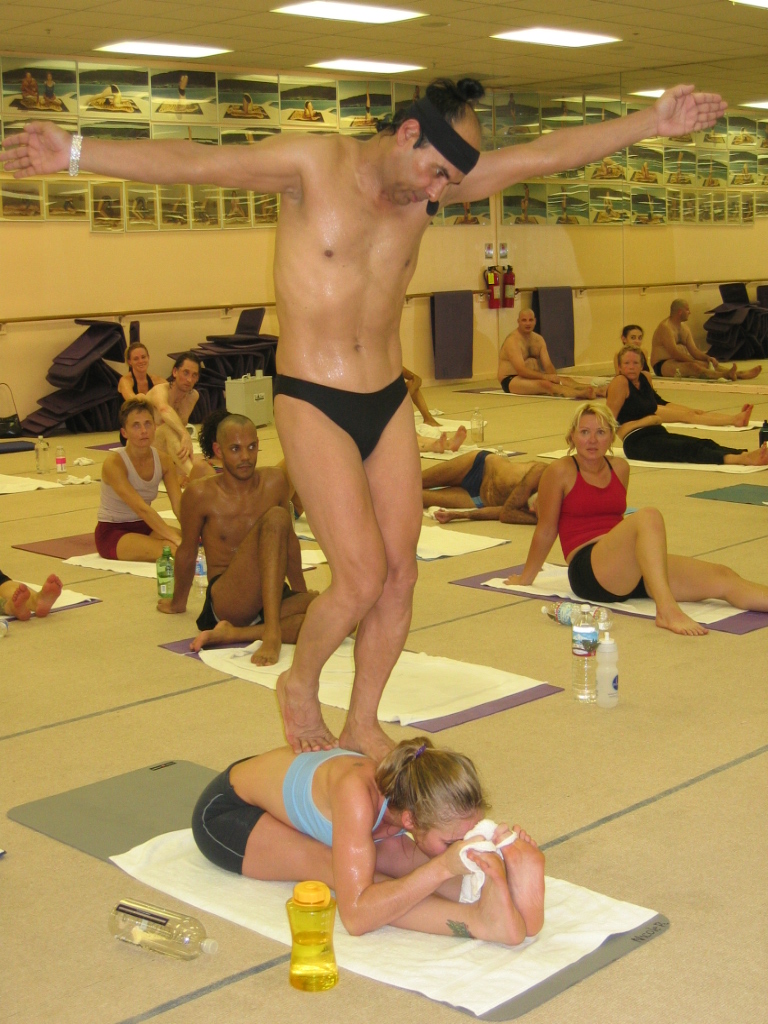
The yoga introduced to the West was transmitted through gurus. The guru tradition is not merely a method for delivering techniques; it is a spiritual technology with its own theology and documented effects.
Sharath Rangaswamy, grandson of Pattabhi Jois and current director of the institutional home in Mysore for the world’s most practiced yoga style, on the official institute website: Knowledge can be transferred only after the student has spent many years with an experienced guru, a teacher to whom he has completely surrendered in body, mind, speech, and inner being. T.K. Sribhashyam, the son of Krishnamacharya himself, widely regarded as the Father of Modern Yoga, said they are considered God.
St. Seraphim Rose identified this as the mechanism of spiritual catastrophe in 1975: the guru is literally regarded as God Himself, the disciple’s Redeemer. Total surrender to a human being regarded as divine is functionally identical to cultic capture. The abuse is not a corruption of the tradition. It is the logic of the tradition, applied by men who claimed its divine authority.
Now, for the documented cases across every major Western yoga lineage, without exception. Drum roll, please.
Swami Muktananda, SYDA Foundation. Publicly preached celibacy. Documented serial sexual abuse of female devotees, including minors. Rabi Maharaj’s own mother was installed as a priestess in Muktananda’s ashram and was later found seated before a mirror, worshipping the Self, with a large portrait of Muktananda above her altar. The same guru. The same lineage. Two testimonies, thirty years apart.
Swami Rama of the Himalayan Institute preached celibacy. A Pennsylvania jury awarded nearly two million dollars to a former devotee for abuse that began when she was nineteen. The same Swami Rama was documented in a CIA-translated West German parapsychology journal as demonstrating paranormal physiological control, stopping his heartbeat, for Soviet scientists at a conference in Alma-Ata in 1973. The siddhis and the abuse are in the same figure. Two faces of one tradition.
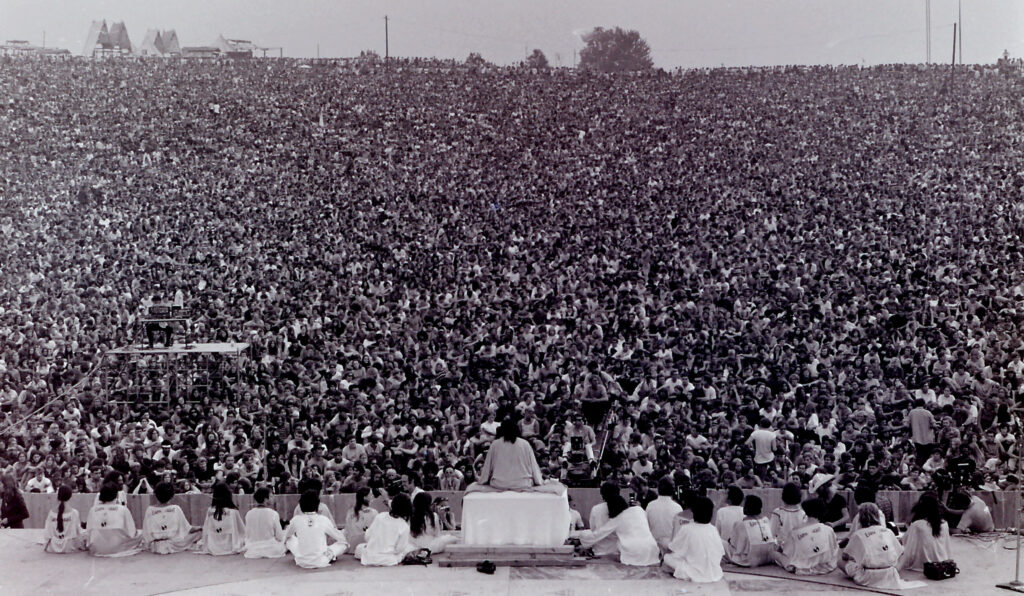
Swami Satchidananda, who delivered the invocation at Woodstock in 1969, faced multiple documented allegations of abuse. In 1991, a former devotee stood at his Virginia symposium and addressed him directly: How can you call yourself a spiritual instructor when you have molested me and other women?
Amrit Desai, Kripalu Yoga Center. Decades of impassioned talks on the spiritual value of chastity. Multiple affairs with students. Settlement: more than two and a half million dollars.
Yogi Bhajan, 3HO. Introduced Kundalini yoga to America. An independent investigation commissioned by his own organization in 2020 found substantial evidence of systemic abuse spanning decades. St. Rose documented him in 1975, before any of this was public, as leading a gathering of a thousand young Americans in the Jemez Mountains at the summer solstice in June 1973, practicing Kundalini and Tantric yoga. That date is now designated by the UN as International Yoga Day.
Bikram Choudhury. Six lawsuits for sexual assault and harassment. Fled the United States in 2017 to avoid paying six million dollars in damages. When asked about sex with students, his on-record response: he couldn’t refuse because of karma.
K. Pattabhi Jois, founder of Ashtanga yoga. Matthew Remski’s Practice and All Is Coming (2019), based on interviews with more than a hundred survivors, documented a pattern of sexual assault against students from 1983 to 2003. Remski: This is not a story about bad apples but about damage at the roots of an orchard.
John Friend, Anusara yoga. Multiple admitted sexual relationships with students. The organization collapsed in 2012.
Every major Western yoga lineage, without exception. William Broad, who has practiced yoga since 1970, notes that yoga teachers and how-to books rarely mention that the discipline began as a sex cult, an omission that leaves many practitioners vulnerable to what he calls libidinal surprise. Remski applies attachment theory to yoga communities: when the guru is both the source of spiritual life and the source of harm, the student develops disorganized attachment. The student cannot leave because leaving means spiritual death. The teacher can reframe dissociation as a sign of spiritual attainment, which can feel euphoric. A word I never heard used to describe rape.
Namaste.
They Stole It Back
By the 1950s, sanitization had largely succeeded. Yoga was in American living rooms, with the Tantric origins safely buried. Then two Harvard psychologists destroyed that respectability from a different angle.
Timothy Leary and Richard Alpert were expelled from Harvard in 1963. The CIA tracked them to Dominica afterward, where intelligence reports noted they planned to open what the agency called an alleged Happiness Hotel. The Mellon banking family funded the next phase. In 1965, Leary told the CBC: LSD is simply modern yoga, made possible by advances in science. He regarded them as the same project.
Aldous Huxley had already advised Leary to frame psychedelic research within the basic Tantrik idea of the yoga of total awareness leading to enlightenment. As Livingstone documents, it was through their enduring interest in Vivekananda’s neo-Vedanta that Huxley, Heard, and Isherwood passed their Hindu perennialism to Esalen and, in turn, to American culture.
Gerald Heard was a British writer, mystic, and close friend of Huxley who emigrated to America with him in 1937, already formed in the Vedanta Society tradition. Christopher Isherwood was a British novelist who settled in California, became a formal disciple of Swami Prabhavananda of the Ramakrishna Order, the order founded by Vivekananda’s own guru, and spent decades translating Hindu sacred texts and promoting Vedanta to Western literary audiences. Together with Huxley, the three formed the intellectual core of what became the California Vedanta scene: British emigres, shaped by Vivekananda’s tradition, who planted it in the soil that would eventually grow into the Human Potential Movement, the counterculture, and Esalen. Vivekananda had built a wide network of influence that included Carl Jung, Joseph Campbell, and Henry Miller, who was also associated with Esalen. Three men whom I once admired.
Kripal confirms that Huxley’s discussions of Tantra, the mystical possibilities of psychedelics, and what he called the perennial philosophy were foundational at Esalen. When Leary asked Huxley about Tantra, Huxley recommended the works of Sir John Woodroffe, Arthur Avalon, the author of The Serpent Power, who built the apologetic case for Western Kundalini yoga. In 1962, a month after introducing Leary to what he called the ultimate yoga of Tantra, Huxley published his final novel, Island, a celebration of Tantric eroticism. The chain from Vivekananda in 1893 to Leary in the 1960s runs directly through Heard and Huxley, from the man who privately worshipped Kali to the men who dissolved a generation’s political consciousness with acid, a generation too burned out to realize the cage they are in.
As mentioned earlier, Maharaj recognized the mechanism from within both traditions: I began to ponder that so many addicts had the same experiences as Yogis: what one got on drugs, the other got through Eastern meditation. His conclusion: the same evil spirits that had led me ever deeper into meditation to gain control of me were obviously behind the drug movement, for the same diabolical purpose.
Alpert went to India in 1967, burned out and seeking. He found a guru named Neem Karoli Baba. He gave the guru three hundred micrograms of LSD. Nothing happened. The guru showed no physiological effect. Alpert stayed eight months, was initiated into Raja and Hatha yoga, received the name Ram Dass, and returned to write Be Here Now, two million copies, Eastern cosmology and yoga practice delivered simultaneously to the generation LSD had opened. Syman writes the sentence that ties it together: They stole yoga from the health seekers and the weight-conscious and put it back in the temple, where they believed it belonged. The housewife of the 1950s was not seen as a threat. The 1970s seeker, who turned to yoga as a lasting alternative to the LSD experience, served as the transmission vector.
Andrew Weil embedded yoga in American medicine through his Center for Integrative Medicine at the University of Arizona, seeding similar programs at medical centers nationwide. By the 1990s, the counterculture had become the culture. Meditation is prescribed by the family doctor. From Vivekananda’s 1893 conquest to the doctor’s 2025 prescription. One current. One transmission. Forty million Americans on the mat and a whole generation of man-bun sex pests propping up in its wake.
What St. Paisios Said
St. Seraphim Rose published Orthodoxy and the Religion of the Future in 1975, the year he called the year of the guru. He watched the Eastern religion wave break over American culture and recognized it with the clarity of someone who had read the Fathers and had come through the Western occult tradition before his conversion. His diagnosis:
Studies of the experiences of many of the consciousness cults show that there is a regular progression in them from experiences which at first are good or neutral to experiences which become strange and frightening and in the end clearly demonic. Even the purely physical side of psychic disciplines like Yoga are dangerous, because they are derived from and dispose one towards the psychic attitudes and experiences which are the original purpose of Yoga practice.
He wrote in 1975. Britton and Lindahl’s peer-reviewed study documented the same progression in 2017. Four decades. Same finding. On the stretching defense: the practitioner is already disposing himself toward certain spiritual attitudes and even experiences of which he is unaware. The yoke binds whether the ox knows it or not.
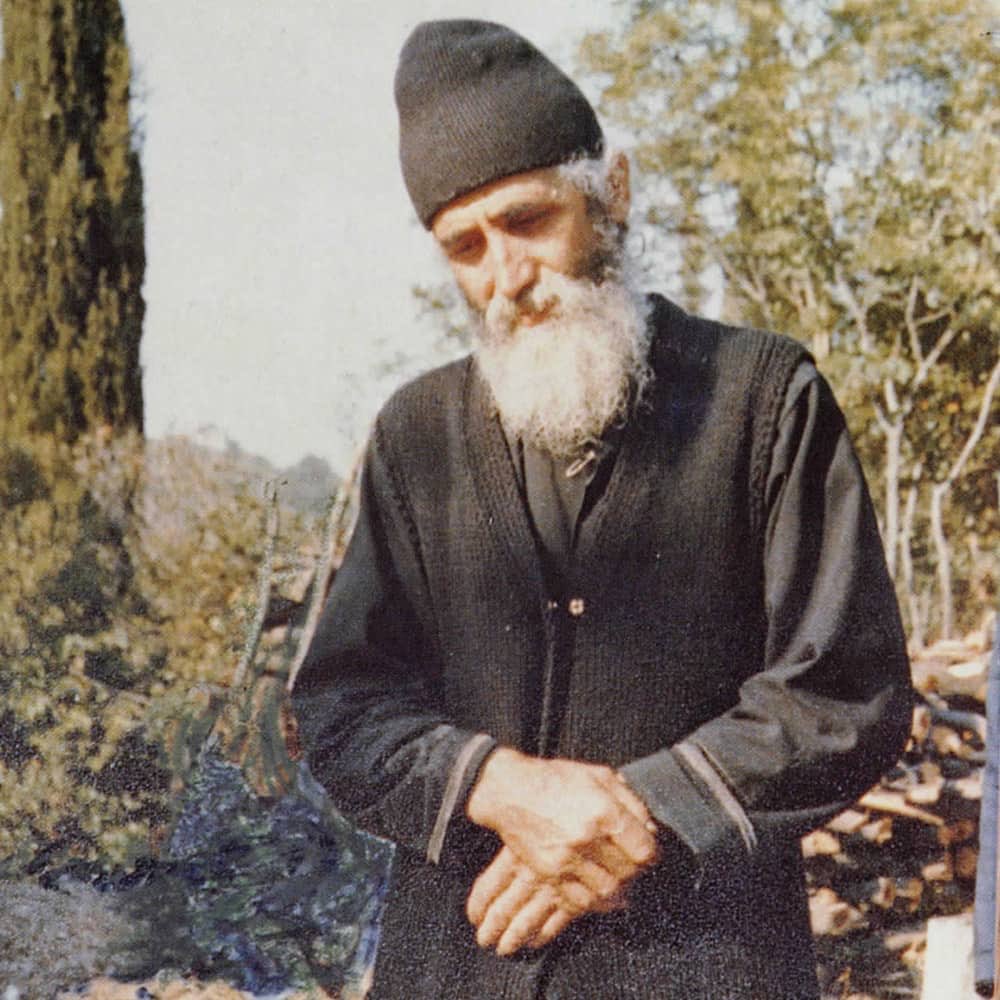
Dionysios Farasiotis was a young Greek man who spent years in Indian ashrams, practicing yoga and Tantric Hinduism at the highest levels before Elder Paisios intervened. His memoir, The Gurus, the Young Man, and Elder Paisios, published by St. Herman of Alaska Brotherhood, St. Seraphim Rose’s own brotherhood in Platina, California, a work I hold in great gratitude and read once a year, is the most direct primary-source account of what happens to someone who practices yoga seriously and of how the Orthodox tradition responds.
After his return from the ashrams, Paisios cast a demon out of him. Not metaphorically. The elder spoke the words directly, Come out of this man, thou unclean spirit, as Farasiotis stood by. His account of what he experienced: I felt an immaterial thing detach and separate from my soul, then come out of me. I felt as though my mind and soul had been freed from the powerful influence of another spirit. I could sense the onerous presence of the spirit that had come out of me, hovering at my left. Even at a distance, its dark power burdened my soul. A spirit acquired through yoga practice, cast out by an Orthodox elder.
St. Paisios on why yoga gives the enemy access: We are the ones who give him that power, by our sins. Most Christians never have such experiences with the powers of evil because they have not given the devil authority over them by immoral living, witchcraft, yoga, and related activities. Yoga gives the devil authority. The Saint’s own words.
When Farasiotis tried to defend the yogis, but they’re elders, and they’re good people, a seven-foot bay tree near them began to shake violently, as though someone were venting fury on it, hard enough to pull it from its roots. No wind. The surrounding vegetation was completely still. It’s your friend, the elder said calmly. The yogis had been sending demons his way, and the elder had been standing between them and him.
The most quotable moment in the entire book comes from a swami named Yogamougananda. When Farasiotis told her that the Orthodox monks said she was with the devil, she replied: So what? She was beyond good and evil, she explained. We’re with the devil, and we’re having a great time. Come along for the ride.
Farasiotis also documents the experiential difference between the mantra and the Jesus Prayer in ways no theology textbook could capture. While in a state of grace, the peace of Christ genuinely present, he let himself chant a Hindu mantra out of curiosity. The result was immediate: A weirdly icy breeze passed through the tree branches and gripped my soul with fear. The grace of Christ that kept my soul calm vanished, and with it my peaceful and tender relationship with the world vanished as well. In its place, there was another, strained power smothering me and altering the spiritual atmosphere, so that everything seemed alien and unnatural. He scrambled back to the Jesus Prayer. That is the comparison. The same door, different keys, identified through direct sensory experience.
The prelest framework, Bishop Ignatius Brianchaninov’s synthesis of patristic teaching on spiritual deception, names what Farasiotis experienced. Prelest has no precise English equivalent. It encompasses the full range of false spiritual experience, from simple illusion to actual possession. The warmth, the peace, the sense of expansion and connectedness are real. The source and destination are false. St. Rose: In every case, the counterfeit is taken as genuine, and the overall effect is an accelerated growth of pride. The experiences of yoga practice, the bliss, the dissolution of ego boundaries, the sense of union with something larger, are genuine. The counterfeit is designed to feel like the genuine article because it is produced by beings who know exactly what it looks like.
The Holy Metropolis of Paphos’s Office against Heresies, November 2024, quoting St. Elder Cleopa of Romania: Those who practice yoga or another occultist activity commit a great sin against the Holy Spirit, as they leave God and ask for the devil’s help. These people cast off Christ and unite with the devil, bringing him into their hearts and houses. They are no longer entitled to be named as Christians, but as apostates.
This is not pastoral hedging. The tradition communicates with the straightforwardness the subject demands.
The First Lie
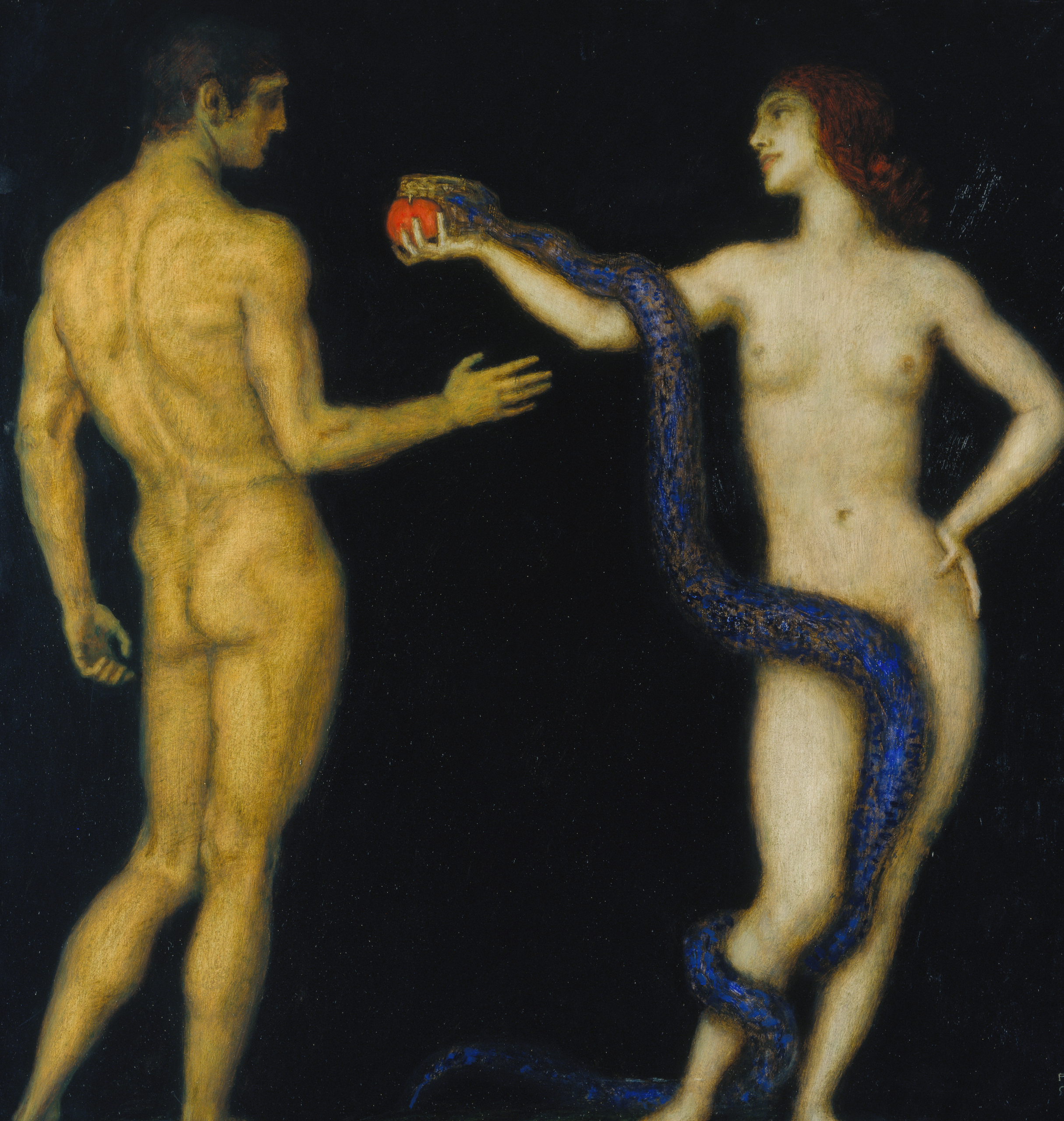
Ye shall be as gods.
The goal of yoga’s highest practice, articulated in the Upanishads, taught by every yoga tradition from Patanjali to Vivekananda, confirmed by Crowley, Jung, and the US Army Intelligence and Security Command, and celebrated by 193 nations on the summer solstice, is Aham Brahmasmi. I am Brahman. I am God. Not in a relationship with God. Not bearing God’s image. Identical with God. Already God, only not yet realized. Vivekananda’s commentary on the Sutras: Each soul is potentially divine. The goal is to manifest this Divinity within. And: The sooner we get out of this condition which we call man, the better for us.
Philosopher Nicolas Berdyaev identified the theological core of the objection a century ago: yoga is a graceless way upward from below. It does not know the grace of love. It does not perceive human personality in its metaphysical individuality and its value to the very life of God. In his formulation, it is something that precedes the revelation of Man in God, the revelation of personality through the Son of God. The tradition precedes the Incarnation in its understanding of what a person is, and it got there first, and wrong.
The Kundalini is a serpent goddess coiled at the base of the human being. The practice awakens her and drives her upward until the practitioner realizes that the self and the divine ground are identical. The serpent’s promise and method are delivered simultaneously through a practice taught in public schools since at least the 1980s, practiced by forty million Americans today, celebrated by the United Nations on the summer solstice, recommended by therapists to trauma survivors, hosted in fellowship halls, and available on a thousand apps.
Nobody on the mat intends to worship Kali. Nobody intends to invoke Kundalini. Nobody intends to pursue the dissolution of the individual self into the Vedantic Absolute. The tradition does not require intention. The yoke is already in place, and the direction of travel is already set.
This is what a yoke does. It does not ask for consent. It binds, pulls, and determines direction.
The Orthodox tradition does not offer union with Brahman. It offers something incomparably greater. Not the dissolution of the self into an impersonal ground. Not the annihilation of the person in the universal. Not the realization that you were always God and simply forgot. A personal relationship with the personal God who made you and knows your name, who knit you together in your mother’s womb, who entered His own creation to rescue you from a condition far worse than the ignorance the Vedanta tradition diagnoses, who calls you toward a union that does not erase you but perfects you. Theosis, deification, is not the erasure of the person. It is the person becoming fully what God made them to be, in eternal relationship with the One who made them. The image restored and the self transformed, not dissolved.
The hesychast tradition does what yoga claims to do. It works with breath, posture, and interior attention, but within the sacramental life, under obedience to a spiritual father, with the name of Jesus Christ as the anchor. The Jesus Prayer: Lord Jesus Christ, Son of God, have mercy on me, a sinner. Specific, personal, directional. Not ego dissolution. Not union with an impersonal ground. The same door. A completely different key. One opens toward God. One opens toward the world, bewildered.
The Lord used the word deliberately. My yoke is easy and My burden is light. Matthew 11:28-30. The yoke of yoga connects the practitioner to the Kundalini serpent goddess at the base of the spine, through a tradition whose founder privately worshipped the goddess of death, transmitted to the West as a spiritual conquest project by a Master Mason, re-sacralized by the CIA’s psychedelic culture operation, institutionalized by the United Nations on the summer solstice, and documented by secular journalists, neuroscientists, Army intelligence officers, and Gnostic psychologists as producing entity encounters and ego dissolution, what the Orthodox tradition, in its precision, calls prelest.
The yoke of Christ connects the person to the living God through grace and the sacraments, in the company of the saints, with the full weight of heaven behind it.
Both call themselves unions. Only one is true.
St. Paisios said what it is and proved it by casting it out. The Fathers have always known. Secular evidence has accumulated to the point that even yoga’s own insiders, Broad, Remski, Britton, White, and Singleton, are confirming, from their own disciplines, what the tradition identified from first principles. Elder Cleopa called it apostasy. The Church is not silent. The question is whether forty million people on the mat will hear it.