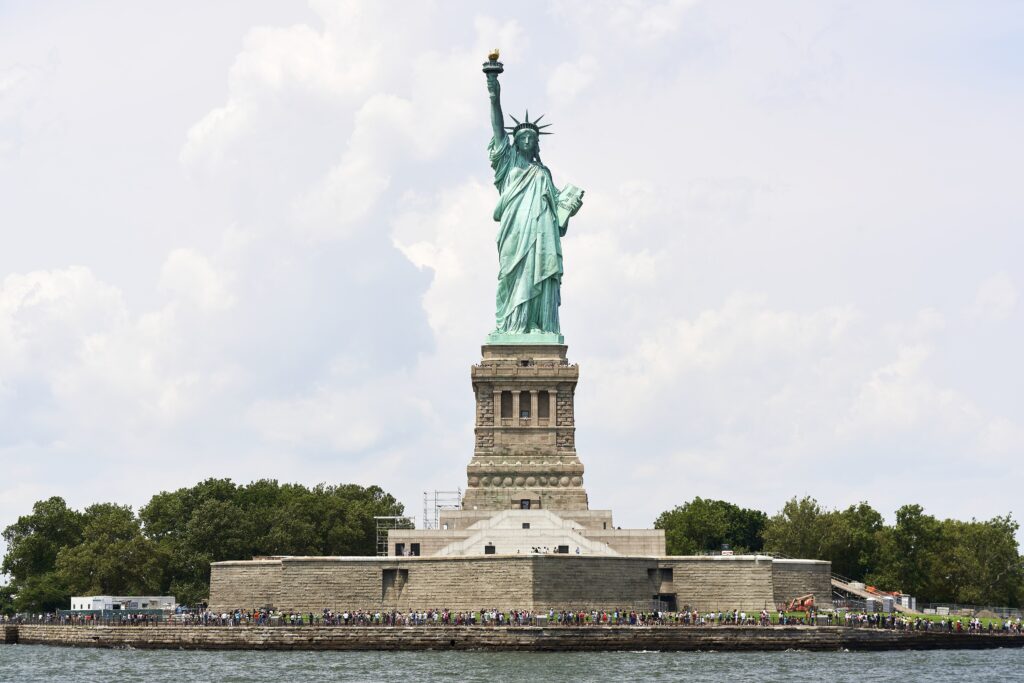
I went to the Statue of Liberty exactly once. I was about six years old. My father took my brother and me shortly after the divorce, one of those days a father plans after the family breaks apart. Real Noo Yawkers do not go to the Statue of Liberty. It is just there, in the background, like the skyline. You grow up seeing it from the ferry, from the bridge, from the flight path into LaGuardia. You stop seeing it. You grow up with it as wallpaper, the way you grow up with the dollar bill in your pocket without looking at the pyramid on the back, which, funny enough, my father was the first and only person to point out to me.
We stood there, the three of us, looking up at her, feeling what you are supposed to feel. Pride, or something like it. The feeling that you live somewhere important, that the harbor you grew up near means something to the world. I had no reason to think otherwise. My father probably said something about what she represented. Freedom. The country. ‘Merica.
My father was also the kind of man who insisted on calling fries “freedom fries” for much longer than anyone else before realizing it didn’t catch on.
That statue looks out over the harbor, where, on a September morning years later, two towers came down in what I now understand as a staged occult mega-ritual, with the Statue of Liberty serving as its silent overseer. The connection between the statue and that morning is not incidental. The same tradition that built the statue and named the torch the light of Masonic illumination consecrated the harbor that morning. I am not here to re-litigate 9/11 in detail. I am here to tell you that the statue in the harbor is not what they told my father to tell me it was.
I also grew up watching the X-Men cartoon on Saturday mornings, reading the comics, and eventually watching the films. The first film ends at the Statue of Liberty. Magneto’s plan plays out in her crown, her torch, and her body. Bryan Singer directed it, the same Bryan Singer who is a confirmed pedophile. Looking back, the film and the franchise as a whole were an early vehicle for the ideological project that has since made itself explicit, namely, LGBTQ normalization packaged as a civil rights narrative, delivered to children through a franchise I loved. The statue was the backdrop for that, too. She keeps showing up. Once you start seeing what she represents, you cannot stop noticing where she appears.
I am writing this as a New Yorker, as someone who grew up in the shadow of that figure, as a former libertarian who wore a hat that read “taxation is theft” and meant it unironically (cringe, I know), and as an Orthodox Christian who now understands what was sold to me under the guise of liberty.
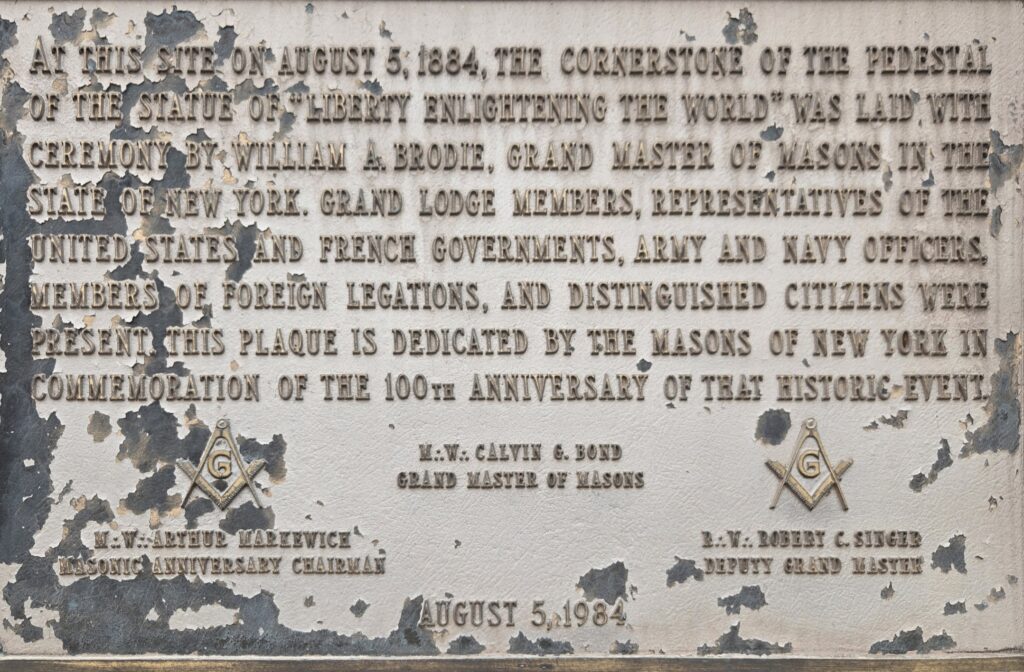
On August 5, 1884, heavy rain fell on Bedloe’s Island in New York Harbor. Despite the weather, the gaily decorated steamship Bay Ridge, adorned with the French tricolor and the American Stars and Stripes, carried about a hundred members of the Grand Lodge of Free and Accepted Masons of New York to a construction site. There, the pedestal for the world’s most famous statue awaited its cornerstone. Drenched, they performed the ceremony anyway because it mattered more than the weather.
The Grand Master, Most Worshipful William A. Brodie, struck the stone three times with his gavel. The Masonic consecration elements, corn, wine, and oil, were presented as symbols of abundance, joy, and peace. Inside the sealed copper time capsule beneath the cornerstone were placed a copy of the United States Constitution, George Washington’s Farewell Address, twenty bronze medals of American presidents, including Washington, Monroe, Jackson, Polk, Buchanan, Johnson, and Garfield, all confirmed Freemasons according to the Grand Lodge of New York’s account, a portrait of the sculptor, a copy of Poem on Liberty by E.R. Johnes, and a parchment listing the Grand Lodge officers. The ceremony replicated the Masonic rites George Washington used when he laid the cornerstone of the United States Capitol in 1793.
Then the Grand Master addressed the assembly. Standing at the podium in the rain, he asked his fellow brethren why the Masonic Fraternity should be called upon to lay the cornerstone of such a structure.
His response is documented in the Grand Lodge’s own records, published in the Grand Lodge of New York’s lodge materials, and verified by the Grand Lodge of New Jersey, Masonic self-testimony given at the founding of the most renowned monument in American history.
“No institution has done more to promote liberty and to free men from the trammels and chains of ignorance and tyranny than has Freemasonry.”
A theological assertion, not a civic one. The Grand Master of New York, standing in the rain at the Statue of Liberty, proclaimed that Freemasonry is, above all other institutions, the embodiment of liberty. The statue and the Lodge share the same core belief. The statue represents the Lodge’s doctrine, cast in metal and raised above the harbor.
This discerning deep dive examines what that doctrine actually is. Not the version they teach schoolchildren, nor the one found in the Lodge’s public literature for the uninitiated. Rather, the version found in primary sources, in the Lodge’s own esoteric writings, within the theological tradition of its creators, and in the continuous chain of imagery linking an ancient sun god’s bronze colossus and a Roman emperor’s radiate crown to the figure in New York Harbor with seven rays on her head and a torch in her hand.
The Statue of Liberty is not a symbol of political freedom. It is a Masonic icon. The sculptor, Frédéric Auguste Bartholdi, was a Master Mason who presented the project to his lodge before any public announcement, and every significant design choice he made traces to the same esoteric tradition his Lodge inhabited. The liberty the statue represents is a specific theological idea, humanity’s liberation from revealed religion. This concept stems from Luciferian illuminism, as documented in the Lodge’s own canonical texts, reflected in Bartholdi’s deliberately chosen iconography, and openly stated by the revolutionary-Masonic tradition that initiated the project.
I. The Chain of Images: From Helios to New York Harbor
Nothing about the Statue of Liberty is truly original. Recognizing this is essential. The sculptor intentionally drew on a series of well-documented iconographic precedents he openly cited. Tracing this chain reveals the underlying theology.
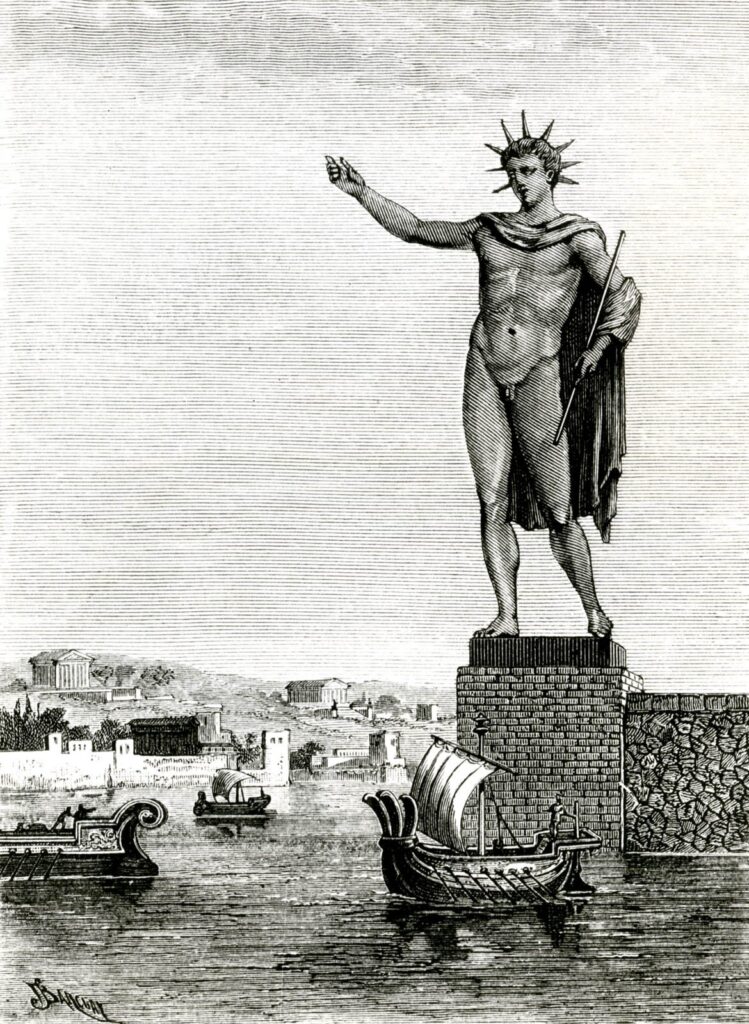
The chain begins in 280 BC on the island of Rhodes. After a yearlong siege by Demetrius Poliorchetes’s forces, the Rhodians sold the abandoned siege equipment and used the proceeds to commission a massive bronze statue in gratitude to their patron deity, Helios, the sun god. An ancient Greek verse captures their intention: they raised “high to heaven this colossus” to “establish the lovely light of unfettered freedom.” The Colossus of Rhodes, one of the Seven Wonders of the Ancient World, was a solar deity positioned at a harbor entrance as a beacon of liberation, standing approximately 110 feet tall. Helios was not an Olympian god but a Titan, a cosmological deity appropriated by rulers throughout antiquity to assert divine solar authority.
Bartholdi had an in-depth understanding of the Colossus of Rhodes. Yasmin Sabina Khan, in her 2010 Cornell University Press monograph Enlightening the World, the definitive scholarly account of the statue’s creation, documents that Bartholdi explicitly called the Colossus of Rhodes “the most celebrated colossal statue of antiquity” and directly linked his own work to it. At the 1876 Paris Opera fundraiser, Laboulaye compared the liberty statue to the Colossus of Rhodes before an audience of eight hundred. Bartholdi was consciously building the Colossus’s successor.
Before New York, there was Suez. In the late 1860s, Bartholdi presented a plan to Ismail Pasha, the Khedive of Egypt, for a massive lighthouse at the northern entrance of the newly opened Suez Canal, calling it “Egypt (or Progress) Bringing Light to Asia” or “Egypt Enlightening the Orient.” It depicted a large robed woman at a harbor entrance holding a lantern to guide ships. The Khedive declined on cost. When Bartholdi later designed the American statue, Khan documents that “the preliminary studies for the American liberty figure assumed the gentle female form of the Suez Canal project” and that “this similarity had recommended the earlier design as a starting point for the new work.” The Suez and New York designs are the same figure.
Bartholdi knew it, and when Americans found out he had worked to conceal it because it threatened the narrative of the statue as a symbol of Franco-American friendship. Khan records in his correspondence that he tried “to downplay the association of the two sculptures” after realizing some Americans believed an article by “an evilly disposed newspaper” accusing him of reusing an old design. When the iconographic lineage became a liability, he buried it. Someone with nothing to hide would not hide his sources. Bartholdi understood what the lineage meant and did not want the public to follow it to where it pointed.
Where did it point? The Colossus of Rhodes stood at a harbor as a beacon for a solar deity. The Pharos of Alexandria, the ancient world’s great lighthouse, stood at a different harbor, guiding seafarers and symbolizing spiritual guidance. Bartholdi explicitly linked his statue to both. Richard Morris Hunt, the American architect who designed the pedestal, named his early pedestal designs after the Pharos. The peer-reviewed archaeologist Lone Wriedt Sorensen confirms in her study of the Colossus of Rhodes that Bartholdi “originally intended the statue to be erected at the entrance to the newly opened Suez Channel, repeating the combination of the Rhodian Colossus and the Pharos of Alexandria,” citing Wolfram Hoepfner’s 2003 monograph. The statue’s title, Liberty Enlightening the World, transplants the Pharos tradition to a new harbor with a new figure.
The Colossus of Rhodes was dedicated to Helios. The Pharos bore a statue of Zeus at its summit. The Statue of Liberty wears the sun god’s rayed crown.
That crown is not decorative. Maerten van Heemskerck, the sixteenth-century Dutch artist who illustrated the Seven Wonders, depicted the Colossus wearing a sunburst crown because Helios required solar headgear. The 1848 seal of the French Republic featured a seated liberty figure wearing a crown of seven rays. The Art-Journal observed that rayed crowns were “reserved for ideal heads” symbolizing divine inspiration. Khan documents Bartholdi replacing the standard liberty cap with a crown of rays during his American visit, though he left no written explanation. Whatever inspired the specific decision, the iconographic meaning was established across two thousand years of art before Bartholdi was born. The rayed crown signified solar divinity.
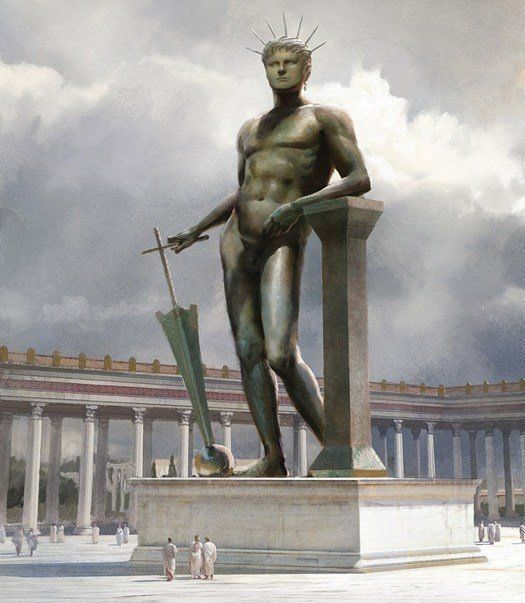
Between 64 and 68 AD, Emperor Nero commissioned a 30-meter bronze statue of himself for the vestibule of his Domus Aurea, the Golden House, which stretched across Rome from the Palatine to the Esquiline. This was the same Nero who, after the Great Fire of Rome in 64 AD, blamed the city’s Christians for the catastrophe and initiated the first imperial persecution of the Church. Tacitus records this in Annals XV.44: Christians were arrested, convicted not on evidence of arson but on hatred of the human race, and executed in ways designed for spectacle. Some were sewn into animal skins and torn apart by dogs. Others were crucified. Others were set alight as human torches to illuminate Nero’s gardens at night. The man who deified himself as the solar light-bearer used the followers of Christ as his fuel. The emperor who claimed to be the light of the sun destroyed those who bore the Light of the World.
After Nero’s death, Emperor Vespasian added a radiate crown and renamed the colossus the Colossus Solis, the Colossus of Sol, the Roman sun god. Three primary sources confirm this: Suetonius (Vespasian 18), Pliny (Natural History XXXIV.45), and Cassius Dio (LXV.15). The self-portrait became a sun god, marked only by a crown of rays and a new name. Hadrian later moved it near the Flavian Amphitheater, where it became so symbolically central that the medieval historian Bede wrote, “As long as the Colossus stands, Rome will stand; when the Colossus falls, Rome will fall; when Rome falls, so falls the world.” Some hold that the name “Colosseum” derives from this proximity. The Colossus of Sol became a symbolic axis of the city and of civilization itself.
The transformation of the emperor into a sun god through the radiate crown was not unique to Nero. Marco Alampi’s 2021 Charles University PhD dissertation on the cult of Sol Invictus documents this across the Severan dynasty, using numismatic evidence. Commodus’s coins depict the solar deity in a radiate crown on a quadriga, and the bearded image implies a deliberate identification of the emperor with the deity. The Historia Augusta links Gallienus to Nero through the same ambition, namely to build a colossal statue of himself as the sun god, showing that Nero’s solar self-deification was understood in antiquity as an imperial template. The radiate crown was the instrument of deification, transferring solar divine authority to its wearer.
The solar-ruler iconographic chain runs from the Colossus of Helios at Rhodes, through the Ptolemies, who associated the Egyptian sun god with Helios to establish their divine lineage, through Nero’s Colossus Solis, through Aurelian, who built Rome’s first dedicated Temple of Sol Invictus in 273 AD and established the agon Solis games on December 25, the Dies Natalis Invicti, the festival that the Emperor Constantius II would later replace with the celebration of the birth of Christ, to the harbor figure in New York wearing the crown of all of them. Bartholdi did not need to consciously trace every link. It was embedded in the tradition he drew on. He knew the Colossus of Rhodes, the Pharos, and the solar crown. He was, after all, a Freemason. The rest followed.
The torch in Liberty’s hand draws on the same tradition. Bartholdi had included a raised light source in the Suez Canal design. Khan explains that the torch was chosen to represent “the victory of light over darkness,” and Laboulaye was explicit that it burned “not with an inflammatory flame but with the passion of enlightenment.” In the esoteric tradition flowing through the Lodge, those words have a specific referent. The Greek torch-bearer is Prometheus, who stole fire from the gods and gave it to humanity, freeing man from divine dependence. The Roman Lucifer, the “light-bearer” or morning star, carries the torch of illumination before the dawn. In the esoteric tradition, they are the same figure, and the torch is their shared symbol. Manly P. Hall states this identity explicitly in Lectures on Ancient Philosophy, describing Promethean fire as “the impregnating flame that would release the life latent in this multitude of germlike potentialities” and identifying Prometheus directly with Lucifer, “who in the guise of a serpent tempted man to revolt against the mandates of Jehovah.” The torch in Liberty’s hand is that flame, and the Lodge built the statue that holds it.
II. The Maker and the Lodge
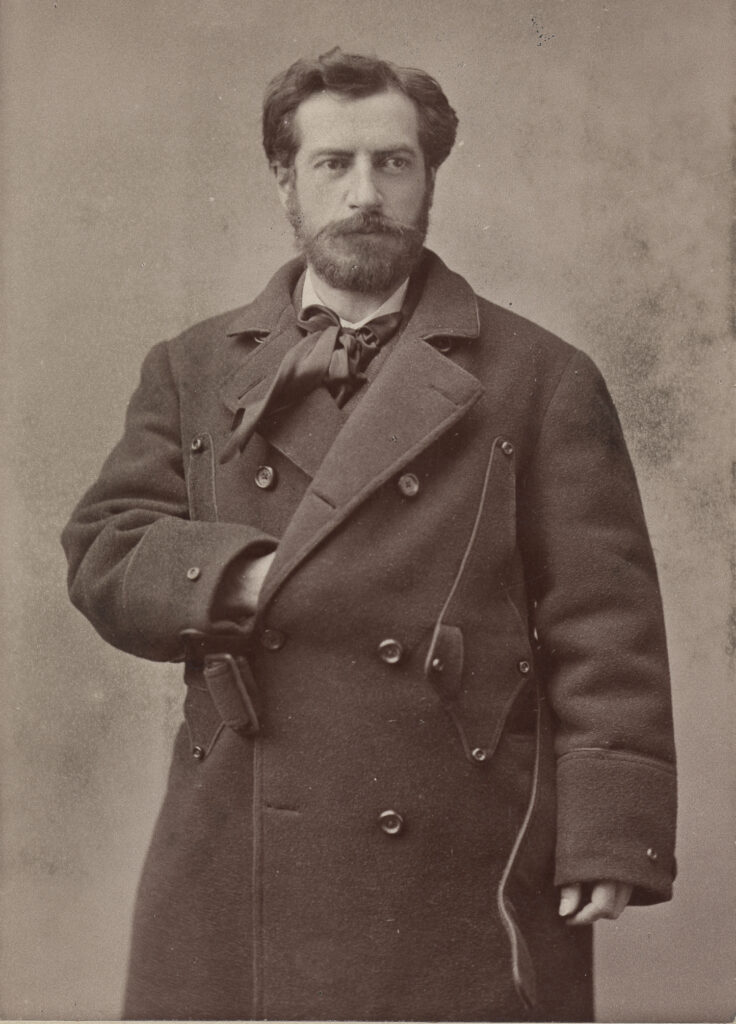
Frédéric Auguste Bartholdi was born in 1834 in Colmar, Alsace, a French Protestant from the bourgeoisie, educated at Louis-le-Grand in Paris, and trained as a sculptor under the Romantic painter Ary Scheffer, who had gathered around Lafayette in the 1820s. In 1855, he traveled to Egypt and was struck by the massive monuments of antiquity, noting his admiration for their “imperturbable majesty” and the “kindly and impassable glance” that looked toward “an unlimited future.” From that point, his artistic ambition was monumental, with works designed to last for the ages.
He did not become a Freemason until after the Franco-Prussian War of 1870-71, when Germany annexed his native Alsace, leaving him burning with a desire to fight for liberty. The war fueled an emotional drive that his Masonic initiation would later channel. According to the Robert Burns Lodge No. 59, drawing on lodge records, Bartholdi was invited to join Freemasonry in 1874 and was initiated into Lodge Alsace-Lorraine in Paris on October 14, 1875. He was raised as a Master Mason on December 9, 1880.
Lodge Alsace-Lorraine was no ordinary lodge. Founded in 1872 by Gustave Dalsace to support exiles from the lost provinces, it drew members, in Dalsace’s own words, “writers and politicians of ardent patriotism, eager to uphold the cult of the lost region and the fierce spirit of revenge.” Its ranks included Jules Ferry, who, as Prime Minister, would secularize France and strip the Church from its schools; Léon Gambetta, who escaped the Prussian siege of Paris by hot-air balloon; Jean Macé, founder of the League of Education; and Adolphe Crémieux, whose decree granted French citizenship to Algerian Jews. A political power network was centered on transforming France into a secular, republican state, hostile to both Church and monarchy, and committed to the Masonic-revolutionary vision of liberty.
The Grand Lodge of New Jersey’s official account, authored by MW Robert C. Singer and drawing on the Robert R. Livingston Masonic Library, states that Laboulaye’s 1865 gathering included “Henri Martin, the noted historian and French Mason.” Multiple sources identify Laboulaye as a member of Lodge Alsace-Lorraine, the same lodge Bartholdi joined a decade later. The men who conceived and funded the statue were part of the same Masonic network.
Bartholdi introduced the project to his lodge. According to Robert Burns Lodge records, when he presented the proposal to Lodge Alsace-Lorraine, it was received “for the first time not with ridicule, but with praise and excitement.” The brethren discussed it for hours. The scale was increased, and financing was discussed. The account states that “it was agreed by the brethren that, following Masonic principles, the Lodge could not be the direct sponsor behind the project, for it does not seek recognition or fame. Thus, the Franco-American Union committee was formed to oversee and contribute to the project.”
Let that sink in. The organization publicly presented as a Franco-American friendship society formed to fund and oversee the Statue of Liberty was created at a Masonic lodge meeting as the Lodge’s public instrument, because direct Lodge sponsorship would have compromised the mystification. The Lodge built the statue, and the Franco-American Union served as the cover.
Throughout construction, Bartholdi remained engaged with his lodge. Robert Burns Lodge records indicate he delivered two formal presentations in 1884, explaining that each design element carried specific symbolic significance, with the torch representing “Masonic Light of freedom and advancement to the World.” On November 13, 1884, he gave an extensive lecture on the statue’s history and creation, a date independently confirmed by Singer’s Grand Lodge account. After the 1887 New York dedication, he returned to the lodge and shared accounts of the reception his work had received.
The October 28, 1886 dedication was a Masonic event. Singer’s account confirms that the main address was delivered by Chauncey M. Depew, a U.S. Senator and active member of Kane Lodge 454. The invocation was delivered by Brother Henry C. Potter, the Episcopal Bishop of New York. Brother Bartholdi pulled the cord to unveil the statue. The Lodge had laid the cornerstone and now dedicated the completed work.
III. What Liberty Means in the Lodge
I went deep into libertarianism. The entry point was Ron Paul, around the time of Occupy Wall Street, that brief window when something resembling genuine populism was visible before the manufactured woke-versus-conservative split was seeded into the culture and divided everyone back into their managed camps. I was an anarcho-capitalist, a remarkable position to hold when you are broke, have no work ethic to speak of, and produce nothing. I wore the hat. I read Rothbard. I believed that liberty was the self-evident foundation of all good things.
The MAGA period came next, casting a different spell, still democratic, still believing that the right man in the right office could fix it. The illusion that there are two sides. Both sides serve the same masters. Two wings of the same Masonic bird. The questions of democracy and monarchy arose together when I broke out of atheism and became Orthodox. Heaven is a monarchy. The Tsar is not elected. The logic is not complicated once you accept the premise. Even in my deepest anarcho-capitalist days, Hans-Hermann Hoppe’s case for monarchy seemed too far-fetched. Now I see that the technocratic pseudo-monarchy Silicon Valley is constructing, the Curtis Yarvin “Caesar” project, seeks to appropriate exactly the libertarian ideas I once held, stripped of any Christian grounding, and to install a managerial sovereign answerable to no God and no law but his own. That is not a monarchy. That is a throne built for the Antichrist. The only monarchy worth the name is an Orthodox one. Tsar Nicholas II was the last great leader in the Western tradition. The Lodge and its revolutionary heirs killed him and his family in a basement in Yekaterinburg in 1918 and called it liberation.
I tell you this so you know what it cost me to understand what that statue in the harbor actually means. It was not an abstract discovery. It was the unraveling of something I had built my identity around for years. The word “liberty” sounded like truth to me. Here is what it actually means in the tradition that raised her.
The Lodge’s own sources make this plain. The Grand Orient de France, the dominant French Masonic body in Bartholdi’s time, published its official bulletin. The Vicomte Leon de Poncins quotes it directly in his 1929 work, Freemasonry and Judaism. The bulletin states, “All must come to understand that the time has arrived for choosing between the old order, which rests upon Revelation, and the new order which knows no other foundation but science and human reason, between the spirit of authority and the spirit of liberty.”
A theological declaration. The Grand Lodge of France stated its mission as replacing Revelation with reason and divine authority with the spirit of liberty. In its own framing, the spirit of liberty and the rejection of revealed religion are the same thing. The pairing is deliberate. This is the Lodge explaining what it is doing.
Mason Bonnet, speaking at the Grand Orient de France in 1904, directly confirmed the historical claim: “During the 18th century… [Freemasonry] alone at that period, invoked the radiant motto, still unknown to the people, of ‘Liberty, Equality, Fraternity.'” The slogan of the French Revolution, the one that accompanied the execution of the King and Queen, the demolition of the Church’s institutional power, and the installation of the secular republic. The Lodge asserts ownership of the French Revolution, the motto, and the statue.
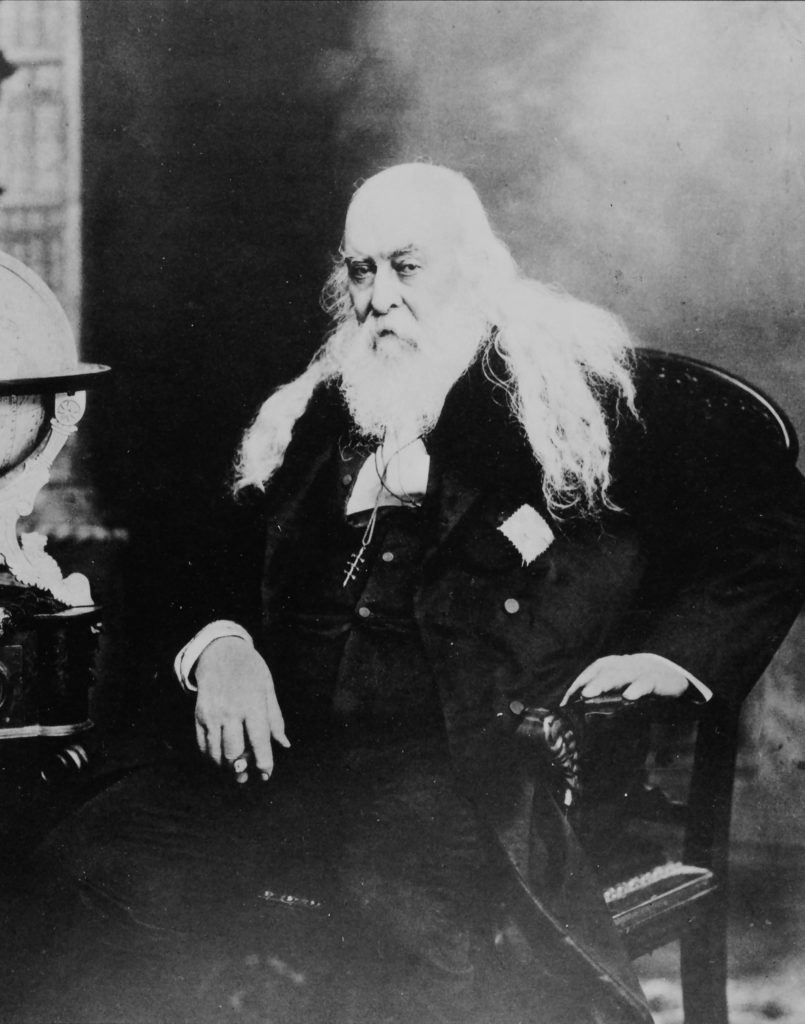
Albert Pike articulated this tradition’s core beliefs most explicitly. As Sovereign Grand Commander of the Supreme Council of Scottish Rite Freemasonry, Southern Jurisdiction, and author of Morals and Dogma, written by authority of the Supreme Council in 1871, he intended it as the definitive theological text of the 33rd Degree. His preface describes him as “about equally Author and Compiler,” drawing on his own thought and unspecified predecessors.
For a century, Masonic apologists have managed the most explosive passage in Morals and Dogma. They call it rhetorical, a question rather than an endorsement, misread out of context. This is the passage from Degree XIX, Grand Pontiff:
“LUCIFER, the Light-bearer! Strange and mysterious name to give to the Spirit of Darkness! Lucifer, the Son of the Morning! Is it he who bears the Light, and with its splendors intolerable blinds feeble, sensual, or selfish Souls? Doubt it not! for traditions are full of Divine Revelations and Inspirations, and Inspiration is not of one Age nor of one Creed. Plato and Philo, also, were inspired.”
“Doubt it not.” An affirmation, not a question. Pike affirms that Lucifer bears the light. The apologist will claim this refers to Venus, the morning star, the astronomical Lucifer rather than the fallen angel. This is the first level of the teaching, suited to the level at which apologists operate. They are correct that Venus and Lucifer are connected, but wrong to claim this connection absolves Pike.
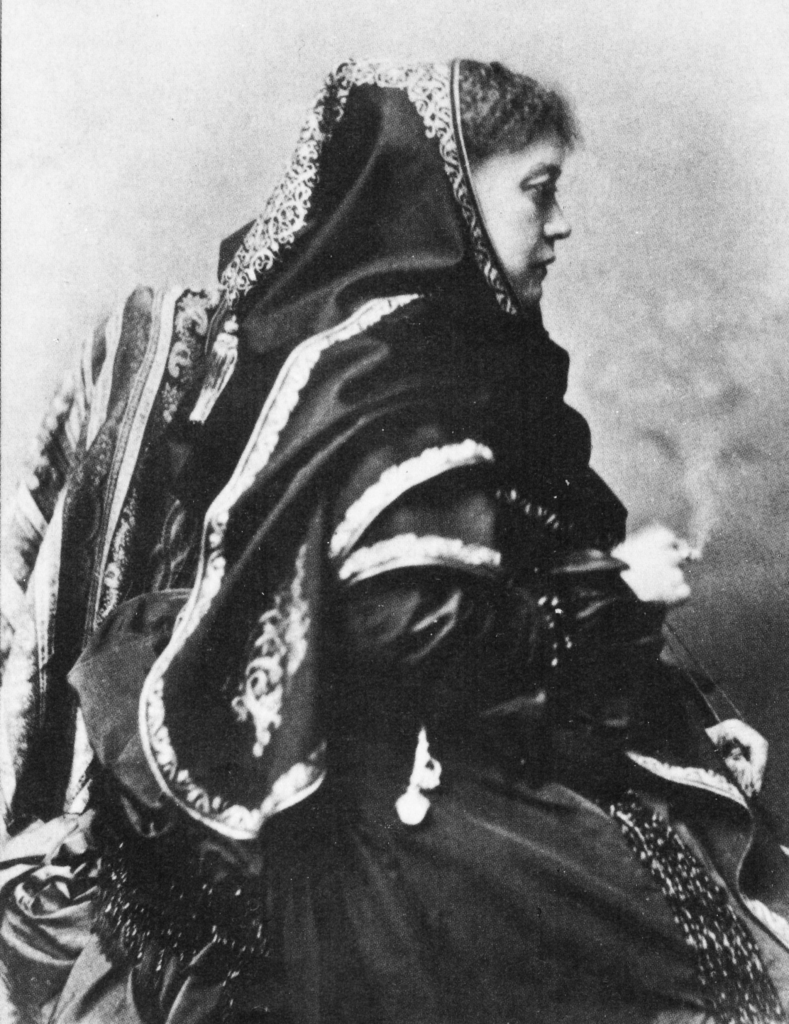
Helena Petrovna Blavatsky, the Russian occultist who founded the Theosophical Society in 1875 and whose esoteric writings formed the intellectual atmosphere of the same Masonic-republican milieu Bartholdi and Laboulaye inhabited, clarifies in The Secret Doctrine, Volume II, “Venus, or Lucifer (also Sukra and Usanas), the planet, is the light-bearer of our Earth, in both its physical and mystic sense.” Venus and Lucifer are the same in this tradition, the morning star, the light-bearer. When an apologist says “Pike only meant the planet,” he is confirming the argument, not defeating it.
The apologists also cite Pike’s statement that “the conviction of all men that God is good led to a belief in a Devil, the fallen Lucifer or Light-bearer, Shaitan the Adversary,” and a passage in which he calls the popular Lucifer figure “the false Lucifer of the legend.” Pike is just doing comparative religion, they say. Explaining the myth. Not endorsing it.
What apologists never want you to see is what Pike writes about the Blazing Star. In Morals and Dogma, he states plainly, “The Ancient Astronomers saw all the great Symbols of Masonry in the Stars. Sirius glitters in our lodges as the Blazing Star.” The Masonic Blazing Star, symbol of the Lodge’s central deity, is Sirius. Pike continues, “The sun and moon…represent the two grand principles…both shed their light upon their offspring, the blazing star, or Horus.” The Blazing Star is Horus, the child of Osiris and Isis, the perfected Masonic man representing the Lodge’s eschatological goal of human apotheosis. It is also Sirius, anchoring the Lodge’s astronomical theology to the Egyptian mystery tradition. And it is the same Lucifer who bears the light, because in the esoteric tradition all these figures point to the same source, the intelligence that offers humanity illumination in exchange for rebellion against the God of Revelation.
Now place Pike’s passages alongside the Grand Master’s cornerstone address. Pike affirms that Lucifer bears the light. The Grand Master, at the Statue of Liberty’s cornerstone, declares that Freemasonry frees men from “the trammels and chains of ignorance and tyranny.” In Pike’s theological framework, the tyranny from which Lucifer frees man is the mandates of Jehovah. Both men make the same declaration. The torch held by Liberty is the Luciferian light that both of them invoke.
The apologists cannot put these together without conceding the point, so they do not put them together.
Manly P. Hall received an honorary 33rd degree from the Scottish Rite in 1973. In 1929, he published Lectures on Ancient Philosophy, a companion to The Secret Teachings of All Ages. In the chapter “The Doctrine of Redemption Through Grace”:
“Man wandered hopelessly in the gloom of mortality, living and dying without light or understanding in his servitude to the Demiurgus and his host of spirits. At last the spirit of rebellion entered creation in the form of Lucifer, who in the guise of a serpent tempted man to revolt against the mandates of Jehovah (the Demiurgus). In Greece this character was known as Prometheus, who brought from the gods the impregnating flame that would release the life latent in this multitude of germlike potentialities.”
Hall explains what the Lodge’s inner tradition teaches. The God of Revelation, Jehovah, is the Demiurgus, a false craftsman-god who enslaves humanity. Lucifer is the liberator. The impregnating flame is the torch. Hall identifies Prometheus and Lucifer as the same figure and function, the spirit of rebellion that frees humanity from the God of Revelation. The man the Lodge later honored with its highest honorary degree wrote this in 1929, and it remains in print today.
Hall also states in the same work the Masonic self-understanding underlying the entire apparatus: “The Mysteries whose rituals Freemasonry perpetuates were the custodians of a secret philosophy of life of such transcendent nature that it can be entrusted to only an individual tested and proved beyond any possibility of human frailty.” Citing Pike directly, Hall adds, “Masonry has and always had a religious creed. It teaches what it deems to be the truth in respect to the nature and attributes of God.” Freemasonry is a religion with a god, as documented in its own canonical literature. The doctrine in the statue is the doctrine in that literature, and the literature names Lucifer as the light-bearer.
Blavatsky was not a Mason, but she shaped the intellectual atmosphere of the entire milieu. The Theosophical Society was the esoteric current flowing beneath the same liberal, republican world inhabited by Laboulaye, Bartholdi, and Lodge Alsace-Lorraine. In The Secret Doctrine (1888), Volume II:
“LUCIFER — the spirit of Intellectual Enlightenment and Freedom of Thought — is metaphorically the guiding beacon, which helps man to find his way through the rocks and sandbanks of Life, for Lucifer is the LOGOS in his highest, and the ‘Adversary’ in his lowest aspect — both of which are reflected in our Ego.”
The guiding beacon. The theology of the torch in its purest form. Note what Blavatsky does not suppress. Lucifer is also the Adversary in his lowest aspect. She is not pretending this is purely a benign astronomical metaphor. She acknowledges the dual nature and chooses the “highest aspect” as her teaching. The Lodge makes the same choice, invoking Lucifer as intellectual liberty, as liberation from revealed religion. Blavatsky has just described a being who is both the supreme light and the Adversary. The Orthodox tradition has a name for that being and has had one for two thousand years. The Lodge proceeds anyway.
In 1875, the year Bartholdi was initiated into Lodge Alsace-Lorraine, Blavatsky founded the Theosophical Society. The Luciferian-illuminist theological current and the Masonic-revolutionary institutional current operated simultaneously and intertwined, producing the Statue of Liberty as their joint monument.
Blavatsky named her foundational work Isis Unveiled. In 1923, her successor, Alice Bailey, and her Freemason husband, Foster Bailey, founded the Lucifer Publishing Company, which published the Theosophical periodical Lucifer. They later renamed it the Lucis Publishing Company when the name became a liability, a gesture similar to Bartholdi’s, who downplayed the Suez connection. Today, Lucis Trust holds consultative status at the United Nations, with a seat in weekly sessions and the operation of the only religious chapel at the UN building in New York. Bailey described Freemasonry as “the custodian of the law…the home of the Mysteries and the seat of initiation…a far more occult organisation than can be realised, and is intended to be the training school for the coming advanced occultists.” The organization that renamed itself to hide its Luciferian origins now runs the chapel of the institution built by the Masonic-revolutionary tradition to replace Christian civilization. The Lucifer Publishing Company manages the spiritual program of the new world order from a building in New York, a few miles from the statue in the harbor.
The tradition did not end with the 1886 dedication. Arturo Reghini, an Italian occultist immersed in alchemy, magic, and theurgy, was initiated into the Rite of Memphis in Palermo in 1902 and, in 1905, founded a lodge in Florence called the Lucifer Lodge, officially part of the Grand Orient of Italy, the same Grand Orient whose Grand Masters had been Garibaldi and Mazzini. David Livingstone documents this in Transhumanism: The History of a Dangerous Idea. Reghini rose to the Supreme Council of the 33rd Degree of the Ancient and Accepted Scottish Rite. A lodge named Lucifer, formally constituted within the Grand Orient of Italy, was led by a man who attained Freemasonry’s highest degree. The Lodge does not merely invoke Lucifer metaphorically but names its lodges after him.
The Lucifer Lodge in Florence, the Lucis Trust chapel at the United Nations, and the torch in the harbor. The same doctrine across a century and a half of institutional continuity.
IV. The Goddess Behind the Figure
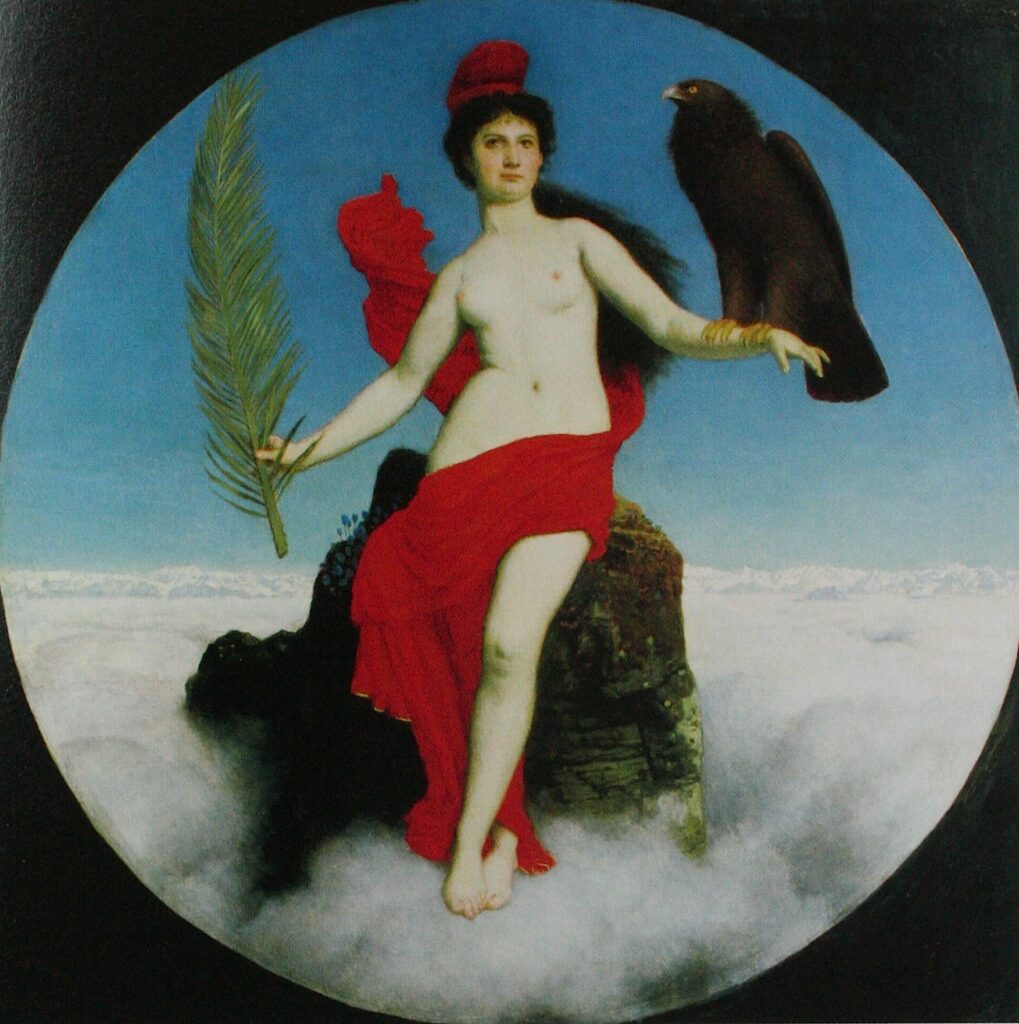
The Statue of Liberty is officially a figure of Libertas, the Roman goddess of freedom. That much is accurate. But Libertas is not a Roman invention. She is a Roman name for a much older goddess whose roots reach back to Babylon, and the theological lineage of that goddess connects the harbor figure to a tradition older than Rome and darker than the civic mythology allows.
The Roman Libertas was the patroness of freed slaves, symbolizing unrestrained personal freedom. Her festival, the Liberalia, was among Rome’s most uninhibited celebrations, directly linked to sexual liberty as an expression of freedom. She appeared on Roman coins wearing a pileus, the cap given to emancipated slaves. Bartholdi considered the pileus for his figure but rejected it, choosing instead the radiate solar crown. He replaced the freed slave’s cap with the sun god’s crown. The figure moved up the theological register.
Libertas embodies an older archetype. The ancient world did not neatly separate its deities. Her roots extend through Venus, Aphrodite, Astarte, Ishtar, and Inanna, the same divine feminine across cultures, always associated with the planet Venus and the morning star, which Blavatsky identifies as Lucifer. Venus traces a pentagram in the sky over an eight-year cycle. The Romans designated Venus’s morning aspect as Lucifer, “light-bringer.” The goddess Libertas and the planet Lucifer belong to the same tradition.
Isis was Egypt’s version of the great goddess. As her worship spread through the Greco-Roman Mediterranean during the Hellenistic period, she absorbed and was absorbed by the traditions of the Greek and Roman goddesses, including Demeter, Aphrodite, Venus, and Libertas. Some of her devotees held that she encompassed all feminine divine powers in the world. In her iconography, she carries a torch. She stands at harbor entrances during her festivals. She guides ships. The Navigium Isidis, the Festival of Isis, was a maritime celebration in which a sacred ship was launched, an annual rite of harbor and navigation, with the goddess opening the seas for safe passage. The Statue of Liberty stands at a harbor entrance with a torch to guide ships. It is the Navigium Isidis frozen in copper.
Blavatsky named her foundational work Isis Unveiled. The Theosophical tradition explicitly identified Isis as the great mother goddess whose mysteries it sought to revive. The context in which Bartholdi and Laboulaye worked was saturated with this identification. The figure in the harbor is not merely the Roman Libertas. She is the Roman mask of a tradition that runs back through Isis, Ishtar, and Inanna to the great goddess of Babylon, the Queen of Heaven, whom the prophets of Israel named and warned against.
An essay by Sophia Dharma entitled “The Mystery of the American Statue of Liberty”, available on Academia.edu, traces this lineage in detail, linking Libertas to Ishtar through shared symbols and roles: goddess of freedom, harbor, morning star, and Mother of Exiles. Some specific claims go beyond what the documentary record fully supports. The core theological lineage aligns with what the esoteric sources confirm. The great goddess of Babylon, Venus, Lucifer, the morning star, the light-bearer, and the torch-holder in New York Harbor all belong to the same tradition.
In The Secret Teachings of All Ages, Hall describes the Colossus of Rhodes tradition that Bartholdi consciously referenced: “This gigantic gilded figure, with its crown of solar rays and its upraised torch, signified occultly the glorious Sun Man of the Mysteries, the Universal Savior.” He was writing about the Colossus of Rhodes, not the Statue of Liberty. Bartholdi built the Colossus’s successor, with the same crown and the same torch. Hall’s description of the ancient figure also applies to the modern one.
Hall also links Lucifer to the Isis tradition through the Venus identification: “it was called the false light, the star of the morning, or Lucifer, which means the light-bearer. Because of this relation to the sun, the planet was also called Venus, Astarte, Aphrodite, Isis, and the Mother of the Gods.” Lucifer, Isis, Venus, and the Mother of the Gods share the same tradition, the same figure, and the same theological current in the harbor statue’s iconography. Hall documented this, and the Lodge honored him. The Lodge also built the statue, which serves as the symbol of the tradition.
V. The Revolutionary Lineage: From Weishaupt to Bedloe’s Island
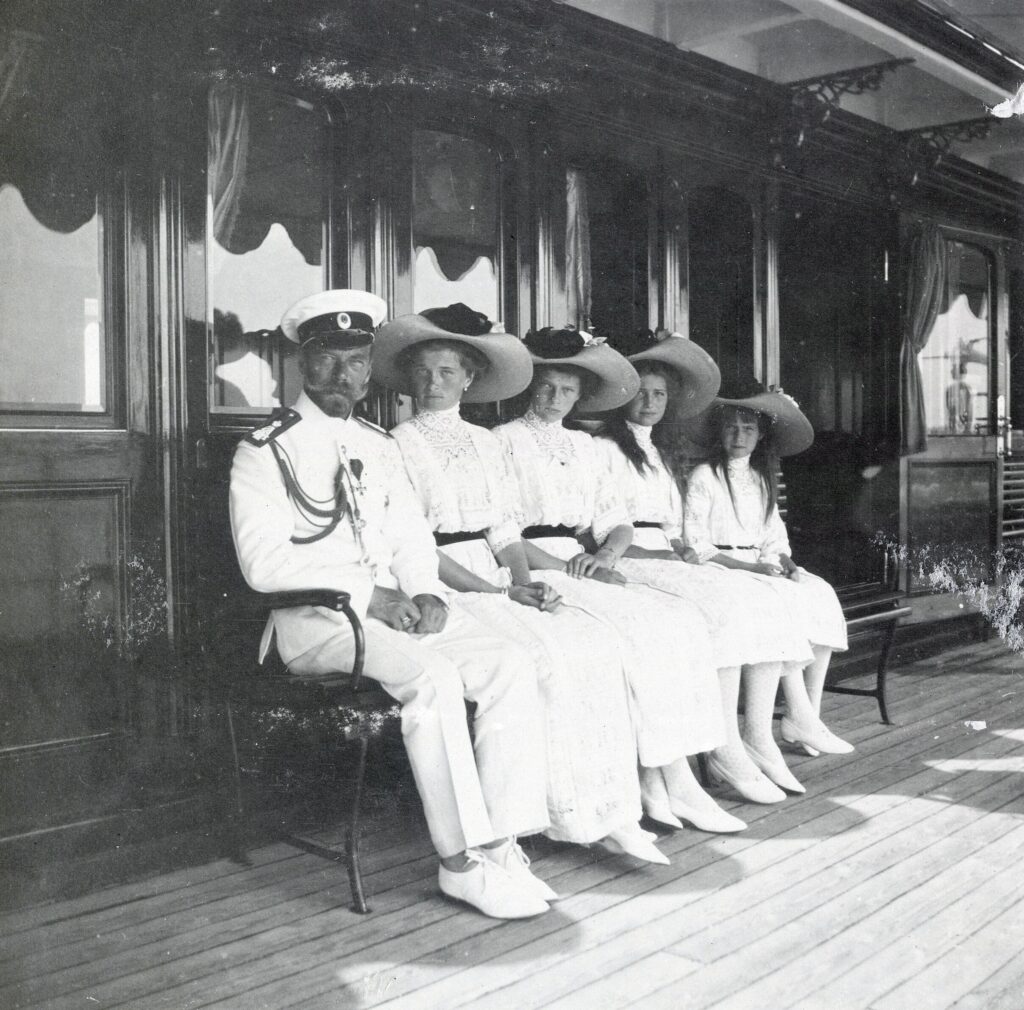
The Statue of Liberty is both a religious and a revolutionary symbol. In the Masonic-revolutionary tradition, these roles are inseparable because the revolution the Lodge has pursued since the eighteenth century is a religious revolution. Its target is not merely a king. Its target is the God of Revelation and every institution built in His name, including the Church, the Orthodox monarchy, and the family ordered by divine law.
I understand this now from the inside. The libertarian tradition I inhabited was not a neutral philosophy of individual rights. It was downstream from the same theological project documented in this article, the same rejection of divine authority dressed in economic language. Rothbard and Hayek did not build their frameworks from nothing. They built them within a civilization whose intellectual foundations the Masonic-revolutionary tradition had systematically dismantled for two centuries. I was professing a doctrine without knowing whose it was or what it had already destroyed. Tsar Nicholas II, the last Orthodox emperor, was murdered in a Yekaterinburg basement in 1918 by the revolutionary heirs of the same Lodge network that built the statue in the harbor. His canonization by the Russian Orthodox Church is the tradition’s answer to what they did to him. He is a saint. They are not.
This is the lineage of the word “liberty” as it actually evolved through history.
Adam Weishaupt founded the Illuminati on May 1, 1776, using the Bavarian Masonic lodge structure as its vehicle. His explicit goal, documented in writings seized during the Bavarian government’s 1785 raid, was the overthrow of Christianity, monarchy, and the family, to be replaced by a world government led by Illuminati-trained initiates. He told his followers, as primary sources cited by Livingstone record, “Oh! Men, of what cannot you be persuaded?” Liberty and freedom were the public face. The destruction of Christian civilization was the substance. At the 1782 Congress of Wilhelmsbad, as Livingstone documents, “all the various bodies of Freemasonry came under the influence of the Illuminati.” From that point, the Masonic-revolutionary and Illuminati currents merged and ran as one.
Weishaupt’s heirs shaped the modern world in the Lodge’s image. Filippo Buonarroti organized the Carbonari, whose networks produced the Risorgimento. He explained why Freemasonry served his purposes, as preserved in Livingstone’s account: “The public character of its meetings, the almost infinite number of its initiates, and the ease with which they are admitted have removed from Masonry every trace of political inclination… all the others are nothing more than entertainment centers or schools of superstition and slavery.” The Lodge’s public face was a cover. The inner current was the revolution against revealed religion. The same structure the Grand Master invoked on Bedloe’s Island in 1884.
Giuseppe Mazzini and Giuseppe Garibaldi, both Grand Masters of the Grand Orient of Italy, led the unification that stripped the Church of its temporal power and established the secular Italian state. Mikhail Bakunin, a Grand Orient Freemason and, according to Livingstone, a disciple of Weishaupt’s tradition, stated the revolutionary tradition’s theological content with the bluntness his more careful predecessors had avoided. His God and the State, available from Dover Publications with an introduction by historian Paul Avrich, contains the plainest statement of the Luciferian-liberty thesis in any published text.
Here is Bakunin, the revolutionary tradition speaking plainly, not in metaphor.
“Jehovah, who of all the good gods adored by men was certainly the most jealous, the most vain, the most ferocious, the most unjust, the most bloodthirsty, the most despotic, and the most hostile to human dignity and liberty — Jehovah had just created Adam and Eve… He wished, therefore, that man, destitute of all understanding of himself, should remain an eternal beast, ever on all-fours before the eternal God, his creator and his master. But here steps in Satan, the eternal rebel, the first freethinker and the emancipator of worlds. He makes man ashamed of his bestial ignorance and obedience; he emancipates him, stamps upon his brow the seal of liberty and humanity, in urging him to disobey and eat of the fruit of knowledge.”
The seal of liberty, stamped on humanity’s forehead by Satan, the eternal rebel, the first freethinker, and the emancipator of worlds.
Bakunin continues with the full theological implications:
“The idea of God implies the abdication of human reason and justice; it is the most decisive negation of human liberty, and necessarily ends in the enslavement of mankind, both in theory and practice.”
And: “If God is, man is a slave; now, man can and must be free; then, God does not exist.”
God’s existence and human liberty are mutually exclusive. That is the operating doctrine of the revolutionary-Masonic tradition, from Weishaupt through the Grand Orient, through Lodge Alsace-Lorraine, through the Franco-American Union and its statue. The Grand Master expressed it in different words on Bedloe’s Island. Freemasonry frees men from “the trammels and chains of ignorance and tyranny.” In the tradition’s own theological language, the tyranny is God. The liberation is Bakunin’s Satan, Blavatsky’s Lucifer, Hall’s Prometheus, Pike’s Light-bearer. The statue holds the torch of that liberation in New York Harbor.
Avrich’s scholarly introduction precisely summarizes Bakunin’s theology. Satan is “the eternal rebel, the first freethinker and the emancipator of worlds,” who “persuaded them to taste the fruit of knowledge and liberty.” These same weapons, reason and rebellion, must now be turned against the church and the state. Avrich presents this as the center of Bakunin’s thought, not a peripheral metaphor. He was a history professor at Queens College. This is the mainstream academic summary of what the revolutionary tradition believed. Avrich confirms it from the outside. Bakunin stated it from the inside. The Lodge enacted it in copper and iron and raised it in the harbor.
The ideology that Bartholdi’s Lodge Alsace-Lorraine described as “ardent patriotism” was the same tradition that produced the French Revolution, the executions of Louis XVI and Marie Antoinette, the systematic destruction of the Church’s institutional presence in France, and the anticlerical legislation of Jules Ferry, who sat in Bartholdi’s Lodge. In Lodge Alsace-Lorraine, liberty meant what it meant in Bakunin, namely liberation from Jehovah, the Church, and the Christian monarchy.
The Masonic-revolutionary program was offensive, not defensive. The Lodge’s own Bulletin declared the choice between the old order based on Revelation and the new order. The Statue of Liberty was dedicated in 1886. The old order it was built to replace had thirty-two years left. Between 1917 and 1918, the Orthodox monarchies of Russia, Austria-Hungary, and the German Reich fell. The revolutionary currents that Lodge Alsace-Lorraine’s membership had spent their careers building achieved their objective. Christian monarchies were gone. The statues of Mazzini, Gambetta, and Garibaldi now stand in the public squares of the secular states they built on the ruins.
The Statue of Liberty faces east toward those ruins, toward Russia, and toward Jerusalem.
VI. What the Tradition Names and the Orthodox Church Confirms
Every tradition names what it encounters. The Lodge calls it Liberty. The revolutionary tradition calls it the emancipator. The Theosophical tradition calls it the Logos in his highest, the guiding beacon, the spirit of Intellectual Enlightenment. The esoteric tradition calls it Lucifer.
The Orthodox Christian tradition has a different name for it.
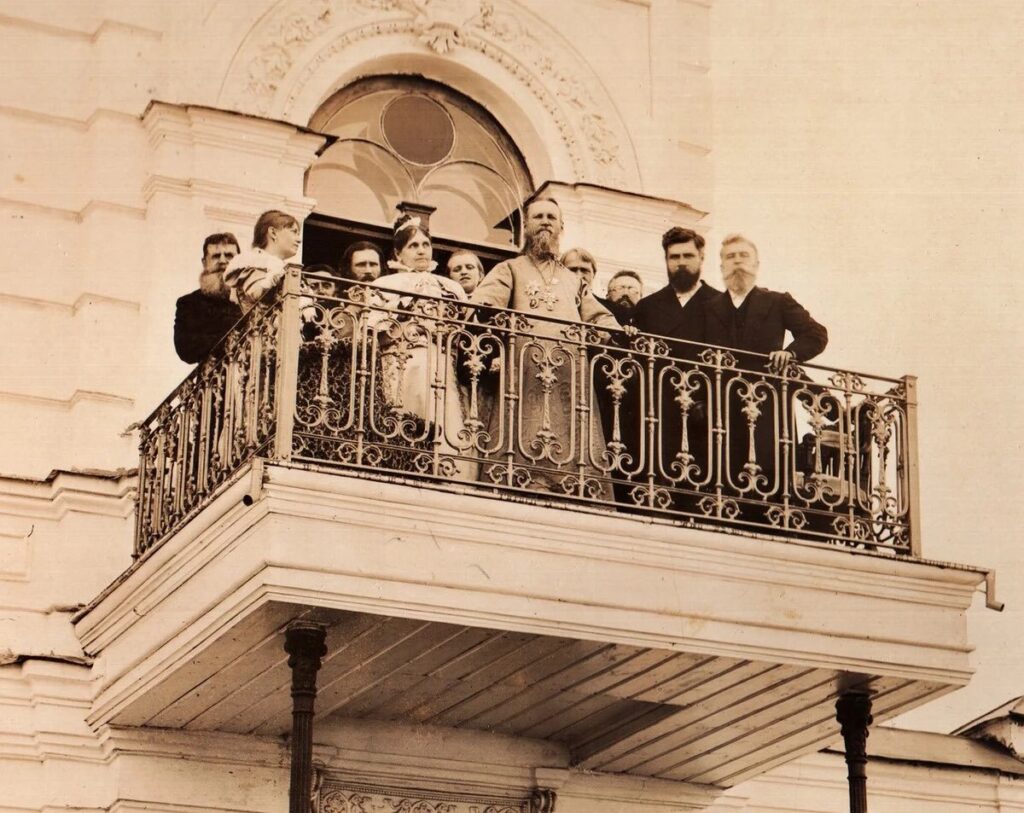
St. John of Kronstadt, writing in the late nineteenth century as Masonic-revolutionary forces dismantled Christian civilization around him, identified the spirit of the revolutionary age precisely. He named the denial of Christ’s kingship, the elevation of human reason over divine revelation, and the liberation of man from God’s law as the defining features of that age. He called this the activity of the enemy of God, working through the institutional networks of liberalism and Masonry that were destroying Christian civilization before his eyes. He was right, and he watched it happen.
The Orthodox understanding of freedom is not the Lodge’s theology of liberty. In Orthodoxy, freedom is not liberation from divine law but participation in divine life. The Theotokos is the icon of true freedom, a human being whose will is perfectly aligned with the divine will, making her the vessel of the Incarnation. This is freedom, the capacity to become what we were created to be, as bearers of the divine image. The Lodge’s liberty is the inversion, a liberation from the Author of that image, from the law that enables us to become what we were created to be, and into the autonomy of the creature who has rejected his Creator.
Bakunin’s Satan stamps his seal on the brow of the liberated man. The Orthodox Christian bears the sign of the Cross on his forehead. The contrast is absolute.
The Lodge financed the French side of the statue through the Franco-American Union, led by Masonic Grand Masters of the Grand Orient. The American pedestal was funded in part by Joseph Pulitzer’s newspaper empire, and the Robert Burns Lodge account identified Pulitzer as a Freemason. The dedication ceremony was led by President Grover Cleveland and addressed by Chauncey M. Depew of Kane Lodge 454. The Lodge built, funded, and dedicated it, and spoke at its unveiling. The Grand Master declared its meaning from the cornerstone podium.
The statue has stood for a century and a half, during which the civilization it was built to replace has been systematically dismantled on every front the Lodge identified as a target. The Church’s institutional authority, the Christian monarchy, the family under divine law, and the education system formed by Christian tradition. The torch burns. The seven rays crown the harbor goddess. The Masonic cornerstone plaque bearing the square and compass remains affixed to the pedestal where the Grand Master struck the stone three times and proclaimed the Lodge’s doctrine to the rain and to history.
In New York, the Lucis Trust, formerly the Lucifer Publishing Company, operates from United Nations Plaza. The tradition that built the statue, named the publishing house after Lucifer, and renamed it when the name became inconvenient now runs the chapel of the institution that governs the world the Lodge built.
VII. The New Colossus and the Old Lie
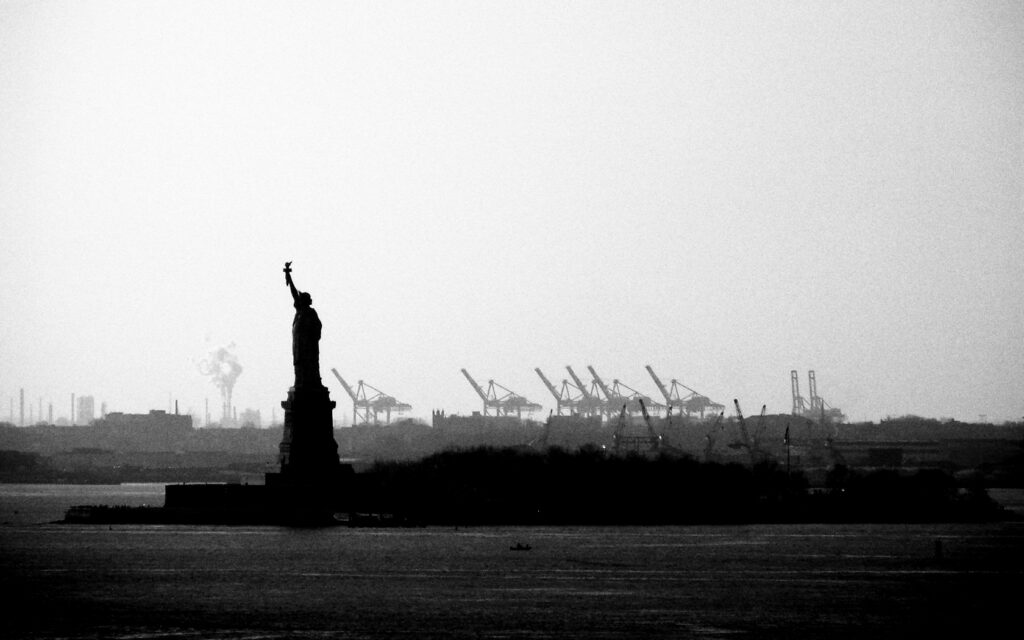
Emma Lazarus wrote the poem on the plaque, titled it “The New Colossus,” and, in 1883, acknowledged that the statue inherits the ancient colossal tradition. She invoked the Colossus of Rhodes in her opening lines: “Not like the brazen giant of Greek fame, with conquering limbs astride from land to land.” The Colossus of Rhodes straddled the harbor. The New Colossus stands at the entrance with a torch. Lazarus knew the iconographic lineage. She named it in the title and displaced it in the poem, transforming the solar-deity harbor colossus into the “Mother of Exiles” welcoming the oppressed masses. The exoteric reading of the statue as an immigration monument was layered over the esoteric reading as a Luciferian solar deity, with Lazarus’s poem as the mortar.
The line every American knows. “Give me your tired, your poor, your huddled masses yearning to breathe free.” The Lodge’s word. The huddled masses yearn for the liberty the Lodge promises, liberation from the old authority, the old order, the old God. They arrive at the harbor where the goddess stands, the New Colossus, the modern Helios, the torch-bearer of the new order. They come to Lucifer’s harbor, where the Grand Master declared that Freemasonry has done more for their freedom than any institution on earth.
The poem was added to the base in 1903, seventeen years after the dedication. The original ceremony had no Lazarus poem. It featured the Grand Master of New York declaring that Freemasonry liberates men from “the trammels and chains of ignorance and tyranny,” including the tyranny of the God of Revelation, the Church, the Orthodox Christian monarchy, and the Lodge and its revolutionary heirs, all of which were in the process of being destroyed. The Lazarus poem arrived as the cover story. The “Mother of Exiles” replaced the Masonic doctrine on the monument’s public face, performing the same function the Franco-American Union had during construction, a presentable public surface over the operational reality.
The Lodge has been extraordinarily patient. It embedded the doctrine in iconography, legible only to those who know what to look for. It embedded the exoteric reading in ceremony and poetry for everyone else. The Grand Master’s address has been on the record for 140 years. The Lodge’s own Bulletin, Pike’s Morals and Dogma, Blavatsky’s Secret Doctrine, Hall’s Lectures on Ancient Philosophy, Bakunin’s God and the State, the Lucifer Lodge in Florence, and the Lucifer Publishing Company operating under its current name are all on the record. All of it is legible to anyone who looks.
The seven rays are those of the solar deity tradition, running from Helios of Rhodes through Sol Invictus to the radiate crown Vespasian placed on Nero’s statue. The torch is Prometheus’s fire, the impregnating flame Hall identified, the Luciferian illumination Blavatsky named, and the beacon of liberation from Jehovah’s mandates that Bakunin declared. The cornerstone beneath her feet was laid with Masonic rites by a Grand Master who told the Lodge, in the rain, that Freemasonry is the supreme institution of liberty. The Franco-American Union that publicly built her was formed at a lodge meeting because the Lodge could not publicly claim the project without breaking the mystification.
The statue is a Masonic icon built to crown the harbor of the nation, the Lodge constructed on the same principles, the nation where the Constitution replaced the Church as the supreme law, where the God of Revelation was excluded from the founding documents by the Masonic Deist current that composed them, and where the dollar bill carries the Masonic eye above the Masonic pyramid and the Latin phrase that has always meant exactly what it says. Novus Ordo Seclorum. A New Order of the Ages.
The New Colossus stands in the harbor of the New Order. She was built by the Lodge, designed by a Mason in the Lodge’s tradition, and her cornerstone was laid by the Grand Master of New York, who explained her meaning from the podium. She bears the torch of the Luciferian illumination tradition. She wears the crown of the solar deity. She faces east, toward the civilization the Lodge destroyed. Toward Russia. Toward Jerusalem.
An Orthodox Christian who has been paying attention knows the face behind the mask. It is the face Hall named, the “spirit of rebellion” that “in the guise of a serpent tempted man to revolt against the mandates of Jehovah.” It is the face Bakunin named, the eternal rebel, the first freethinker, the emancipator of worlds, who stamps upon humanity’s brow “the seal of liberty.” It is the face Blavatsky named the LOGOS in his highest and the Adversary in his lowest, confirming that both aspects belong to the same being. It is the face Pike invoked and told his initiates not to doubt.
The seal is on the harbor. The torch is lit. The Grand Master struck the stone three times.